Main Content
Extended Reality (XR) is transforming multiplayer applications by combining Virtual Reality (VR), Augmented Reality (AR), and Mixed Reality (MR) with immersive real-time interaction. Unlike traditional multiplayer games, XR applications must synchronize not only player positions but also headsets, controllers, hands, interactive objects, spatial environments, physics, voice, and user actions.
Building this type of experience requires a carefully designed networking architecture. Photon Fusion, Unity Netcode, and dedicated servers provide different approaches for creating scalable and responsive XR multiplayer applications.
Understanding XR Multiplayer Architecture
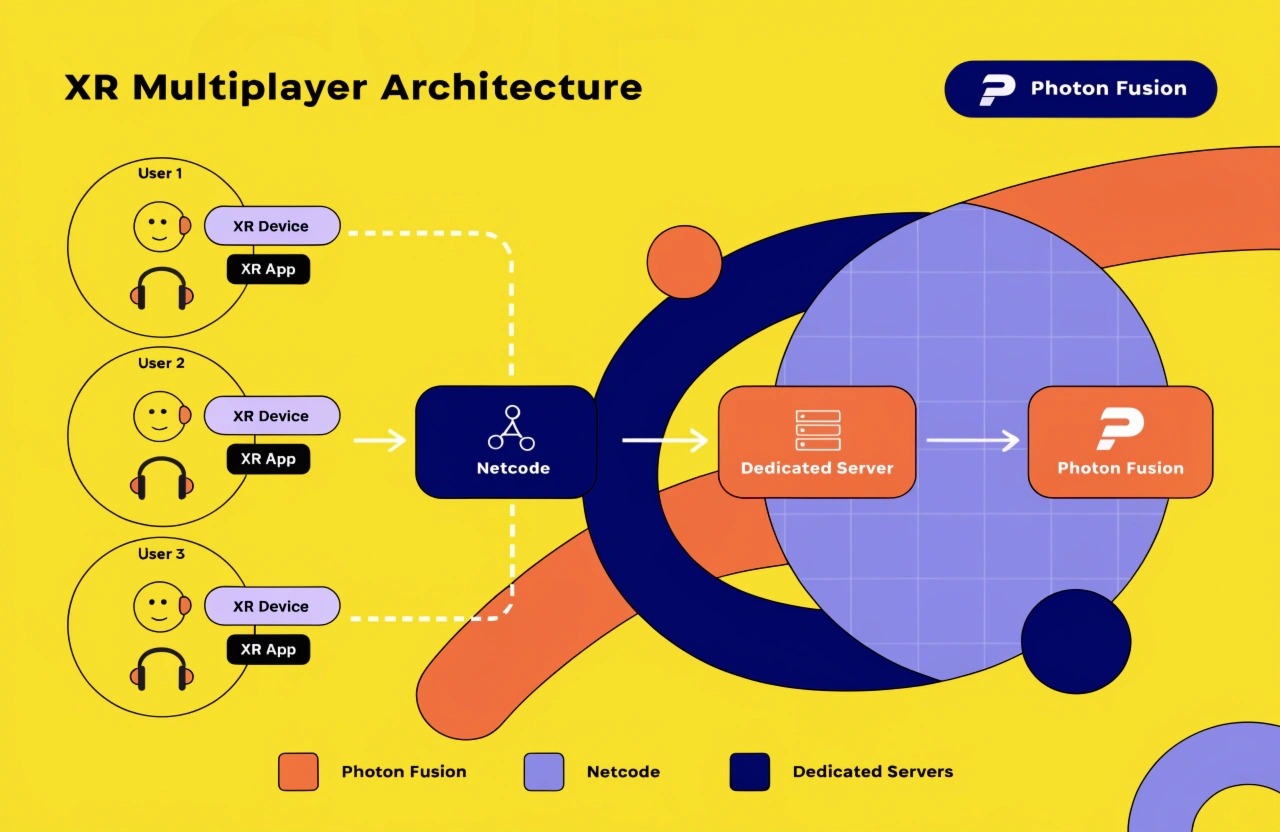
A typical XR multiplayer architecture consists of XR clients, a networking layer, game-server infrastructure, authentication services, matchmaking, and persistent backend systems.
Each XR client represents a player using a VR headset, AR device, or compatible XR hardware. The client collects input such as head movement, controller positions, hand gestures, and interaction events. Networking technology then synchronizes the required information with other connected players.
The architecture should avoid sending every piece of XR data continuously. Instead, developers should identify important networked states and synchronize them efficiently.
For example, headset position, controller orientation, player actions, and important interactive objects may require frequent synchronization, while cosmetic information can be updated less frequently.
Photon Fusion for Real-Time XR Multiplayer
Photon Fusion is designed for real-time multiplayer experiences and supports different networking models, including server-authoritative approaches.
For XR applications, Fusion can synchronize player avatars, transforms, networked objects, gameplay states, and interactions. Its networking architecture can be useful when developers need responsive multiplayer gameplay with prediction and state synchronization.
An XR player can be represented through a networked avatar containing:
- Head or headset transform
- Left-hand controller
- Right-hand controller
- Hand-tracking information
- Avatar animation state
- Interaction state
- Voice or communication state
However, sending raw tracking information at extremely high frequency can consume significant bandwidth. Developers should use interpolation, compression, interest management, and appropriate update rates to reduce unnecessary traffic.
Unity Netcode for GameObjects
Unity Netcode for GameObjects (NGO) is another option for multiplayer applications built with Unity. It integrates closely with Unity's development ecosystem and can be suitable for projects that require a Unity-centric networking solution.
NGO provides networking concepts such as NetworkObjects, RPCs, network variables, ownership, and connection management.
For an XR application, developers can create networked objects for players, interactable objects, weapons, tools, doors, vehicles, and other gameplay elements.
A key architectural decision is determining which information should be authoritative. For example, an object such as a virtual ball should generally have a clearly defined authority model rather than allowing every client to independently modify its position.
Dedicated Servers and Server Authority
Dedicated servers are especially important when security, scalability, and competitive multiplayer are major requirements.
Instead of one player's device acting as the host, a dedicated server runs the authoritative game state. Clients send input or requests to the server, and the server validates and distributes the resulting state.
A simplified architecture can look like this:
XR Client → Authentication → Matchmaking → Dedicated Server → Other XR Clients
This model reduces dependence on individual players and makes it easier to control cheating, synchronization conflicts, and host migration problems.
Dedicated servers are particularly valuable for large-scale VR games, multiplayer simulations, enterprise training platforms, and persistent virtual environments.
Synchronizing XR Interactions
XR networking introduces unique synchronization challenges. Consider two players grabbing the same virtual object.
The system needs to determine:
- Who has authority over the object?
- When does ownership change?
- How is the object's position synchronized?
- What happens if network latency occurs?
- What happens if two users attempt interaction simultaneously?
A robust architecture should define interaction ownership and conflict resolution before implementation.
Instead of continuously synchronizing every transform, developers can synchronize important state transitions such as GrabStarted, GrabReleased, ObjectActivated, or InteractionCompleted.
This event-driven approach can significantly reduce unnecessary network traffic.
Latency, Prediction, and Interpolation
Low latency is critical in XR because users directly experience motion and interaction. Even small synchronization delays can make multiplayer interactions feel unnatural.
Interpolation can smooth remote player movement by displaying a predicted position between received network states. Client-side prediction can also make local interactions feel more responsive.
However, prediction must be carefully implemented for XR because incorrect prediction of hand movements or physics objects can produce visible inconsistencies.
Developers should separate local responsiveness from authoritative game state wherever possible.
Interest Management and Scalability
Large XR environments can contain hundreds or thousands of networked objects. Sending every object's state to every player is inefficient.
Interest management allows the server to determine which objects each player actually needs to receive.
For example, a player inside one virtual room does not necessarily need high-frequency updates for objects located several rooms away.
Combining spatial interest management, network culling, lower update frequencies, and state compression can dramatically improve scalability.
Security Considerations
XR multiplayer systems should never completely trust client-side information.
Clients can request actions, but important game-state decisions should be validated by the server. This is especially important for competitive games, virtual economies, multiplayer training systems, and applications involving persistent user data.
Authentication, authorization, rate limiting, server validation, encrypted communication, and anti-cheat mechanisms should be incorporated into the architecture.
Choosing the Right Architecture
Photon Fusion can be attractive when developers need a specialized real-time networking solution with features designed around multiplayer game development.
Unity Netcode can be appropriate for teams looking for a Unity-integrated networking framework and greater control over their infrastructure.
Dedicated servers become increasingly important when applications require authoritative simulation, reliability, scalability, security, or large concurrent player populations.
For advanced XR projects, the best architecture may combine networking technology with dedicated server infrastructure, matchmaking services, authentication, monitoring, analytics, and cloud deployment.
Conclusion
Building a scalable XR multiplayer application requires more than synchronizing player positions. Developers must consider headset and controller tracking, interaction ownership, networked physics, latency, prediction, interest management, security, matchmaking, and server scalability.
Photon Fusion and Unity Netcode provide powerful foundations for real-time multiplayer development, while dedicated servers can provide authoritative control and scalable infrastructure.
By designing the networking architecture around efficient synchronization, server authority, spatial relevance, and optimized data transmission, development teams can create immersive multiplayer XR experiences that remain responsive and reliable as the number of users and interactive objects increases.
As XR continues to evolve, robust multiplayer architecture will become increasingly important for VR games, AR applications, enterprise simulations, collaborative virtual environments, education, training, and next-generation digital experiences.