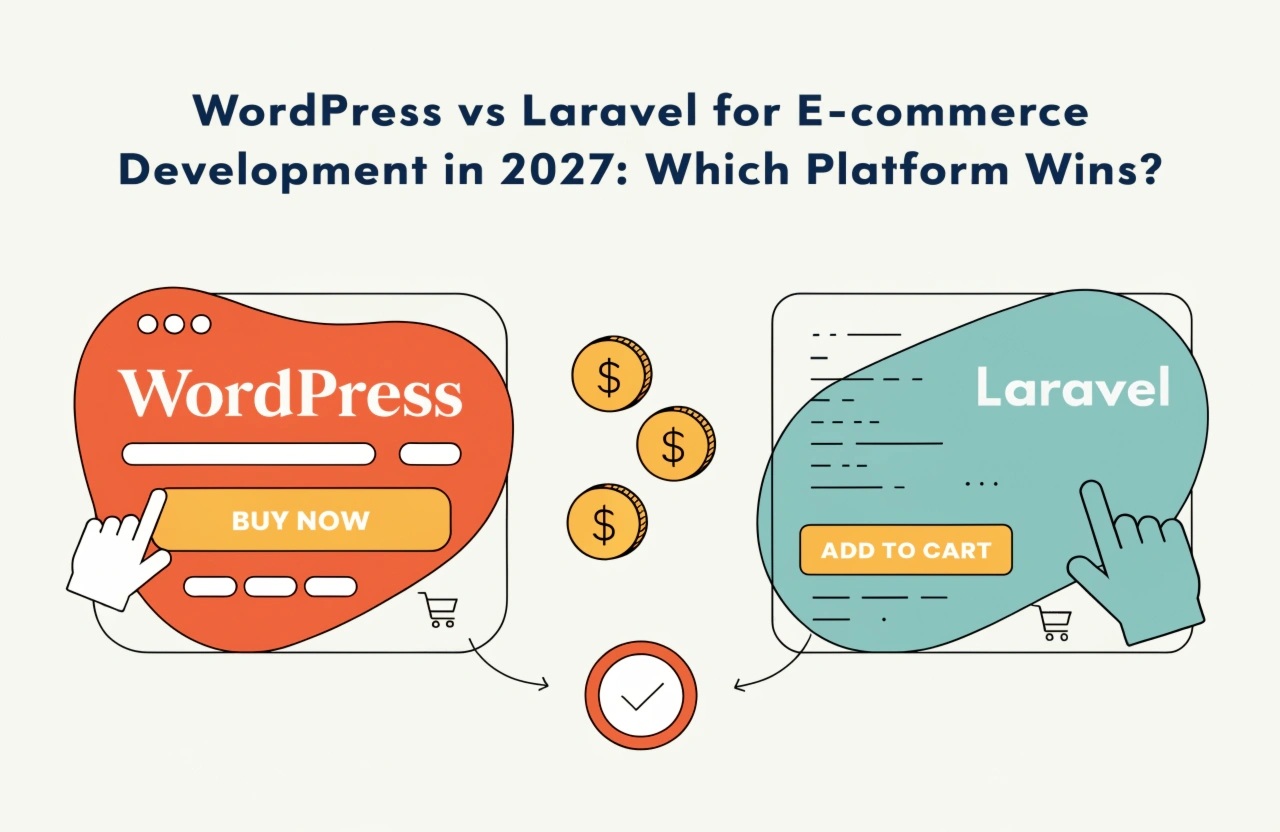
Choosing the right technology for your e-commerce website is one of the most important business decisions in 2027. While WordPress with WooCommerce offers affordability and speed, Laravel provides unmatched flexibility, security, and scalability. This guide compares both platforms across performance, customization, AI capabilities, SEO, maintenance, and business suitability to help you select the ideal solution for your online business.
WordPress vs Laravel for E-commerce Development in 2027: Which Platform Wins?
The e-commerce industry continues to evolve rapidly in 2027. Customers now expect lightning-fast websites, AI-powered product recommendations, seamless mobile experiences, personalized shopping journeys, and secure payment systems. As a result, choosing the right technology stack has become more important than ever.
Among PHP-based technologies, WordPress and Laravel remain two of the most popular choices for developing e-commerce websites. Although both are built on PHP, they serve very different purposes. WordPress is a Content Management System (CMS) designed for quick website creation, while Laravel is a powerful PHP framework built for custom web application development.
So, which one is better for your business in 2027? Let's compare them across the most important factors.
1. Ease of Development
WordPress is well known for its simplicity. By installing WooCommerce and a few plugins, businesses can launch an online store within days. It is ideal for companies that need a fast market launch without extensive custom development.
Laravel, however, requires experienced developers. Every feature is built specifically for your business, resulting in a completely customized solution. Although development takes longer, the final product perfectly matches business requirements.
Winner:
- WordPress for quick deployment
- Laravel for custom business applications
2. Performance
Website speed directly impacts customer experience and search engine rankings.
WordPress websites often depend on multiple plugins. As the number of plugins increases, loading times may decrease if optimization is ignored.
Laravel applications are built with optimized code and only include the features required by the business. This results in faster page loading, better server performance, and improved handling of high traffic.
Winner: Laravel
3. Customization
Modern online businesses require unique features such as AI recommendations, subscription models, advanced inventory systems, ERP integration, and custom checkout flows.
WordPress customization is limited by available plugins. Complex modifications often become difficult.
Laravel allows developers to build every feature from scratch without platform limitations.
Winner: Laravel
4. Security
Cybersecurity remains one of the biggest concerns in e-commerce.
WordPress websites can become vulnerable if outdated plugins or themes are used. Regular updates and proper maintenance are essential.
Laravel includes advanced security features such as CSRF protection, authentication, authorization, encrypted passwords, secure routing, and robust validation, making it highly suitable for enterprise applications.
Winner: Laravel
5. Scalability
As businesses grow, their websites must handle increasing users, products, and transactions.
WordPress works well for small and medium-sized businesses but may require additional optimization for very large stores.
Laravel is designed for scalable architecture and can efficiently support enterprise-level applications with thousands of products and high traffic volumes.
Winner: Laravel
6. SEO Capabilities
SEO remains essential for online success.
WordPress has a significant advantage because of plugins like Yoast SEO and Rank Math, allowing users to optimize content without technical knowledge.
Laravel offers complete SEO flexibility, but implementation depends on developers rather than ready-made plugins.
Winner: WordPress
7. AI Integration in 2027
Artificial Intelligence is transforming online shopping through personalized recommendations, intelligent search, predictive analytics, and automated customer support.
Laravel makes AI integration easier because developers have complete control over APIs and business logic.
WordPress supports AI plugins, but advanced AI implementations may face plugin compatibility and customization limitations.
Winner: Laravel
8. Maintenance
WordPress maintenance involves regular updates for themes, plugins, and the core CMS. Ignoring updates can create compatibility or security issues.
Laravel requires professional maintenance but generally experiences fewer conflicts because every feature is custom-built.
9. Development Cost
WordPress offers a lower initial investment due to pre-built themes and plugins. It is a budget-friendly option for startups and small businesses.
Laravel development typically costs more upfront because of custom coding. However, it can reduce long-term expenses by minimizing plugin dependencies and offering better scalability.
Winner:
- WordPress for lower initial cost
- Laravel for long-term business value
Which Businesses Should Choose WordPress?
WordPress is ideal for:
- Small businesses
- Local retailers
- Startup online stores
- Bloggers selling products
- Businesses with limited budgets
- Stores requiring quick deployment
Which Businesses Should Choose Laravel?
Laravel is best for:
- Enterprise businesses
- Multi-vendor marketplaces
- Subscription-based platforms
- International e-commerce brands
- Businesses with complex workflows
- Companies requiring custom integrations with ERP, CRM, or AI systems
Final Verdict
There is no single winner because the best choice depends on your business goals.
If you need an affordable online store with fast deployment and standard e-commerce functionality, WordPress with WooCommerce is an excellent solution.
However, if your business demands high performance, enterprise-grade security, unlimited customization, AI-powered features, and future scalability, Laravel is the stronger choice for 2027.
As digital commerce becomes increasingly competitive, investing in the right technology today will help your business deliver better customer experiences and stay ahead of the competition tomorrow.
We build scalable web, mobile, and game products for clients worldwide — combining modern frameworks, cloud infrastructure, and best engineering practices.