Introduction
Modern digital products are no longer judged only by their technical capabilities. Users expect websites and applications to be visually appealing, easy to navigate, fast, responsive, and simple to use. Businesses therefore need more than just skilled developers to create successful digital products.
Two important professionals play a critical role in this process: UI/UX designers and React.js developers.
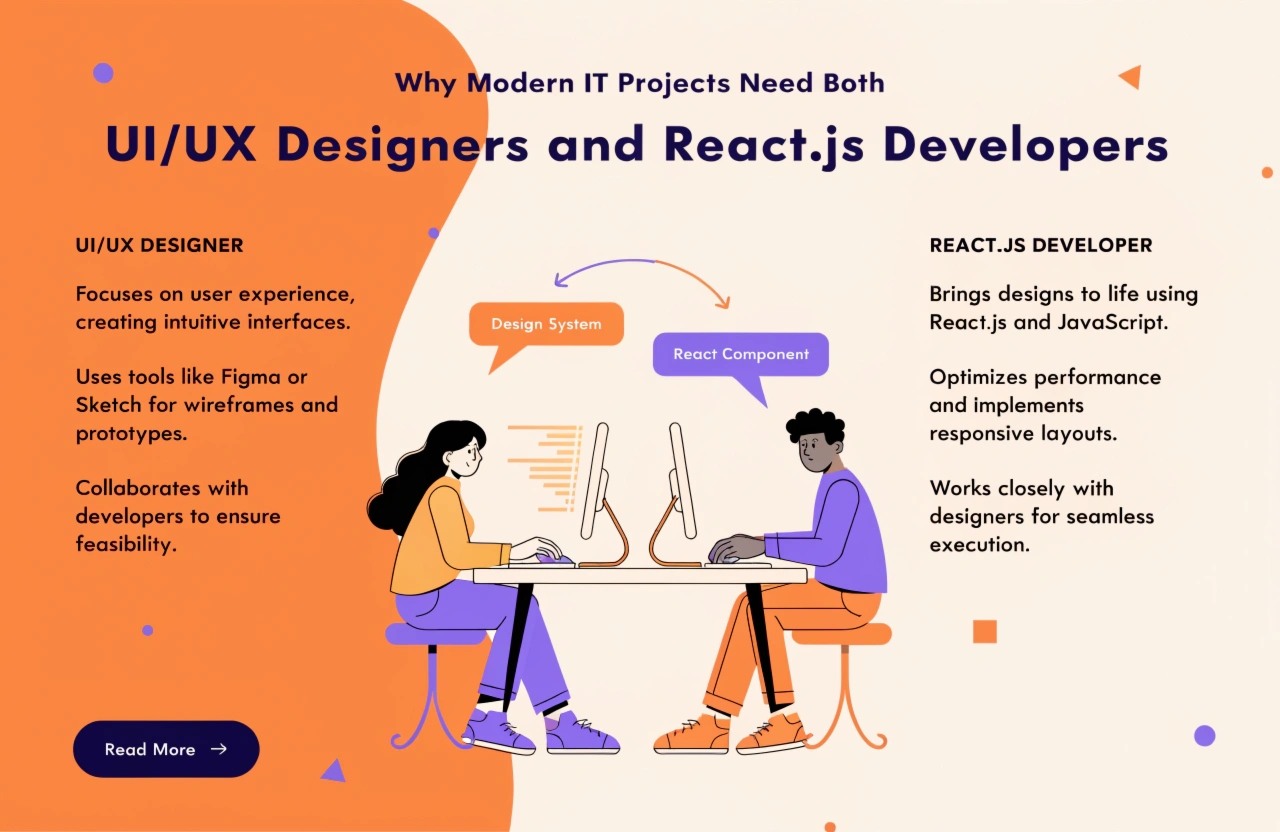
UI/UX designers focus on understanding users and creating intuitive interfaces, while React.js developers transform those designs into functional, interactive, and scalable applications. When these two roles work together, businesses can create digital products that are both attractive and technically powerful.
What Does a UI/UX Designer Do?
A UI/UX designer focuses primarily on the user's experience with a digital product.
UX, or User Experience, involves understanding how users interact with a website or application. Designers research user requirements, identify usability problems, create user journeys, develop wireframes, and organize information in a logical way.
UI, or User Interface, focuses on the visual presentation of the product. This includes colors, typography, buttons, layouts, icons, spacing, animations, and other visual elements.
A good UI/UX designer ensures that users can quickly understand how a product works without unnecessary confusion.
What Does a React.js Developer Do?
A React.js developer specializes in building modern and interactive user interfaces using React, a popular JavaScript library.
React allows developers to create reusable components, manage dynamic interfaces, and build applications efficiently. Developers are responsible for converting design concepts into working digital products.
Their responsibilities may include implementing responsive layouts, integrating APIs, handling application state, improving performance, connecting frontend systems with backend services, and ensuring compatibility across browsers and devices.
However, even excellent development cannot compensate for a poorly designed user experience.
Why Both Roles Are Necessary
A successful digital product requires both good design and good implementation.
Imagine a UI/UX designer creates an excellent dashboard with a clean layout and intuitive navigation. If the React.js developer does not understand the design requirements properly, the final product may look different, behave incorrectly, or provide a poor experience.
Similarly, developers may build technically advanced features, but if the interface is confusing, users may struggle to use them.
Collaboration between designers and developers bridges this gap.
1. Better User Experience
UI/UX designers understand user behavior and design interfaces around real user needs. React.js developers then implement those designs with appropriate interactions and functionality.
This combination helps create products that are easier to understand and navigate.
A smooth experience can reduce user frustration and encourage customers to spend more time using the application.
2. Consistent Design and Development
Modern applications often contain hundreds of interface elements. Without proper collaboration, inconsistencies can appear between different screens.
UI/UX designers can establish design systems containing reusable components, typography, colors, spacing rules, and interaction patterns.
React.js developers can translate these systems into reusable frontend components. This creates consistency throughout the application while also making development more efficient.
3. Responsive Applications
Users access websites and applications through smartphones, tablets, laptops, and desktop computers.
UI/UX designers consider different screen sizes when creating layouts, while React.js developers implement responsive behavior using modern frontend techniques.
Working together ensures that the product maintains usability and visual consistency across different devices.
4. Faster Development
Design and development teams can save significant time when they communicate throughout the project.
Developers can identify technical limitations before designs are finalized, while designers can understand which interactions and animations are practical to implement.
This reduces unnecessary revisions and helps teams move from concept to production more efficiently.
5. Improved Performance
User experience is strongly connected to application performance.
React.js developers can optimize components, reduce unnecessary rendering, manage application state efficiently, and implement performance-focused development techniques.
At the same time, UI/UX designers can avoid unnecessarily complicated interfaces and excessive visual elements.
Together, they can create experiences that are both visually engaging and technically efficient.
6. Easier Scalability
Modern IT projects frequently evolve after launch. Businesses may add new features, user roles, dashboards, integrations, or payment systems.
A strong UI/UX foundation helps maintain consistent user experiences as the product grows.
React's component-based architecture also supports reusable and maintainable frontend structures. This combination makes it easier to expand applications without completely redesigning the existing experience.
7. Stronger Business Results
The ultimate goal of an IT project is not simply to launch software. Businesses want more conversions, customer satisfaction, engagement, retention, and revenue.
A well-designed interface can make important actions easier, such as registration, purchasing products, submitting forms, or contacting support.
React.js developers ensure those interactions work correctly and efficiently.
Therefore, the collaboration between UI/UX and React development can directly contribute to business performance.
The Importance of Collaboration
The best results happen when designers and developers communicate from the beginning rather than working independently.
Designers should understand technical constraints, while developers should understand the reasoning behind important design decisions.
Regular discussions, design reviews, component libraries, prototypes, documentation, and testing can help both teams stay aligned.
Instead of treating design and development as separate stages, modern IT teams should consider them connected parts of the same product development process.
Conclusion
Modern IT projects require a combination of creativity, usability, and technical expertise. UI/UX designers create experiences that users understand and enjoy, while React.js developers transform those experiences into powerful, responsive, and scalable digital products.
Neither role should be considered a replacement for the other. The strongest digital products are created when design and development work together from the beginning.
For businesses building websites, SaaS platforms, dashboards, e-commerce solutions, or modern web applications, investing in both UI/UX expertise and React.js development can lead to better usability, faster development, stronger performance, and greater long-term product success.