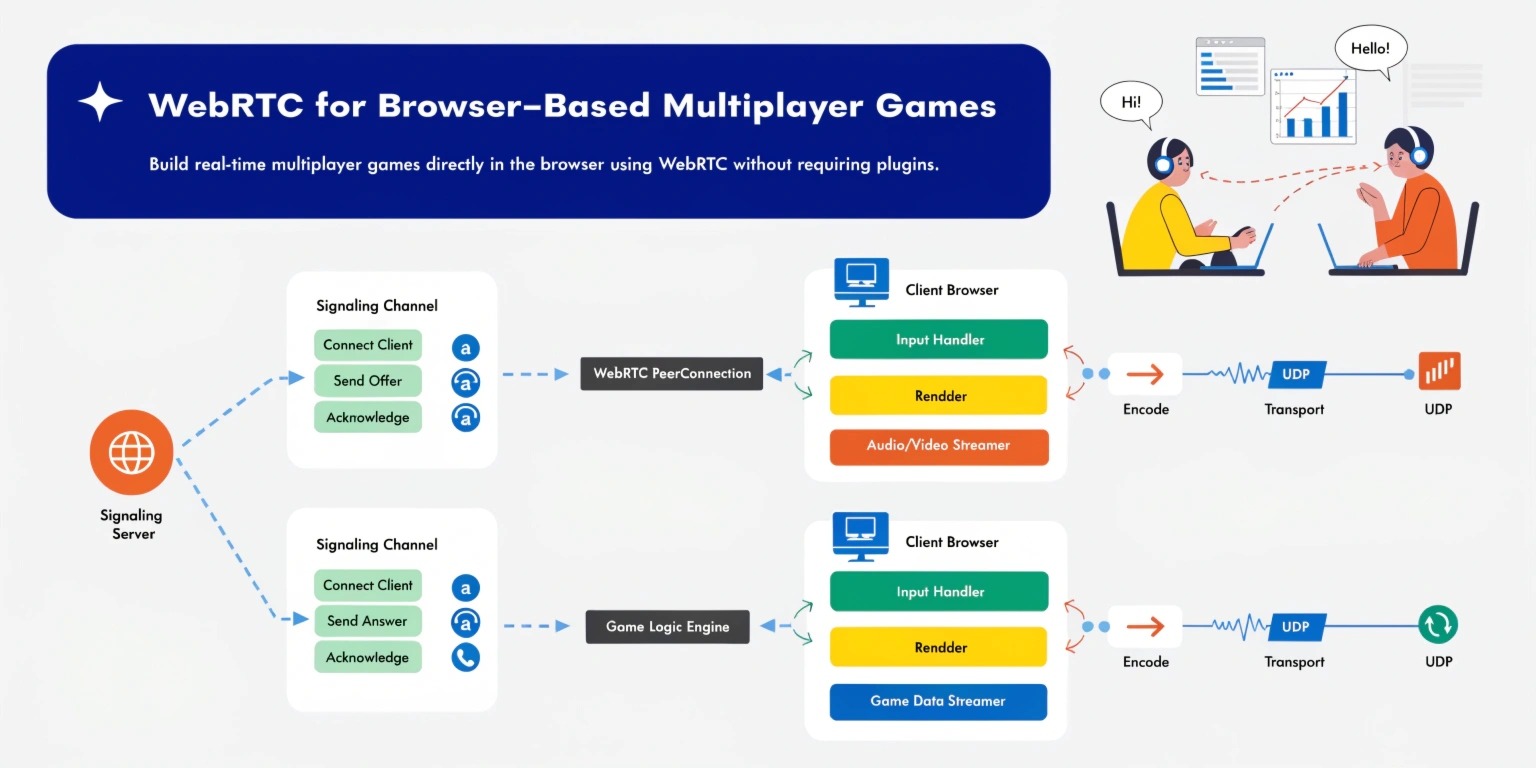
WebRTC allows developers to build real-time multiplayer games directly in the browser using peer-to-peer communication and ultra-low latency data channels. This article explains architecture, benefits, challenges, and best practices for implementing WebRTC in browser-based games.
Modern multiplayer games demand extremely low latency, real-time synchronization, and seamless communication between players. Traditionally, browser-based games relied on technologies such as HTTP polling or WebSockets to exchange game data. However, these approaches often require centralized servers and may introduce additional latency.
WebRTC (Web Real-Time Communication) has emerged as a powerful technology that enables direct peer-to-peer communication between browsers. Originally designed for video and audio communication, WebRTC is now widely used for real-time multiplayer gaming in the browser.
This article explores how WebRTC works, why it is useful for multiplayer games, and how developers can implement it effectively.
What is WebRTC?
WebRTC is an open-source technology that allows browsers and mobile applications to communicate directly without requiring plugins or additional software. It supports real-time data, audio, and video transmission between peers.
For game developers, the most important feature is the WebRTC Data Channel, which enables fast peer-to-peer data transfer. This allows players' browsers to send gameplay information such as player movement, actions, and state updates directly to each other.
Why Use WebRTC for Multiplayer Games?
Browser-based multiplayer games require extremely fast communication to maintain synchronization between players. WebRTC offers several advantages:
1. Ultra-Low Latency
Because WebRTC uses peer-to-peer connections, data does not always need to travel through a central server. This reduces round-trip time and improves gameplay responsiveness.
2. Reduced Server Load
In traditional multiplayer architectures, servers must process and relay messages between players. WebRTC offloads much of this communication directly between clients, reducing infrastructure costs.
3. Built-in Encryption
WebRTC connections are encrypted by default using secure protocols. This ensures that player communication remains private and secure.
4. Native Browser Support
Modern browsers like Chrome, Firefox, Safari, and Edge support WebRTC natively, allowing developers to build multiplayer experiences without plugins.
Basic WebRTC Architecture for Multiplayer Games
Implementing WebRTC in a multiplayer game typically involves three main components:
1. Signaling Server
Before peers can communicate directly, they must exchange connection information. This process is handled by a signaling server.
The signaling server is responsible for exchanging:
- Session descriptions
- Network information
- Connection negotiation data
Technologies commonly used for signaling include:
- WebSockets
- Node.js servers
- Socket.IO
Once peers establish a connection, the signaling server is no longer required for gameplay communication.
2. STUN and TURN Servers
Because players are often behind firewalls or NAT routers, WebRTC uses additional services to establish connections:
STUN (Session Traversal Utilities for NAT)
Helps determine the public IP address of the client.
TURN (Traversal Using Relays around NAT)
If a direct peer-to-peer connection fails, TURN servers relay traffic between peers.
Although TURN adds some latency, it ensures reliable connectivity across different networks.
3. WebRTC Data Channels
The Data Channel allows browsers to exchange arbitrary data with extremely low latency. This is ideal for game state synchronization.
Typical data transmitted includes:
- Player positions
- Game events
- Inputs and actions
- Physics updates
- Match state information
Because data channels support both reliable and unreliable transmission modes, developers can optimize communication for different game mechanics.
Game Architecture Patterns Using WebRTC
Developers commonly use two networking models when building multiplayer games with WebRTC.
Peer-to-Peer Model
Each player communicates directly with other players.
Advantages:
- Minimal latency
- Reduced server cost
Disadvantages:
- Harder to manage in large matches
- Network complexity increases with more players
This model works best for small multiplayer sessions such as:
- 1v1 games
- Cooperative games
- Small strategy games
Hybrid Client-Server Model
In this model, WebRTC is used for real-time communication while a central server handles authoritative game logic.
Advantages:
- Better cheat prevention
- Improved scalability
- More consistent gameplay state
Many modern multiplayer web games adopt this hybrid architecture.
Challenges of Using WebRTC in Games
While WebRTC provides powerful real-time capabilities, developers must also address several challenges.
NAT and Firewall Issues
Some networks restrict peer-to-peer connections, requiring TURN servers to relay traffic.
Synchronization Complexity
Because players communicate directly, ensuring consistent game state across clients can be challenging.
Scaling Multiplayer Sessions
Peer-to-peer models become difficult to manage with many players. Developers often combine WebRTC with server-based matchmaking systems.
Debugging Complexity
WebRTC networking issues can be difficult to debug due to the complexity of NAT traversal and peer negotiation.
Best Practices for WebRTC Game Development
To successfully implement WebRTC multiplayer games, developers should follow several best practices:
- Use WebSockets for signaling and connection negotiation
- Implement state reconciliation to handle network delays
- Use unreliable data channels for real-time movement updates
- Use reliable channels for important game events
- Monitor latency and implement lag compensation techniques
- Combine WebRTC with authoritative servers for competitive games
These practices help ensure smooth gameplay and reliable network performance.
Future of WebRTC in Browser Gaming
As browser technologies continue to evolve, WebRTC is becoming increasingly important in real-time applications. With the rise of cloud gaming, multiplayer web games, and collaborative virtual environments, peer-to-peer communication is becoming a core component of modern web architecture.
Game engines such as Phaser, PlayCanvas, and Babylon.js are already integrating WebRTC networking capabilities, making it easier for developers to build real-time browser games.
In the future, WebRTC will likely power a new generation of multiplayer web experiences where players can connect instantly without downloads or installations.
We build scalable web, mobile, and game products for clients worldwide — combining modern frameworks, cloud infrastructure, and best engineering practices.
.jpg)