Storytelling Techniques in Software Marketing: Turning Technology Into Compelling Brand Stories
Software marketing is often filled with technical terms, feature lists, specifications, integrations, and performance metrics. While these details are important, they don't always capture the attention of potential customers.
A buyer may not remember a list of software features, but they are more likely to remember a story about how a business solved a difficult problem using that software.
This is where storytelling in software marketing becomes powerful. Storytelling allows IT companies and SaaS businesses to transform complex technology into relatable narratives that communicate problems, solutions, outcomes, and value.
Why Storytelling Matters in Software Marketing
Software products can be difficult to understand, particularly when they involve artificial intelligence, cloud computing, cybersecurity, APIs, automation, or enterprise infrastructure.
Instead of simply explaining what a product does, storytelling answers a more important question:
Why should the customer care?
A strong story connects technology with a real business problem. It shows potential customers how a solution can improve productivity, reduce costs, increase revenue, improve customer experience, or solve operational challenges.
Storytelling can also make brands more memorable. When several software companies offer similar services, a compelling brand story can help one company stand apart.
1. Start With the Customer's Problem
One of the most effective storytelling techniques is to begin with the customer's challenge rather than the product.
For example, instead of saying:Our platform provides automated workflow management."
A story could begin with:
A growing company was spending hundreds of hours every month managing repetitive approval processes manually."
The second approach immediately creates context.
The audience can identify with the problem before being introduced to the solution.
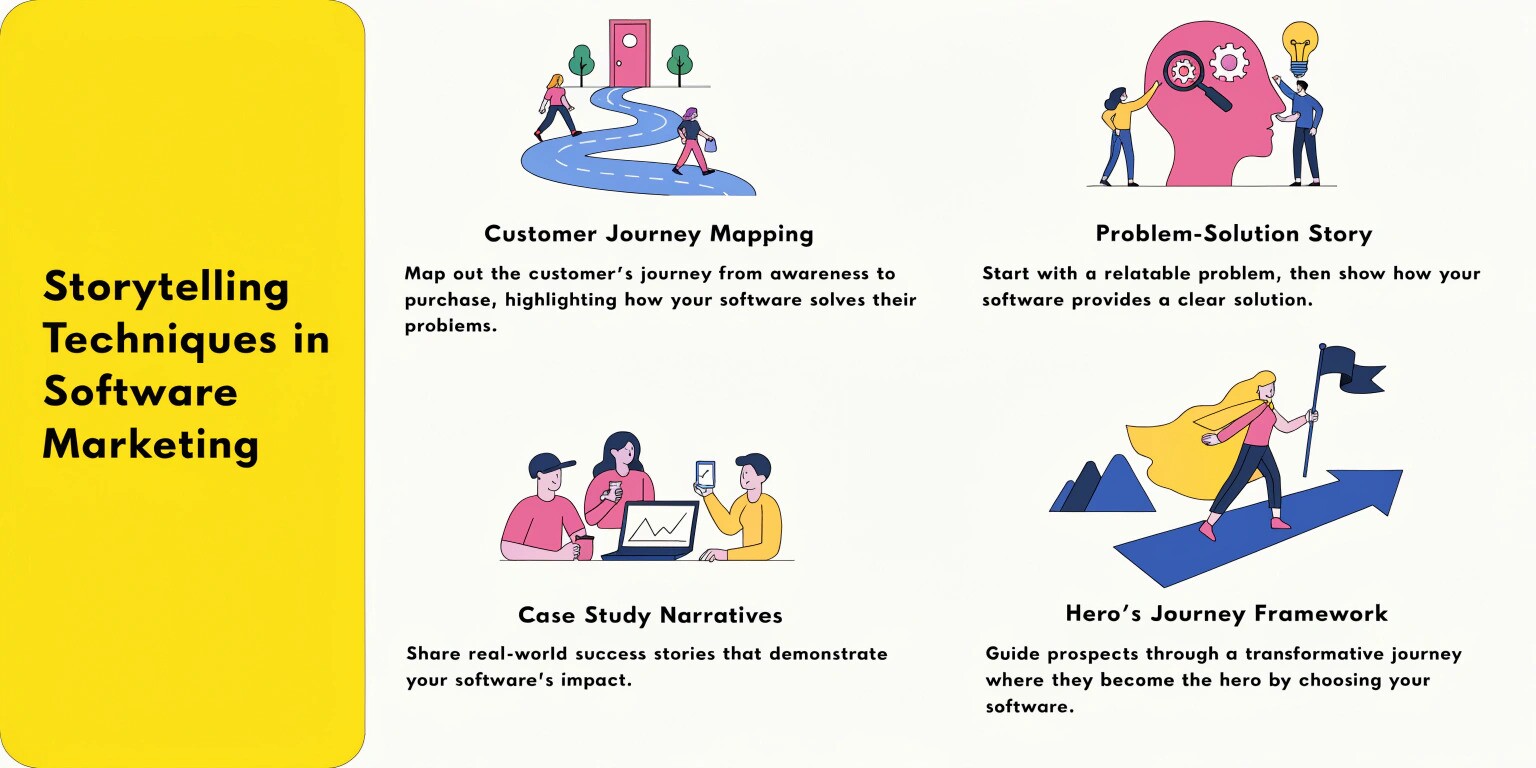
2. Use the Problem-Solution-Result Framework
A simple structure for software marketing stories is:
Problem → Solution → Result
First, explain the challenge.
Next, introduce the technology or service that addresses it.
Finally, demonstrate the outcome.
For example:
- Problem: A company struggled with slow manual processes.
- Solution: An automated software platform was implemented.
- Result: Employees spent less time on repetitive work and could focus on higher-value activities.
This framework works particularly well for case studies, landing pages, sales presentations, and social media content.
3. Turn Customer Success Into Stories
Customer success stories are among the most valuable storytelling assets for software companies.
Instead of simply publishing a testimonial saying, "Great service and excellent support," develop a complete narrative.
Explain:
- Who the customer was
- What challenge they faced
- Why existing solutions weren't sufficient
- How your team approached the problem
- What technology was implemented
- What obstacles appeared during development
- What results were achieved
This provides social proof while demonstrating technical expertise.
4. Make Technical Concepts Human
Technical content doesn't always need to sound technical.
For example, instead of explaining cloud migration entirely through infrastructure terminology, describe the business situation surrounding the migration.
Explain how outdated infrastructure affected employees, customers, performance, or business growth.
Then introduce cloud technology as part of the solution.
This makes complicated subjects easier for decision-makers who may not have deep technical backgrounds.
5. Use Data to Strengthen the Story
Storytelling doesn't mean removing facts and statistics.
Data can make a story more credible.
For example, instead of saying:
"Our solution significantly improved productivity."
A stronger narrative could explain:
"After automation was introduced, the team reduced repetitive manual processes and redirected employee time toward customer-facing activities."
Whenever possible, use verified metrics such as:
- Processing time
- Cost reduction
- Conversion rates
- Customer retention
- Development time
- Response time
- Productivity improvements
Numbers provide evidence behind the narrative.
6. Create a Strong Founder Story
Founder stories can help humanize technology brands.
Explain:
- Why the company was created
- What problem inspired the founders
- Early challenges
- Important milestones
- Lessons learned
- The company's vision
This approach is especially useful for startups and software development agencies trying to establish a recognizable identity.
A founder story can transform a company from an anonymous service provider into a brand with purpose and personality.
7. Use the Customer as the Hero
One common mistake in software marketing is making the company the hero of every story.
A stronger approach is to make the customer the hero.
Your company becomes the expert or guide helping the customer overcome obstacles.
This storytelling structure creates a customer-centric marketing message and focuses attention on outcomes rather than company achievements.
8. Use Storytelling Across Multiple Marketing Channels
Storytelling shouldn't exist only in long-form blog posts.
IT companies can use narratives across:
- Website pages
- LinkedIn posts
- Case studies
- Email campaigns
- Product videos
- Sales presentations
- Whitepapers
- Webinars
- Product demos
- Social media campaigns
A single customer success story can become multiple pieces of marketing content.
For example, a detailed case study can be transformed into LinkedIn posts, short videos, email content, website sections, and sales presentation material.
9. Build Emotional Connections With B2B Buyers
B2B purchasing decisions may appear completely rational, but people are still involved in the decision-making process.
Decision-makers care about risk, reliability, reputation, career impact, efficiency, and confidence.
Software storytelling can address these emotions without becoming overly dramatic.
A story showing how technology helped a team avoid operational problems or confidently scale their business can be more persuasive than a simple list of product features.
10. Avoid Overcomplicating the Narrative
Good software storytelling should simplify, not complicate.
Avoid unnecessary technical terminology when the audience doesn't need it.
Use clear language, relatable examples, and logical progression.
A useful structure is:
Challenge → Context → Conflict → Solution → Transformation → Result
This gives readers a reason to continue reading while naturally introducing the product or service.
Conclusion
Storytelling is becoming an increasingly valuable strategy for software marketing because it bridges the gap between complex technology and human business needs.
Instead of simply explaining what software does, effective storytelling demonstrates why it matters.
By using customer success stories, problem-solution frameworks, founder narratives, data-driven results, and human-centered messaging, IT companies can make their marketing more engaging and memorable.
The strongest software marketing stories don't simply sell features. They show customers where they are today, what challenges stand in their way, and how technology can help them reach a better future.
For software companies competing in crowded markets, that ability to communicate value through stories can become a significant advantage in building trust, generating leads, and creating long-term customer relationships.