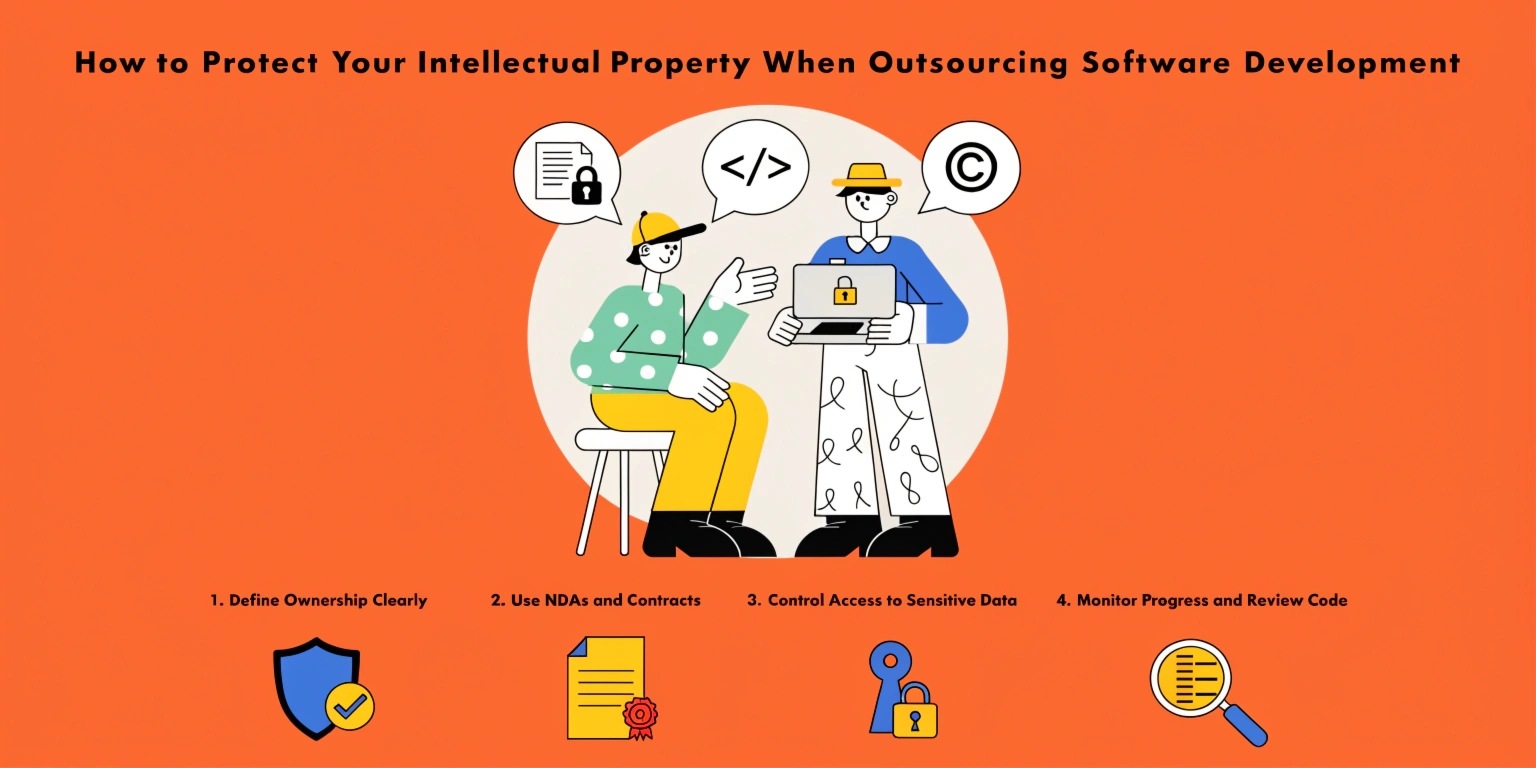
Outsourcing software development allows businesses to access specialized technical expertise, accelerate product delivery, and manage development costs. However, sharing product ideas, source code, business strategies, algorithms, and customer information with an external development team can create intellectual property (IP) risks.
Without appropriate safeguards, businesses may face disputes over software ownership, unauthorized disclosure of confidential information, licensing issues, or difficulties transferring a product to another development partner.
Protecting intellectual property should therefore begin before outsourcing work starts and continue throughout the development lifecycle. A combination of legal agreements, technical safeguards, and operational controls helps businesses protect their innovations while maintaining productive relationships with external developers.
1. Understand What Intellectual Property Needs Protection
Before engaging an outsourcing partner, identify the assets that must remain confidential or under your ownership.
These may include source code, application architecture, algorithms, UI designs, product specifications, proprietary datasets, business processes, technical documentation, and product roadmaps.
Different assets may receive different legal protections. Copyright may protect qualifying software code and original creative works, while trade secret protection may apply to valuable confidential information that is subject to reasonable secrecy measures. Patents and trademarks may be relevant to other types of innovation and branding.
Create an inventory of existing intellectual property before development begins. Document what your company already owns, what the contractor will create, and what third-party components may be incorporated into the product.
This distinction helps prevent disputes when the project is completed or the outsourcing relationship ends.
2. Sign a Strong Non-Disclosure Agreement
A non-disclosure agreement (NDA) establishes obligations concerning confidential information shared during the engagement.
The agreement should define what qualifies as confidential, explain permitted uses, identify authorized recipients, and specify how information must be protected. It should also address exclusions for information that is already public, independently developed, or lawfully obtained from another source.
Include requirements for handling confidential files, restricting disclosure to authorized personnel, and returning or securely deleting information when the engagement ends, subject to applicable retention obligations.
An NDA alone does not transfer ownership of software or automatically establish every necessary intellectual property right. It should be combined with a comprehensive development agreement that addresses ownership and licensing.
Have qualified legal counsel review the agreement, especially when the outsourcing provider operates in another country.
3. Define Intellectual Property Ownership in the Contract
One of the most important protections is a clear contractual statement about who owns the software produced during the engagement.
The agreement should specify ownership of deliverables, including source code, documentation, designs, tests, configurations, and other project-specific work. It should also explain when ownership or rights transfer, what conditions apply, and which rights must be assigned through additional documents.
Distinguish between newly developed work and the provider's pre-existing tools, frameworks, libraries, or reusable components. For background intellectual property retained by the provider, define the license your business needs to use, maintain, modify, and distribute the completed product.
Do not assume that paying for development automatically gives your company every desired right. Ownership and transfer rules vary by jurisdiction and contract wording.
4. Secure Source Code and Development Environments
Legal agreements should be supported by technical controls that reduce unauthorized access to proprietary code.
Use company-controlled repositories whenever practical, such as GitHub, GitLab, or Bitbucket organizations managed by your business. Grant each developer only the permissions needed for their responsibilities.
Enable multifactor authentication, protect sensitive branches, require pull-request reviews, and maintain audit logs. Avoid sharing repository credentials or embedding secrets such as API keys and passwords in source code.
Separate development, testing, and production environments. Limit access to production systems and confidential customer data unless access is necessary and properly authorized.
Regularly review permissions, particularly when developers change roles or leave the project. These practices improve accountability and make it easier to retain control over critical assets.
5. Evaluate the Outsourcing Partner Carefully
Before sharing sensitive information, assess the provider's reputation, security practices, development procedures, and contractual reliability.
Ask how the company manages employee confidentiality agreements, repository access, subcontractors, backups, incident reporting, and staff departures.
Clarify whether third-party developers or subcontractors will participate. The contract should require appropriate confidentiality and IP obligations for everyone who may access your proprietary materials.
Check how the provider handles open-source software and other third-party components. Request a software bill of materials or dependency inventory when appropriate, and review licenses for compatibility with your intended distribution and commercial model.
A technically capable vendor is important, but strong IP management and security discipline are equally essential.
6. Protect Trade Secrets and Confidential Business Knowledge
Some of the most valuable intellectual property consists of information that is not publicly known, such as proprietary algorithms, pricing models, customer insights, or internal technical methods.
To preserve trade secret protection where available, restrict access to people who genuinely need the information. Mark confidential documents appropriately, use secure sharing platforms, and document confidentiality requirements.
Avoid providing an outsourcing team with unrestricted access to every business system or dataset. Share only the information required for its assigned tasks.
Maintain records of access permissions, document transfers, and confidentiality training. These measures support operational security and can help demonstrate that reasonable steps were taken to protect sensitive information.
7. Manage Open-Source and Third-Party Licensing
Modern software frequently includes open-source libraries, APIs, commercial SDKs, and external code. These components can introduce licensing obligations that affect how the finished product may be used or distributed.
Require the development partner to disclose third-party dependencies and obtain approval for components that could create significant licensing or security concerns.
Review license conditions, attribution requirements, redistribution restrictions, and any obligations that may apply to modifications or derivative works.
Use dependency scanning and software composition analysis tools to identify known vulnerabilities and track component licenses. Keep an updated inventory so your company can maintain the product even after the outsourcing agreement ends.
8. Plan for Project Completion and Vendor Exit
Intellectual property protection must continue when the relationship ends.
The contract should specify delivery of complete source code, build instructions, technical documentation, deployment configurations, test suites, and other agreed deliverables. Ensure that your business retains access to required repositories and infrastructure.
Define the process for returning or deleting confidential information, revoking accounts, rotating credentials, and transferring operational responsibilities.
Confirm that required IP assignment documents have been completed and that third-party license records are available. A planned transition reduces the risk of becoming dependent on a single provider to maintain or improve your software.
Conclusion
Protecting intellectual property when outsourcing software development requires more than signing an NDA. Businesses should identify their valuable assets, establish clear ownership terms, assess external providers, secure source code, control confidential information, and manage third-party licensing carefully.
Legal agreements establish responsibilities, while technical controls and documented processes help enforce them throughout the engagement.
By addressing these protections before development begins and reviewing them at every major project milestone, organizations can reduce disputes, maintain control over their software, and build secure, productive partnerships with outsourced development teams.