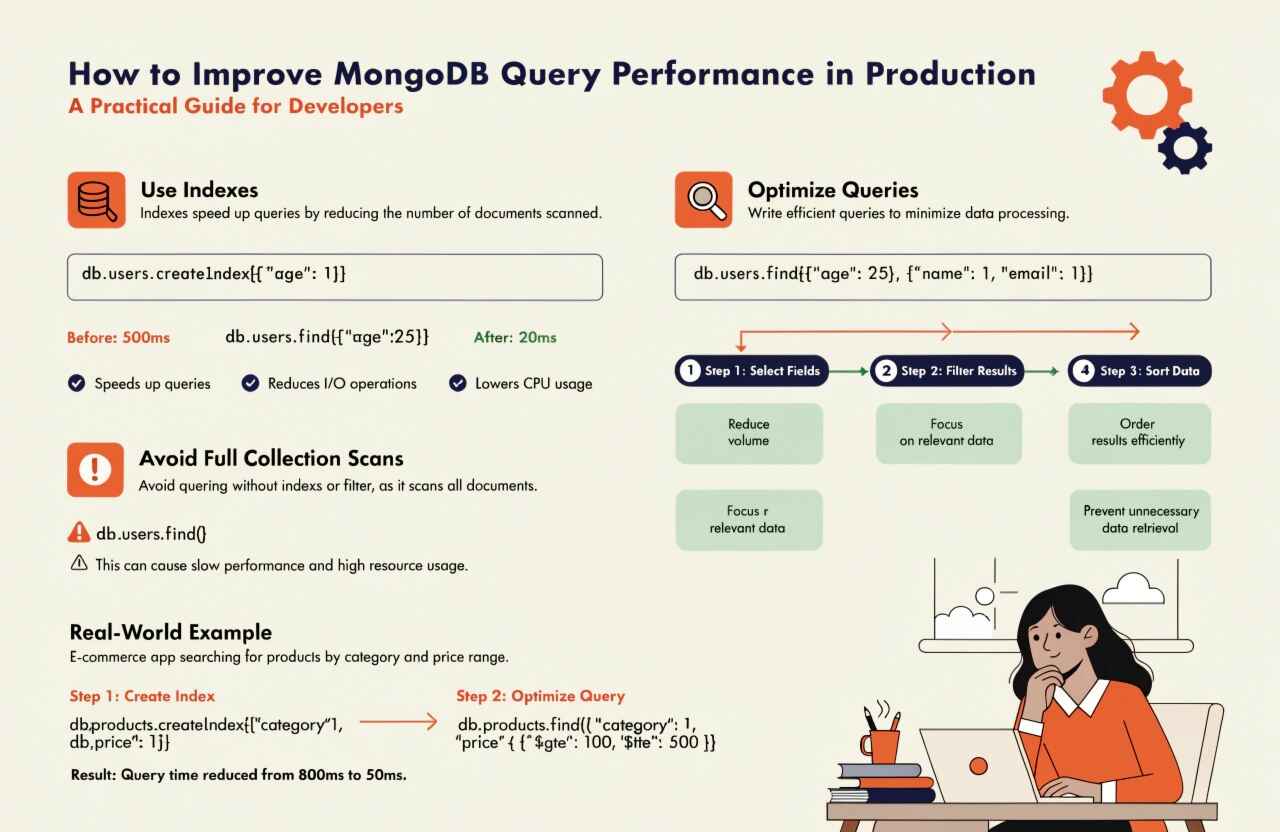
Improve MongoDB query performance in production with effective indexing, query analysis, aggregation optimization, efficient data retrieval, connection pooling, and continuous monitoring. Discover practical strategies to reduce latency, improve scalability, and maintain reliable database performance.
How to Improve MongoDB Query Performance in Production
MongoDB is a popular NoSQL database used to build scalable web applications, mobile applications, SaaS platforms, and real-time systems. However, as an application grows and its database accumulates more records, queries that once performed efficiently may become slow. Poor indexing, inefficient aggregation pipelines, excessive data retrieval, and increasing concurrent requests can affect response times and application reliability.
Improving MongoDB query performance in production requires more than adding indexes. Developers must identify bottlenecks, understand query execution, monitor database behavior, and optimize the application’s interaction with the database. The following practices can help maintain fast and reliable MongoDB performance.
1. Identify Slow Queries Before Making Changes
The first step in optimization is understanding which queries are causing performance problems. Guessing the cause can lead to unnecessary indexes, increased storage consumption, or changes that fail to improve performance.
MongoDB provides tools such as the database profiler, slow-query logs, and monitoring dashboards to help identify inefficient operations. Developers should examine query duration, documents examined, documents returned, execution frequency, and resource consumption.
For example, a query that takes 800 milliseconds and executes thousands of times per minute may deserve more attention than a query that takes two seconds but runs only once daily.
Use MongoDB's explain() method to inspect how a query executes:
db.orders.find({
customerId: 1024,
status: "completed"
}).explain("executionStats");
Review fields such as executionTimeMillis, totalDocsExamined, and totalKeysExamined. A large number of examined documents compared with returned documents may indicate an opportunity for optimization.
Always test performance changes against representative production-like data before deploying them.
2. Create the Right Indexes
Indexes are among the most effective ways to improve MongoDB query performance. Without an appropriate index, MongoDB may need to scan many documents to find matching records.
Consider a query that retrieves completed orders for a particular customer:
db.orders.find({
customerId: 1024,
status: "completed"
});
A compound index can help MongoDB locate matching documents more efficiently:
db.orders.createIndex({
customerId: 1,
status: 1
});
Index design should reflect actual query patterns, including filtering, sorting, and field selection. For compound indexes, field order matters because it influences which queries can efficiently use the index.
However, creating indexes for every field is not recommended. Indexes consume memory and storage and add overhead to inserts, updates, and deletes. Review existing indexes regularly and remove redundant or genuinely unused indexes only after validating their purpose and impact.
3. Retrieve Only the Required Fields
Fetching entire documents when an application needs only a few fields increases data transfer and processing costs.
For example, instead of retrieving complete customer records, request only the necessary information:
db.customers.find(
{ status: "active" },
{ name: 1, email: 1, _id: 0 }
);
This projection returns only the customer's name and email address. It can reduce network traffic and application-side processing, particularly when documents contain large arrays, descriptions, or embedded objects.
For frequently executed queries, consider whether a suitable index can support the filter and projection together. Covered queries may avoid fetching the full document when all required fields are available in the index and the query conditions permit it.
4. Optimize Aggregation Pipelines
MongoDB aggregation pipelines support reporting, analytics, data transformation, and complex filtering. Poorly designed pipelines can consume significant CPU and memory.
Place selective $match stages early so unnecessary documents are eliminated before later processing. Use $project when reducing document size helps subsequent stages, and review $sort, $group, $lookup, and $unwind operations for unnecessary work.
For example:
db.orders.aggregate([
{
$match: {
status: "completed"
}
},
{
$group: {
_id: "$customerId",
totalOrders: { $sum: 1 }
}
}
]);
An appropriate index on the filtered field may improve the initial matching stage. The actual benefit depends on the query, data distribution, and execution plan.
Avoid joining unnecessarily large datasets through $lookup. Ensure join fields are indexed where appropriate and consider whether the application would benefit from a different document structure or a precomputed summary.
5. Use Pagination Efficiently
Large result sets can slow applications and increase database workload. Traditional pagination using skip() and limit() is convenient for small offsets, but performance can deteriorate when the offset becomes very large because MongoDB must work through earlier results.
For example:
db.products.find({})
.sort({ _id: 1 })
.skip(50000)
.limit(20);
For large datasets, consider range-based pagination using a stable, indexed sort field:
db.products.find({
_id: { $gt: lastSeenId }
})
.sort({ _id: 1 })
.limit(20);
The application stores the last returned identifier and uses it to request the next page. This approach avoids repeatedly skipping large numbers of documents and is especially useful for feeds, product listings, and activity histories.
6. Improve Connection Pooling and Application Queries
Database performance also depends on how applications manage connections and issue requests. Opening a new database connection for every operation introduces unnecessary overhead.
Use a suitable MongoDB driver connection pool and configure its size according to workload, server capacity, and concurrent request patterns. Avoid setting excessively large pools without measuring the results, as too many concurrent operations can increase resource contention.
Additionally, eliminate repeated database calls when a single query can retrieve the required information. Batch operations where appropriate, use bulk writes for multiple related updates, and avoid unnecessary sequential queries in request-handling code.
Caching frequently requested data can also reduce database load, provided the application manages expiration and invalidation correctly.
7. Monitor Production Performance Continuously
Query optimization is an ongoing process. Database performance can change as data grows, traffic increases, indexes evolve, and application features introduce new query patterns.
Monitor query latency, CPU utilization, memory usage, disk I/O, connection counts, cache behavior, replication lag, and storage growth. MongoDB Atlas provides monitoring tools for managed deployments, while self-managed environments can use database metrics, logs, and compatible observability platforms.
Set performance baselines and alerts for meaningful deviations. After deploying an optimization, compare measurements before and after the change using similar workloads.
Avoid relying on a single execution-time measurement because caching, concurrency, and system load can affect results.
Conclusion
Improving MongoDB query performance in production requires a structured approach combining query analysis, appropriate indexing, efficient data retrieval, aggregation optimization, scalable pagination, connection management, and continuous monitoring.
Start by identifying the most expensive queries, inspect their execution plans, and make targeted changes based on measurable evidence. Test every significant optimization against realistic workloads and monitor the results after deployment.
By following these practices, developers can reduce query latency, use database resources more efficiently, and build scalable applications that remain responsive as their data and user base grow.
We build scalable web, mobile, and game products for clients worldwide — combining modern frameworks, cloud infrastructure, and best engineering practices.