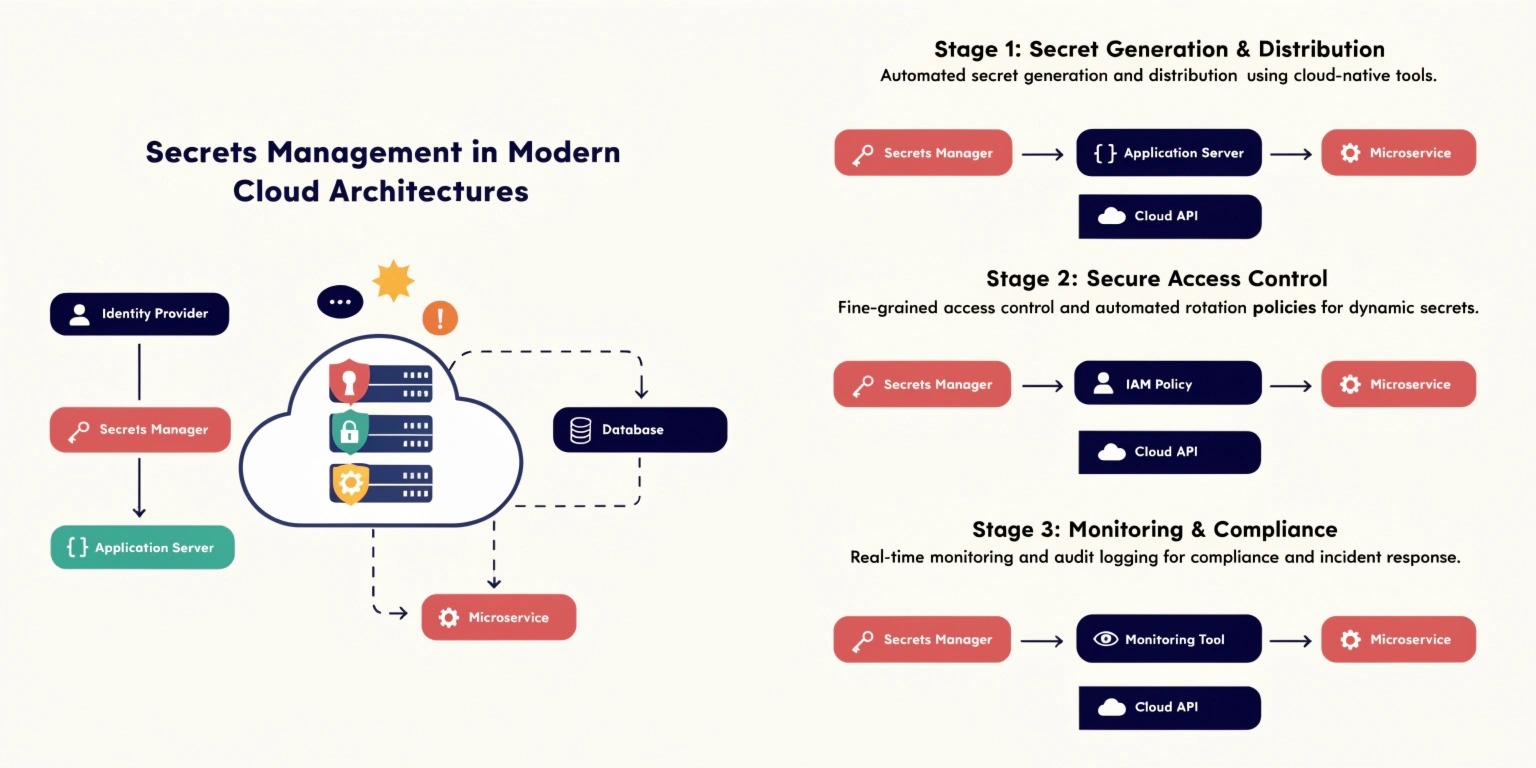
Secrets management protects sensitive credentials such as API keys, passwords, tokens, certificates, and encryption keys throughout their lifecycle. Modern cloud architectures use centralized secret stores, identity-based access, automated rotation, encryption, and auditing to reduce security risks and prevent credential exposure.
Modern cloud applications depend on numerous credentials to communicate with databases, APIs, cloud services, third-party platforms, and internal infrastructure. These credentials can include API keys, passwords, access tokens, encryption keys, certificates, SSH keys, and service credentials.
If these secrets are stored incorrectly or exposed through source code, logs, configuration files, or deployment pipelines, attackers can potentially gain unauthorized access to critical systems.
Secrets management provides a structured approach for securely storing, accessing, rotating, monitoring, and revoking sensitive credentials.
1. What Is Secrets Management?
Secrets management is the process of securely controlling sensitive information required by applications and infrastructure.
Common secrets include:
- Database credentials
- API keys
- OAuth tokens
- Cloud access credentials
- TLS certificates
- Encryption keys
- Service account credentials
- Private keys
Instead of storing these values directly inside application source code or configuration files, organizations can use dedicated secrets-management systems.
The objective is to ensure that applications receive the credentials they need without exposing those credentials unnecessarily.
2. Why Hardcoded Secrets Are Dangerous
One of the most common security mistakes is hardcoding secrets into source code.
For example:
DATABASE_PASSWORD="MySecretPassword123"
Even if the credential is later removed, it may remain in Git history, backups, logs, or developer environments.
Public repositories and accidentally exposed private repositories can become targets for automated credential scanning.
A safer approach is to store the secret in a dedicated secret-management system and retrieve it securely at runtime.
3. Centralized Secret Storage
Modern cloud environments often use centralized secret-management platforms.
Examples include HashiCorp Vault, AWS Secrets Manager, Azure Key Vault, and Google Cloud Secret Manager.
These systems provide encrypted storage and controlled access to secrets.
Centralization also makes it easier for security teams to implement consistent policies across multiple applications and environments.
Instead of maintaining credentials separately across dozens of services, organizations can manage them through controlled infrastructure.
4. Encrypt Secrets at Rest and in Transit
Secrets should be protected both while stored and while being transmitted.
Encryption at rest protects credentials stored within secret-management infrastructure. Encryption in transit protects credentials as they move between applications and secret-management services.
Cloud environments commonly integrate secret stores with key-management services to strengthen encryption controls.
However, encryption alone is not sufficient. Strong identity and authorization policies are also required.
5. Use Identity-Based Access
Applications should not rely on a single shared master credential to access every secret.
Instead, workloads should authenticate using their own identities.
For example, a cloud workload can receive an identity that grants access only to the specific secrets it requires.
This follows the principle of least privilege.
If an application only needs access to a database password, it should not automatically have permission to retrieve payment-service credentials, production certificates, or administrative keys.
6. Automate Secret Rotation
Secrets should not remain valid indefinitely.
Regular rotation reduces the potential impact of compromised credentials.
A modern secrets-management strategy should automate rotation whenever possible.
For example, database credentials can be periodically changed while applications retrieve the current value dynamically.
Automated rotation reduces dependence on manual security procedures and makes credential management more scalable.
7. Secrets Management in CI/CD
CI/CD pipelines frequently require credentials to deploy applications or access external services.
Storing these credentials directly in pipeline configuration files creates unnecessary risk.
Instead, CI/CD systems should integrate with secure secret stores and retrieve credentials only when required.
Secrets should also be prevented from appearing in build logs, deployment output, error messages, or debugging information.
Security scanning tools can detect accidentally committed credentials before code reaches production.
8. Kubernetes Secrets Management
Kubernetes applications frequently require credentials for databases, APIs, registries, and other services.
Kubernetes provides a Secrets resource, but organizations with stricter security requirements may integrate Kubernetes workloads with external secret-management platforms.
Approaches such as secret injection, workload identity, and external secret operators can help applications retrieve credentials without permanently embedding sensitive values in application images.
Access should be carefully controlled using Kubernetes RBAC and cloud-native identity mechanisms.
9. Manage the Complete Secret Lifecycle
Secrets management should cover the entire lifecycle of a credential:
Creation → Storage → Distribution → Usage → Rotation → Revocation → Deletion
A credential should be revoked immediately when an employee leaves, a system is compromised, or suspicious activity is detected.
Organizations should also maintain ownership information so teams know why a secret exists, which application uses it, and when it should expire.
10. Monitoring and Auditing
A secure secrets-management system should provide detailed audit information.
Security teams should be able to determine:
- Who accessed a secret?
- Which application requested it?
- When was it accessed?
- From where was it accessed?
- Which secrets were modified?
- When was a credential rotated?
Audit logs can help detect unusual access patterns and support incident investigations.
Organizations should also establish alerts for suspicious secret access, repeated authentication failures, and unexpected privilege changes.
11. Avoid Secrets in Logs
Even when applications use secure secret stores, credentials can accidentally leak through logs.
For example, developers may log complete HTTP requests containing authorization headers or print environment variables during debugging.
Production logging should therefore use structured filtering and secret redaction.
Sensitive values should never be included in error messages, monitoring dashboards, screenshots, or support tickets.
12. Implement Zero-Trust Principles
Modern secrets management aligns closely with zero-trust security.
Applications should not automatically trust other workloads simply because they operate inside the same cloud network.
Every request should be authenticated and authorized based on identity, policy, and context.
Combining strong workload identity, least-privilege permissions, encryption, short-lived credentials, and continuous monitoring can significantly reduce the impact of credential compromise.
Conclusion
Secrets management is a fundamental component of modern cloud security. As applications become increasingly distributed across containers, Kubernetes clusters, cloud services, APIs, and CI/CD pipelines, organizations must have a reliable way to protect sensitive credentials.
A strong strategy combines centralized storage, encryption, identity-based access, least privilege, automated rotation, lifecycle management, auditing, and continuous monitoring.
Most importantly, secrets management should be integrated into application development and DevOps processes from the beginning rather than treated as an afterthought. By automating credential protection and minimizing unnecessary access, organizations can significantly reduce the risk of accidental exposure and unauthorized access across modern cloud architectures.
We build scalable web, mobile, and game products for clients worldwide — combining modern frameworks, cloud infrastructure, and best engineering practices.