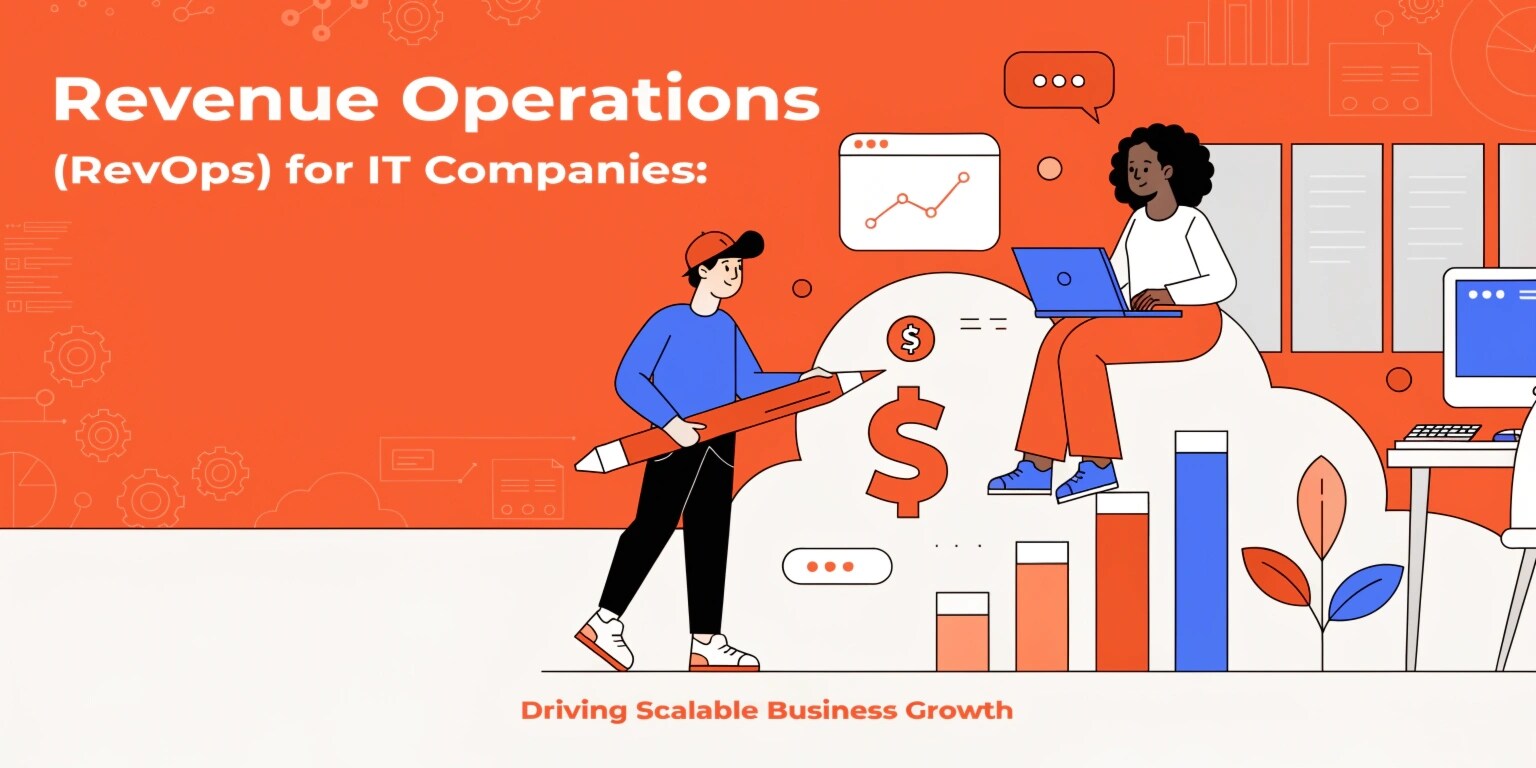
Discover how Revenue Operations (RevOps) helps IT companies align teams, improve customer experience, optimize sales processes, and drive predictable revenue growth.
As the technology industry becomes increasingly competitive, IT companies are under constant pressure to scale efficiently, improve customer experience, and generate predictable revenue. Traditional business structures often separate sales, marketing, customer support, and operations into disconnected departments, creating communication gaps and inefficiencies.
This is where Revenue Operations (RevOps) is transforming modern IT businesses.
Revenue Operations is a strategic business model that aligns sales, marketing, customer success, and operational teams under a unified revenue-focused framework. Instead of operating independently, departments collaborate using shared processes, data, technology, and performance goals.
RevOps helps organizations:
- Improve operational efficiency
- Increase revenue predictability
- Enhance customer experiences
- Optimize lead management
- Reduce internal silos
- Scale business growth effectively
For modern IT companies, especially SaaS businesses, software agencies, cloud service providers, and AI startups, RevOps is becoming a critical competitive advantage.
What is Revenue Operations (RevOps)?
Revenue Operations is a centralized operational approach focused on aligning all revenue-generating teams.
Traditionally:
- Marketing generates leads
- Sales closes deals
- Customer success handles retention
- Operations manages systems separately
This fragmented approach often creates:
- Data inconsistencies
- Communication problems
- Poor forecasting
- Customer experience gaps
RevOps unifies these departments through:
- Shared metrics
- Centralized systems
- Workflow automation
- Unified reporting
- Cross-functional collaboration
The primary goal is improving the entire customer lifecycle from lead generation to long-term retention.
Why RevOps Matters for IT Companies
IT companies often operate in fast-changing and highly competitive markets.
Challenges include:
- Long sales cycles
- Technical buying decisions
- Complex customer onboarding
- Subscription renewals
- Customer churn
- Rapid scaling demands
Without operational alignment, growth becomes difficult to manage efficiently.
RevOps helps IT organizations create smoother workflows between teams and improve visibility across the entire revenue pipeline.
Core Components of RevOps
Revenue Operations typically combines three major operational areas:
Sales Operations
Focuses on:
- CRM management
- Pipeline optimization
- Forecasting
- Sales automation
- Performance tracking
Marketing Operations
Handles:
- Lead generation systems
- Campaign analytics
- Marketing automation
- Attribution tracking
- Customer segmentation
Customer Success Operations
Manages:
- Client onboarding
- Retention strategies
- Upselling opportunities
- Customer health monitoring
- Renewal processes
Together, these areas create a unified revenue engine.
Benefits of RevOps for IT Companies
Improved Team Alignment
One of the biggest problems in traditional organizations is departmental misalignment.
For example:
- Marketing may focus on lead quantity
- Sales may prioritize only high-budget clients
- Customer success may lack onboarding visibility
RevOps creates shared objectives across teams.
Everyone works toward:
- Revenue growth
- Customer retention
- Customer satisfaction
- Operational efficiency
This improves collaboration significantly.
Better Revenue Forecasting
IT companies need accurate forecasting to:
- Plan hiring
- Allocate budgets
- Manage investments
- Scale infrastructure
RevOps centralizes data from multiple departments, improving forecast accuracy and business visibility.
Predictable revenue becomes easier to achieve.
Enhanced Customer Experience
Customers interact with multiple departments during their lifecycle.
Without alignment, customers may experience:
- Repeated communication
- Delayed responses
- Inconsistent information
- Poor onboarding experiences
RevOps creates smoother customer journeys through integrated workflows and shared customer data.
Increased Operational Efficiency
Automation and process optimization reduce:
- Manual tasks
- Data duplication
- Administrative overhead
- Reporting inconsistencies
Teams can focus more on strategic growth activities instead of operational inefficiencies.
Role of Technology in RevOps
Technology platforms are central to successful RevOps implementation.
Popular RevOps tools include:
- HubSpot
- Salesforce
- Zoho
- Monday.com
These platforms help businesses unify:
- CRM systems
- Marketing automation
- Customer support
- Reporting dashboards
- Sales analytics
Integrated systems improve operational visibility across the organization.
RevOps in SaaS and Software Businesses
RevOps is especially important for SaaS companies because subscription-based models depend heavily on:
- Customer retention
- Upselling
- Renewals
- Long-term customer value
Revenue is not generated only during initial sales.
Successful SaaS businesses continuously optimize:
- Customer onboarding
- Product adoption
- Usage engagement
- Expansion revenue
RevOps provides the operational structure required to manage these complex customer relationships efficiently.
Importance of Data and Analytics
RevOps depends heavily on centralized data.
Data helps organizations:
- Track customer journeys
- Measure conversion rates
- Identify revenue bottlenecks
- Analyze churn risks
- Improve campaign performance
Modern IT companies increasingly use AI-powered analytics to improve operational decision-making.
AI and Automation in RevOps
Artificial intelligence is transforming Revenue Operations significantly.
AI systems can:
- Predict lead conversion probability
- Identify churn risks
- Recommend upsell opportunities
- Automate reporting
- Optimize sales outreach
- Analyze customer behavior patterns
AI-powered RevOps improves both efficiency and strategic decision-making.
Companies such as OpenAI and Microsoft are accelerating AI integration into business operations platforms.
Common Challenges in RevOps Implementation
Although RevOps offers major advantages, implementation can be challenging.
Organizational Resistance
Departments may resist operational changes or centralized systems.
Data Silos
Legacy systems often contain fragmented and inconsistent customer data.
Technology Complexity
Integrating multiple platforms requires careful planning and technical expertise.
Process Standardization
Different teams may follow inconsistent workflows and reporting structures.
Successful RevOps implementation requires both technical and cultural alignment.
Best Practices for Building a RevOps Strategy
Create Shared KPIs
All revenue-related teams should work toward aligned business objectives.
Centralize Customer Data
Unified data improves visibility and collaboration.
Invest in Automation
Workflow automation reduces operational inefficiencies.
Improve Cross-Team Communication
Transparent collaboration improves customer experience and revenue performance.
Continuously Optimize Processes
RevOps should evolve continuously based on analytics and operational insights.
Future of Revenue Operations
The future of RevOps will likely include:
- AI-driven forecasting
- Autonomous workflow automation
- Predictive customer analytics
- Intelligent CRM systems
- Real-time revenue optimization
- Personalized customer lifecycle management
As digital business ecosystems become more complex, operational alignment will become increasingly critical.
RevOps as a Competitive Advantage
IT companies adopting RevOps often gain significant advantages:
- Faster scaling
- Better customer retention
- Improved operational efficiency
- Higher recurring revenue
- Better forecasting accuracy
- Stronger customer relationships
RevOps enables organizations to grow more sustainably and predictably.
Conclusion
Revenue Operations (RevOps) is rapidly becoming a foundational strategy for modern IT companies seeking scalable and efficient growth. By aligning sales, marketing, customer success, and operational workflows, RevOps improves revenue predictability, customer experience, and overall business performance.
As SaaS, cloud computing, AI services, and subscription-based business models continue expanding, companies that adopt RevOps frameworks will be better positioned to compete in increasingly complex digital markets.
Organizations that successfully combine operational alignment, automation, analytics, and customer-centric strategies through RevOps will gain long-term advantages in growth, scalability, and profitability.
We build scalable web, mobile, and game products for clients worldwide — combining modern frameworks, cloud infrastructure, and best engineering practices.