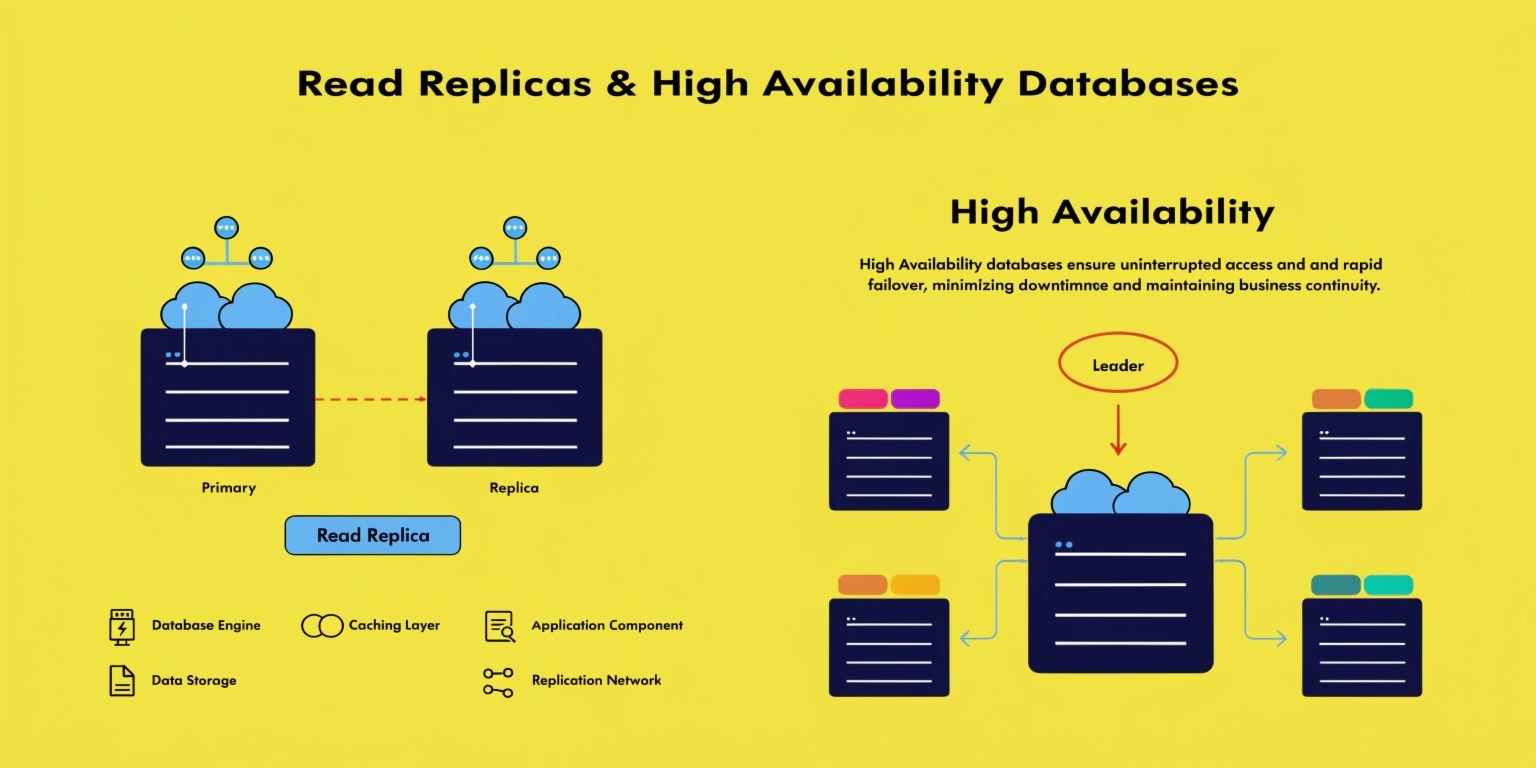
Discover how read replicas and high availability databases enhance scalability, reliability, and performance. Learn replication methods, failover strategies, clustering techniques, and best practices for building enterprise-ready database systems.
Read Replicas & High Availability Databases: Building Scalable and Resilient Data Architectures
Databases are the backbone of nearly every modern application, from e-commerce platforms and banking systems to SaaS products and gaming services. As user traffic grows, databases must process increasing numbers of read and write requests while maintaining high availability and data integrity. A single database server can quickly become a performance bottleneck or a single point of failure, leading to slow response times or costly downtime.
To overcome these challenges, organizations use read replicas and high availability (HA) database architectures. Read replicas distribute read workloads across multiple database instances, while high availability solutions ensure applications remain operational even if a primary database fails. Together, these strategies improve scalability, reliability, and fault tolerance, enabling applications to serve millions of users with minimal disruption.
This article explores how read replicas and high availability databases work, their benefits, implementation strategies, and best practices for building resilient data infrastructures.
What Are Read Replicas?
A read replica is a copy of a primary database that continuously receives updates through replication. While the primary database handles write operations such as inserts, updates, and deletes, read replicas are dedicated to serving read-only queries.
This separation allows applications to distribute database traffic more efficiently.
Common read operations include:
- Product searches
- User profile retrieval
- Dashboard analytics
- Reports
- Catalog browsing
- Historical data queries
By directing these requests to replicas, the primary database remains focused on processing write transactions.
Benefits of Read Replicas
Read replicas provide several advantages:
- Increased read throughput
- Lower latency for user queries
- Reduced load on the primary database
- Better scalability for growing applications
- Improved user experience
- Support for geographically distributed users
- Simplified reporting without affecting production workloads
These benefits are particularly valuable for applications with significantly more read operations than write operations.
Understanding High Availability (HA)
High Availability refers to designing database systems that continue operating despite hardware failures, software issues, or network outages.
A typical HA architecture includes:
- Primary database server
- Standby or secondary database
- Automatic failover mechanisms
- Health monitoring
- Load balancers
- Redundant storage
If the primary database becomes unavailable, a standby instance is promoted automatically, minimizing downtime and maintaining service continuity.
Replication Methods
Database replication can be implemented using different approaches depending on performance and consistency requirements.
Asynchronous Replication
The primary database commits transactions immediately and replicates changes to replicas afterward.
Advantages:
- High write performance
- Lower latency
Limitation:
- Brief replication delays may result in slightly stale data on replicas.
Synchronous Replication
Transactions are confirmed only after replicas acknowledge the update.
Advantages:
- Strong consistency
- Minimal data loss
Limitation:
- Increased write latency due to coordination between nodes.
Semi-Synchronous Replication
This hybrid approach requires acknowledgment from at least one replica before confirming the transaction, balancing consistency and performance.
High Availability Components
Building an HA database environment involves multiple supporting technologies.
Automatic Failover
Monitoring systems detect failures and automatically promote a healthy standby database.
Load Balancing
Database-aware load balancers distribute read requests across available replicas while directing write operations to the primary instance.
Backup and Recovery
Regular backups and tested recovery procedures protect against accidental deletion, corruption, and catastrophic failures.
Health Monitoring
Continuous monitoring detects issues such as replication lag, disk usage, CPU utilization, memory consumption, and connection failures before they impact users.
Common Use Cases
Read replicas and HA databases are widely used in:
- E-commerce platforms
- Banking and financial services
- Social media applications
- Healthcare systems
- SaaS platforms
- Gaming backends
- Business intelligence dashboards
- Enterprise resource planning (ERP) systems
Any application requiring high uptime and heavy read traffic can benefit from these architectures.
Challenges
Despite their advantages, these solutions introduce additional complexity.
Common challenges include:
- Replication lag
- Conflict resolution
- Failover testing
- Network partitioning
- Increased infrastructure costs
- Backup synchronization
- Monitoring multiple database instances
Careful planning and operational discipline are essential to manage these complexities effectively.
Best Practices
To build reliable database architectures:
- Separate read and write workloads.
- Choose replication strategies based on application requirements.
- Monitor replication lag continuously.
- Automate failover whenever possible.
- Test disaster recovery procedures regularly.
- Implement robust backup policies.
- Encrypt data both in transit and at rest.
- Use connection pooling to optimize database access.
- Scale horizontally as traffic grows.
- Continuously monitor performance metrics and system health.
Following these practices improves scalability, reliability, and operational resilience.
Cloud-Native Database Solutions
Major cloud providers simplify the deployment of highly available databases by offering managed services with built-in replication, automated backups, and failover capabilities.
Typical managed features include:
- Multi-zone deployments
- Automatic patching
- Continuous backups
- Read replica creation
- Performance monitoring
- Autoscaling options
- Disaster recovery support
Managed database platforms reduce operational overhead while improving reliability.
Future Trends
Database technologies continue to evolve alongside modern distributed systems.
Emerging trends include:
- Globally distributed databases
- Multi-primary replication
- AI-assisted database optimization
- Autonomous database management
- Serverless databases
- Cross-region replication
- Intelligent workload routing
- Hybrid transactional and analytical processing (HTAP)
These innovations enable organizations to build resilient, globally scalable applications with minimal manual intervention.
Conclusion
Read replicas and high availability databases are essential for supporting modern applications that demand speed, scalability, and uninterrupted service. By distributing read workloads, replicating critical data, and automating failover processes, organizations can reduce downtime, improve performance, and ensure a seamless user experience even during failures.
Whether deploying self-managed database clusters or leveraging managed cloud services, implementing a well-designed HA architecture is a crucial step toward building reliable, enterprise-grade software systems capable of handling today's growing data and traffic demands.
We build scalable web, mobile, and game products for clients worldwide — combining modern frameworks, cloud infrastructure, and best engineering practices.