Learn how pruning strategies reduce the size and complexity of deep neural networks while maintaining high performance. Explore modern AI optimization techniques used in scalable and efficient machine learning systems.
Deep neural networks have revolutionized artificial intelligence by enabling breakthroughs in computer vision, natural language processing, robotics, and recommendation systems. However, modern deep learning models often contain millions or even billions of parameters, making them computationally expensive and difficult to deploy on resource-constrained devices.
Large AI models require significant processing power, memory, and energy consumption. This challenge has made model optimization a critical area of research in artificial intelligence. One of the most effective optimization approaches is neural network pruning.
Pruning strategies help reduce the size and complexity of deep neural networks by removing unnecessary parameters while preserving model accuracy. These techniques improve inference speed, reduce storage requirements, and enable efficient deployment across mobile devices, edge systems, and cloud environments.
What is Neural Network Pruning?
Neural network pruning is a model compression technique that removes redundant or less important weights, neurons, or layers from a trained neural network.
The goal is to create a smaller and faster model without significantly affecting prediction accuracy.
Pruning helps address several challenges:
- High computational costs
- Large memory usage
- Slow inference speed
- Energy inefficiency
- Difficult edge deployment
Pruned models are particularly useful in real-time AI applications where speed and efficiency are essential.
Why Pruning is Important in Deep Learning
Modern AI systems often prioritize accuracy during training, resulting in over-parameterized models. Many weights contribute very little to the final predictions.
Pruning eliminates these unnecessary components to achieve:
- Faster inference
- Reduced latency
- Lower hardware requirements
- Improved scalability
- Better edge AI deployment
- Lower power consumption
Companies like NVIDIA, Google, and Meta actively research model compression techniques for production AI systems.
Types of Pruning Strategies
There are several pruning methods used in deep learning optimization.
1. Unstructured Pruning
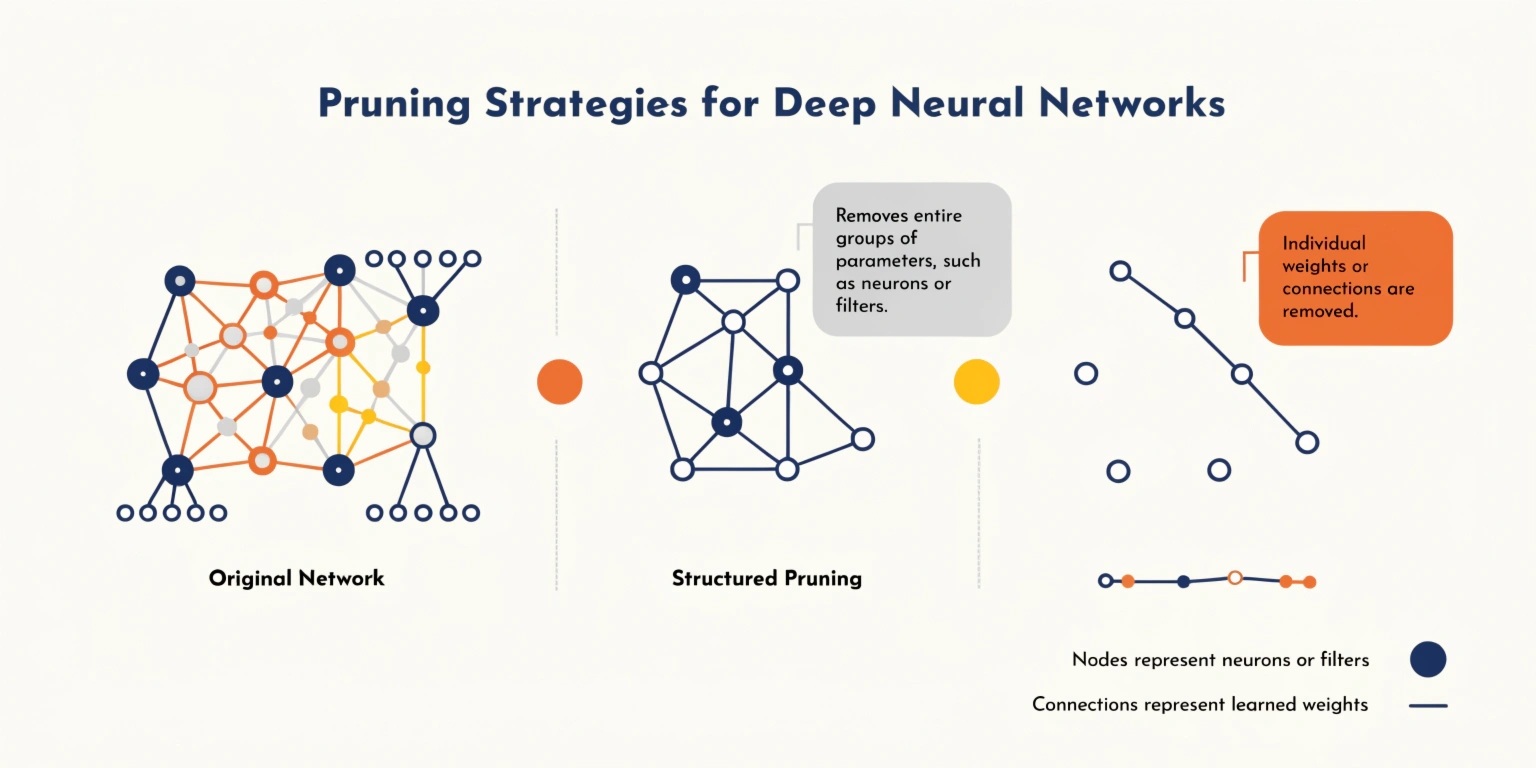
Unstructured pruning removes individual weights based on their importance.
Weights with very small values are considered less useful and are removed.
Advantages
- High compression rates
- Flexible pruning
- Preserves model architecture
Disadvantages
- Sparse matrices may require specialized hardware
- Less efficient on standard GPUs and CPUs
This method is commonly used in research environments focused on maximizing compression ratios.
2. Structured Pruning
Structured pruning removes entire neurons, filters, channels, or layers instead of individual weights.
Unlike unstructured pruning, this approach maintains hardware-friendly architectures.
Advantages
- Faster inference on real hardware
- Easier deployment
- Better compatibility with existing accelerators
Disadvantages
- Slightly lower compression flexibility
- Risk of larger accuracy drops
Structured pruning is widely used in production AI systems.
3. Magnitude-Based Pruning
Magnitude-based pruning is one of the simplest and most common techniques.
Weights with the smallest absolute values are removed because they contribute less to predictions.
Workflow
- Train the neural network
- Rank weights by magnitude
- Remove low-value weights
- Fine-tune the model
This strategy is computationally efficient and widely supported in frameworks like Google TensorFlow and Meta PyTorch.
4. Iterative Pruning
Instead of removing many parameters at once, iterative pruning gradually removes weights over multiple training cycles.
Benefits
- Better accuracy preservation
- Improved model stability
- More controlled optimization
This method is commonly used in high-performance AI systems where accuracy is critical.
5. Dynamic Pruning
Dynamic pruning removes or activates weights during runtime based on input conditions.
This adaptive strategy helps optimize real-time inference performance.
Applications
- Autonomous vehicles
- Smart cameras
- Mobile AI systems
- Real-time recommendation engines
Dynamic pruning is gaining popularity in edge AI and adaptive computing.
Pruning and Sparse Neural Networks
Pruning often creates sparse neural networks where many weights become zero.
Sparse models require specialized optimization libraries and hardware accelerators for maximum efficiency.
Sparse computing is becoming increasingly important in:
- Edge AI
- IoT systems
- Embedded AI devices
- Mobile machine learning
Companies like Qualcomm and Intel are developing hardware optimized for sparse AI workloads.
Challenges in Neural Network Pruning
Although pruning offers major advantages, it also introduces several challenges.
1. Accuracy Loss
Aggressive pruning may reduce model performance.
2. Retraining Requirements
Pruned networks often require fine-tuning after compression.
3. Hardware Compatibility
Sparse architectures may not fully utilize standard processors.
4. Optimization Complexity
Finding optimal pruning ratios can be difficult.
Researchers continue developing automated pruning algorithms to address these challenges.
Combining Pruning with Other Optimization Techniques
Pruning is often combined with additional AI optimization methods.
Quantization
Reduces numerical precision of weights.
Knowledge Distillation
Transfers knowledge from large models to smaller models.
Low-Rank Factorization
Simplifies large matrix operations.
Neural Architecture Search (NAS)
Automatically designs optimized neural networks.
These combined strategies enable highly efficient AI systems for real-world deployment.
Real-World Applications of Pruned Models
Pruned neural networks are widely used across industries.
Mobile Applications
Smaller AI models improve smartphone performance.
Autonomous Vehicles
Efficient inference reduces decision latency.
Healthcare AI
Optimized models accelerate medical imaging analysis.
Smart Surveillance
Edge devices process video streams more efficiently.
Recommendation Systems
Large-scale platforms handle millions of predictions faster.
Applications like voice assistants and real-time translation systems heavily depend on optimized deep learning models.
Future of Neural Network Pruning
The future of pruning is closely connected to efficient AI research.
Emerging trends include:
- Automated pruning with reinforcement learning
- AI-specific hardware accelerators
- Energy-efficient machine learning
- Sparse transformer models
- Adaptive neural networks
- Edge-native AI optimization
As AI systems continue growing larger, pruning will remain essential for scalable and sustainable artificial intelligence.
Conclusion
Pruning strategies play a critical role in modern deep learning optimization. By removing unnecessary parameters, pruning reduces computational complexity while maintaining strong model performance.
From structured pruning and sparse networks to dynamic optimization techniques, these strategies enable AI systems to operate efficiently across cloud platforms, mobile devices, and edge environments.
As artificial intelligence continues evolving, efficient model optimization will become even more important for scalability, energy efficiency, and real-time AI deployment. Organizations investing in neural network pruning and model compression will gain significant advantages in building faster, smarter, and more accessible AI solutions.
We build scalable web, mobile, and game products for clients worldwide — combining modern frameworks, cloud infrastructure, and best engineering practices.