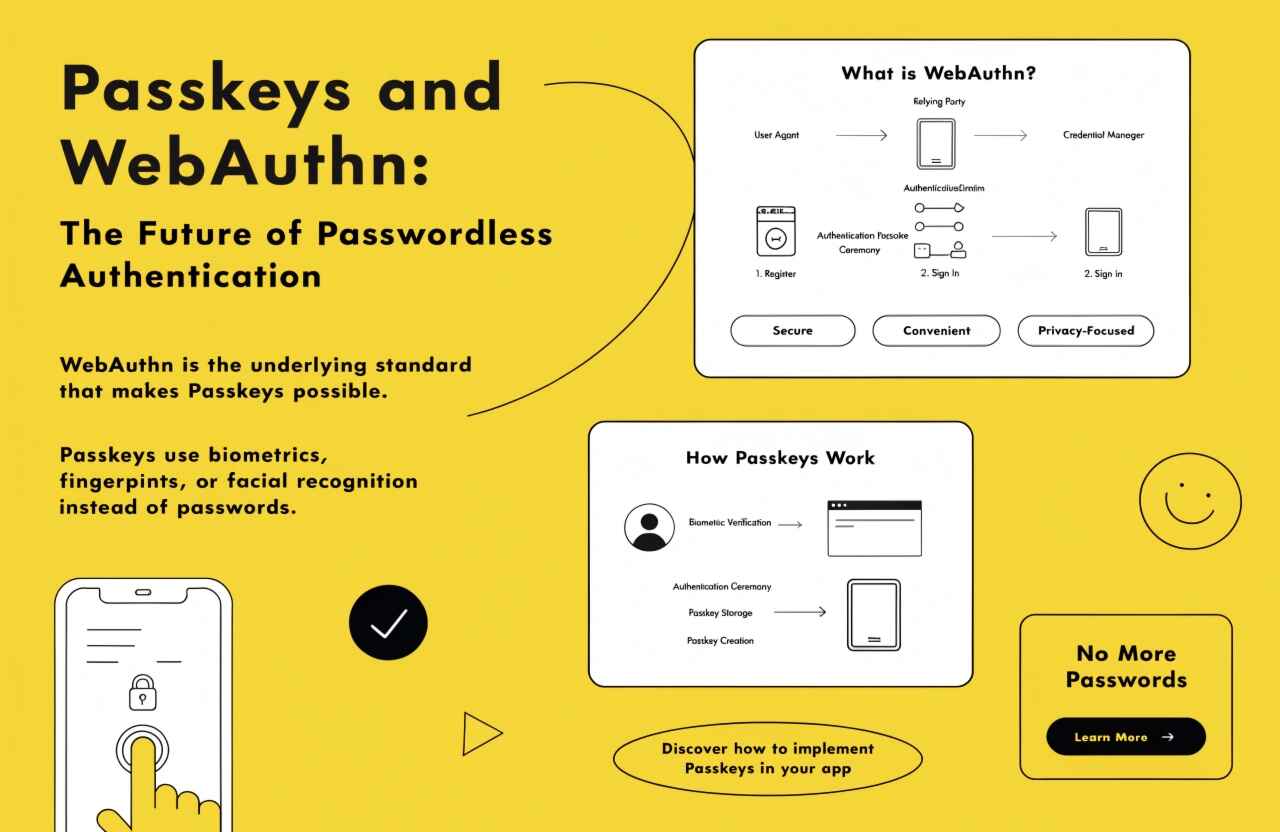
Passkeys and WebAuthn are modern authentication technologies that replace traditional passwords with cryptographic credentials, helping businesses improve account security, reduce phishing risks, and deliver faster, more convenient login experiences across websites and mobile applications.
Introduction
Online security has become a major priority as businesses increasingly depend on websites, mobile applications, cloud platforms, and digital services. Traditional passwords remain widely used, but they often create security and usability challenges. Users frequently reuse passwords, forget login credentials, or fall victim to phishing attacks that steal sensitive information.
To address these challenges, modern authentication technologies are changing how people access digital accounts. Passkeys and Web Authentication (WebAuthn) are leading this transformation by enabling secure, passwordless login experiences.
These technologies use public-key cryptography to verify users without requiring them to enter conventional passwords. By reducing reliance on shared secrets, they can help organizations strengthen account protection while making authentication faster and easier.
What Are Passkeys?
Passkeys are digital credentials that allow users to sign in to websites and applications without remembering or typing a password. Depending on the device and platform, users can authenticate with a fingerprint, facial recognition, a device PIN, or another supported screen-lock method.
Unlike traditional passwords, passkeys use a cryptographic key pair. The private key remains protected by the user's device or credential provider, while the corresponding public key is registered with the service.
During login, the service sends a cryptographic challenge. The user's authenticator signs that challenge using the private key, and the server verifies the signature using the registered public key.
Because the private key is not shared with the website, passkeys significantly reduce the risks associated with stolen passwords and credential reuse.
Passkeys may be synchronized across a user's devices through a supported credential provider or remain tied to a particular device, depending on the implementation.
What Is WebAuthn?
Web Authentication, commonly known as WebAuthn, is a web standard that enables passwordless and strong authentication through public-key cryptography. It is part of the broader FIDO2 authentication ecosystem, alongside the Client to Authenticator Protocol (CTAP).
WebAuthn defines how websites and applications interact with supported authenticators to register credentials and authenticate users. It is supported by modern browsers and operating systems, although available capabilities vary by platform.
Developers can use WebAuthn to create authentication systems that support passkeys, hardware security keys, and other compatible public-key credentials.
In a typical implementation, the server generates a challenge, the browser communicates with the authenticator, and the server verifies the resulting credential response. This process allows services to authenticate users without storing or transmitting conventional passwords during passkey login.
How Do Passkeys and WebAuthn Work Together?
Passkeys and WebAuthn serve related but different purposes. Passkeys are the credentials users use to sign in, while WebAuthn provides the browser-based protocol for registering and using supported credentials.
The process generally follows these steps:
- Registration: After verifying a user's identity, the service requests the creation of a new credential.
- Credential creation: The authenticator generates a public-private key pair and protects the private key.
- Public-key storage: The service stores the public key and associated credential information.
- Login request: When the user returns, the service generates a fresh authentication challenge.
- User verification: The user approves authentication using a supported biometric method, device PIN, or other local verification.
- Server verification: The server validates the signed challenge and relevant response parameters before granting access.
This process helps prevent attackers from using a stolen password on a fraudulent website because passkey authentication is bound to the legitimate relying party's identity.
Key Benefits of Passwordless Authentication
1. Stronger Protection Against Phishing
Passkeys are designed to resist phishing because authentication credentials are associated with the legitimate website or service. A fraudulent domain cannot simply collect a passkey as it might collect a typed password.
2. Better User Experience
Users do not need to remember complex passwords or repeatedly reset forgotten credentials. Signing in can become a simple action using a device's built-in authentication features.
3. Reduced Password-Related Risks
Organizations can reduce their dependence on password storage, password reuse prevention, and password reset workflows for accounts that use passkeys.
4. Support for Multiple Devices
Depending on the credential provider and platform, passkeys can be synchronized across supported devices. Cross-device authentication mechanisms can also allow users to authenticate with a nearby device in certain situations.
5. Improved Authentication Efficiency
Passwordless login can reduce friction during registration and sign-in. Businesses may benefit from fewer password-related support requests and a smoother customer journey.
Real-World Applications of Passkeys
Passkeys can be useful across many industries and digital services.
E-commerce platforms can simplify customer sign-ins while helping protect accounts containing personal information and order histories.
Banking and financial services can use passkeys as part of a strong authentication strategy, subject to applicable security and regulatory requirements.
Enterprise applications can integrate passkeys into employee access systems and identity management workflows.
Healthcare platforms can use passwordless authentication to improve access security for patient portals and digital services.
Mobile applications and SaaS platforms can offer convenient login experiences without requiring users to create and remember another password.
The exact benefits depend on implementation quality, recovery procedures, device support, and the sensitivity of the protected information.
Challenges and Implementation Considerations
Despite their advantages, passkeys require careful planning. Organizations must consider browser compatibility, device availability, credential synchronization, account recovery, and support for users who lose access to their devices.
Developers must implement WebAuthn correctly, including challenge validation, origin checks, relying-party identification, credential verification, and protection against replay attacks. Secure account recovery is equally important because weak recovery procedures can undermine strong authentication.
Businesses should also provide accessible alternatives for users whose devices do not support a preferred authentication method. Any fallback method must be designed carefully to avoid becoming an easier path for attackers.
A gradual rollout, clear user instructions, secure recovery options, and monitoring of authentication events can help organizations adopt passkeys successfully.
The Future of Passwordless Authentication
Passkeys are gaining importance as organizations look for authentication methods that combine strong security with convenient access. Continued improvements in browser support, credential management, and cross-device experiences are making passwordless login more practical.
In the future, passkeys may become a standard login option across consumer applications, enterprise platforms, and digital services. Organizations may also combine them with risk-based access controls, device security policies, and other identity protection measures.
However, passkeys do not eliminate every security risk. Account recovery, compromised devices, social engineering, and poorly configured applications still require attention.
Conclusion
Passkeys and WebAuthn represent a major step forward in online authentication. By replacing shared passwords with public-key cryptography, they help reduce phishing risks, simplify login experiences, and strengthen account security.
For businesses developing websites and mobile applications, adopting passwordless authentication can support a more secure and user-friendly digital environment. Successful implementation requires standards-based development, care
As digital threats continue to evolve, passkeys offer organizations a praful testing, accessible recovery options, and ongoing security monitoring.ctical path toward a safer future with fewer passwords and stronger authentication
We build scalable web, mobile, and game products for clients worldwide — combining modern frameworks, cloud infrastructure, and best engineering practices.
.jpg)