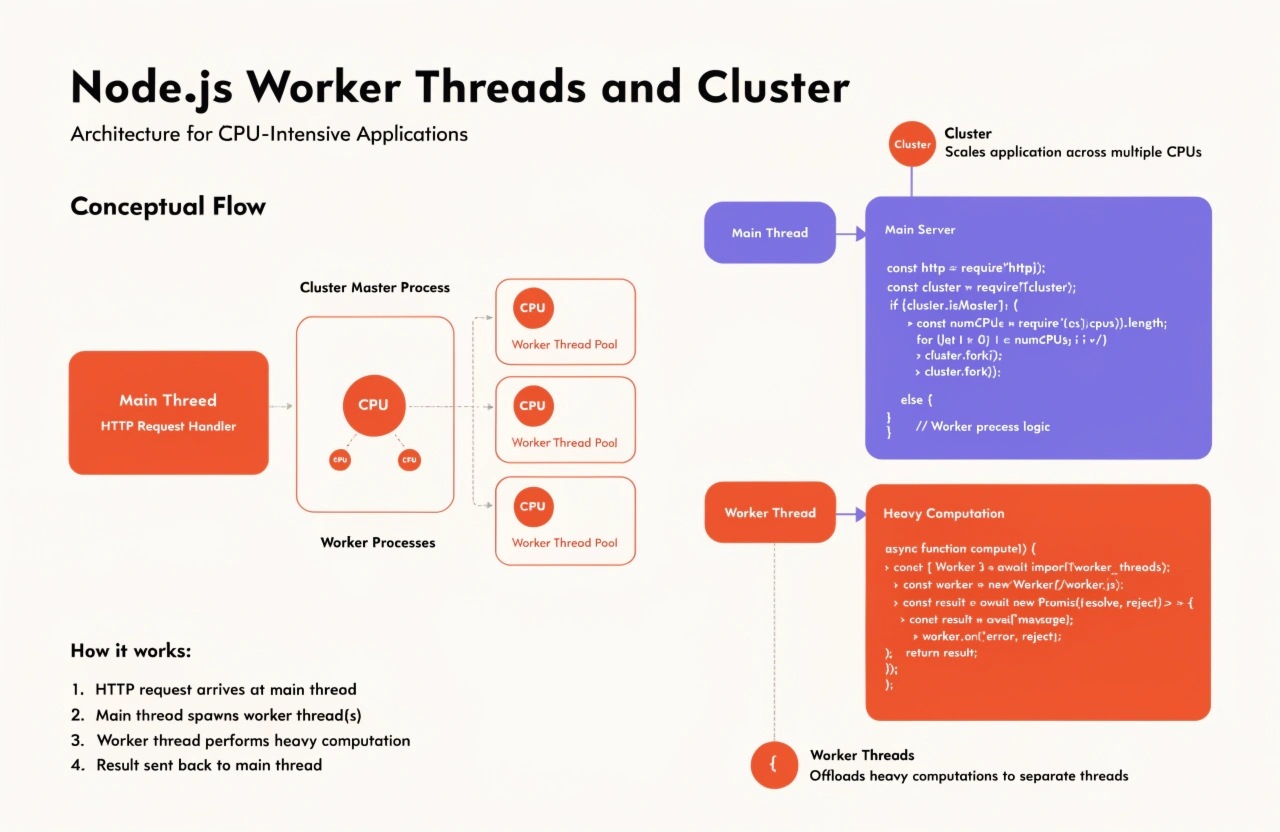
Node.js Worker Threads and Cluster Architecture provide powerful approaches for handling CPU-intensive workloads. Worker Threads enable parallel computation within a process, while Cluster distributes workloads across processes and CPU cores. Together, they can improve performance, scalability, responsiveness, and reliability in demanding Node.js applications.
Main Content
Modern applications increasingly perform CPU-intensive operations such as image processing, video conversion, encryption, data analysis, machine learning calculations, file processing, and complex mathematical computations. Although Node.js is well known for its asynchronous and event-driven architecture, CPU-heavy operations can block the event loop and negatively affect application responsiveness.
This is where Node.js Worker Threads and Cluster Architecture become valuable. Both technologies allow developers to take better advantage of multicore processors, but they solve performance challenges in different ways.
Understanding the Node.js Event Loop
Node.js uses a single main JavaScript thread to execute application code through its event loop. This model is highly efficient for I/O-intensive operations such as database queries, API requests, file operations, and network communication.
However, CPU-intensive JavaScript operations can occupy the main thread for a significant amount of time. While the CPU is busy performing the calculation, other requests may have to wait.
For example, generating a large report, compressing files, processing images, or performing complex calculations directly inside the main thread can make an API slow or unresponsive.
Worker Threads help solve this problem by moving CPU-heavy JavaScript execution away from the main event loop.
What Are Node.js Worker Threads?
Node.js Worker Threads allow developers to run JavaScript code in separate threads within the same Node.js process. Each worker has its own JavaScript execution environment, event loop, and memory space.
A common architecture is to keep the main thread responsible for handling HTTP requests while Worker Threads process expensive calculations.
For example, an application receiving an image-processing request can send the processing task to a worker. The main thread remains available to handle other incoming requests while the worker performs the CPU-intensive operation.
Worker Threads are particularly useful for:
- Image and video processing
- Encryption and hashing
- Data transformation
- Large mathematical calculations
- File processing
- AI and machine learning workloads
- PDF generation
- Compression and decompression
- Complex data analysis
Benefits of Worker Threads
The biggest advantage of Worker Threads is improved responsiveness. CPU-heavy operations can run independently without continuously blocking the primary event loop.
They can also utilize multiple CPU cores, allowing applications to perform parallel computations. Communication between the main thread and workers can be achieved through message passing, while certain data can be shared using mechanisms such as SharedArrayBuffer.
However, creating a new worker for every small task may introduce unnecessary overhead. For high-volume workloads, a worker pool is often a better architectural choice because workers can be reused.
Understanding Node.js Cluster Architecture
The Node.js Cluster module takes a different approach. Instead of creating multiple threads inside one process, Cluster allows applications to create multiple Node.js processes that can run across CPU cores.
A primary process can manage multiple worker processes. Incoming connections can then be distributed among these workers, allowing the application to handle more concurrent requests.
For example, a server with eight CPU cores can potentially run multiple Node.js processes to utilize available processing capacity more effectively.
Cluster is particularly useful for:
- Scaling HTTP servers
- Handling high numbers of concurrent requests
- Improving application availability
- Utilizing multiple CPU cores
- Providing process-level isolation
- Building highly available backend services
Worker Threads vs Cluster
The key difference is the level at which they operate.
Worker Threads are designed primarily for CPU-intensive JavaScript tasks within an application process. They are ideal when one request requires expensive computation that should not block the event loop.
Cluster is primarily useful for scaling server processes across CPU cores. Each process has its own memory space, which provides stronger isolation.
Worker Threads can share certain memory structures, while Cluster workers generally communicate through inter-process communication.
Using Both Together
For complex production systems, Worker Threads and Cluster can be combined.
Imagine an application running several Node.js server processes through Cluster. Each process handles incoming HTTP requests. When a request requires expensive computation, that process can delegate the calculation to a Worker Thread.
This creates a two-level architecture:
Client → Load Balancing → Node.js Cluster Processes → Worker Thread Pool → CPU-Intensive Processing
This approach can provide both request-level scalability and efficient CPU utilization.
However, adding more layers also increases architectural complexity. Developers should monitor CPU usage, memory consumption, worker counts, task queues, and communication overhead before implementing this architecture.
Best Practices for Production Applications
Start by identifying the actual bottleneck using profiling and monitoring tools. Do not introduce Worker Threads or Cluster simply because an application uses Node.js.
For CPU-heavy tasks, use a controlled worker pool instead of creating unlimited workers. Too many workers can cause CPU contention and increase memory usage.
With Cluster, configure the number of processes according to available CPU resources and workload characteristics. Applications should also implement graceful shutdown so workers can finish existing tasks before terminating.
Monitoring is equally important. Track CPU utilization, response time, memory usage, worker failures, queue length, and throughput.
Conclusion
Node.js Worker Threads and Cluster Architecture provide effective strategies for building high-performance applications that need to handle CPU-intensive workloads.
Worker Threads are excellent for moving expensive computations away from the main event loop, while Cluster helps distribute server workloads across multiple Node.js processes and CPU cores.
For demanding enterprise applications, combining Cluster with a carefully designed Worker Thread pool can provide an effective balance between scalability, responsiveness, and CPU utilization. The right architecture ultimately depends on the workload, resource requirements, application design, and production performance goals.
We build scalable web, mobile, and game products for clients worldwide — combining modern frameworks, cloud infrastructure, and best engineering practices.