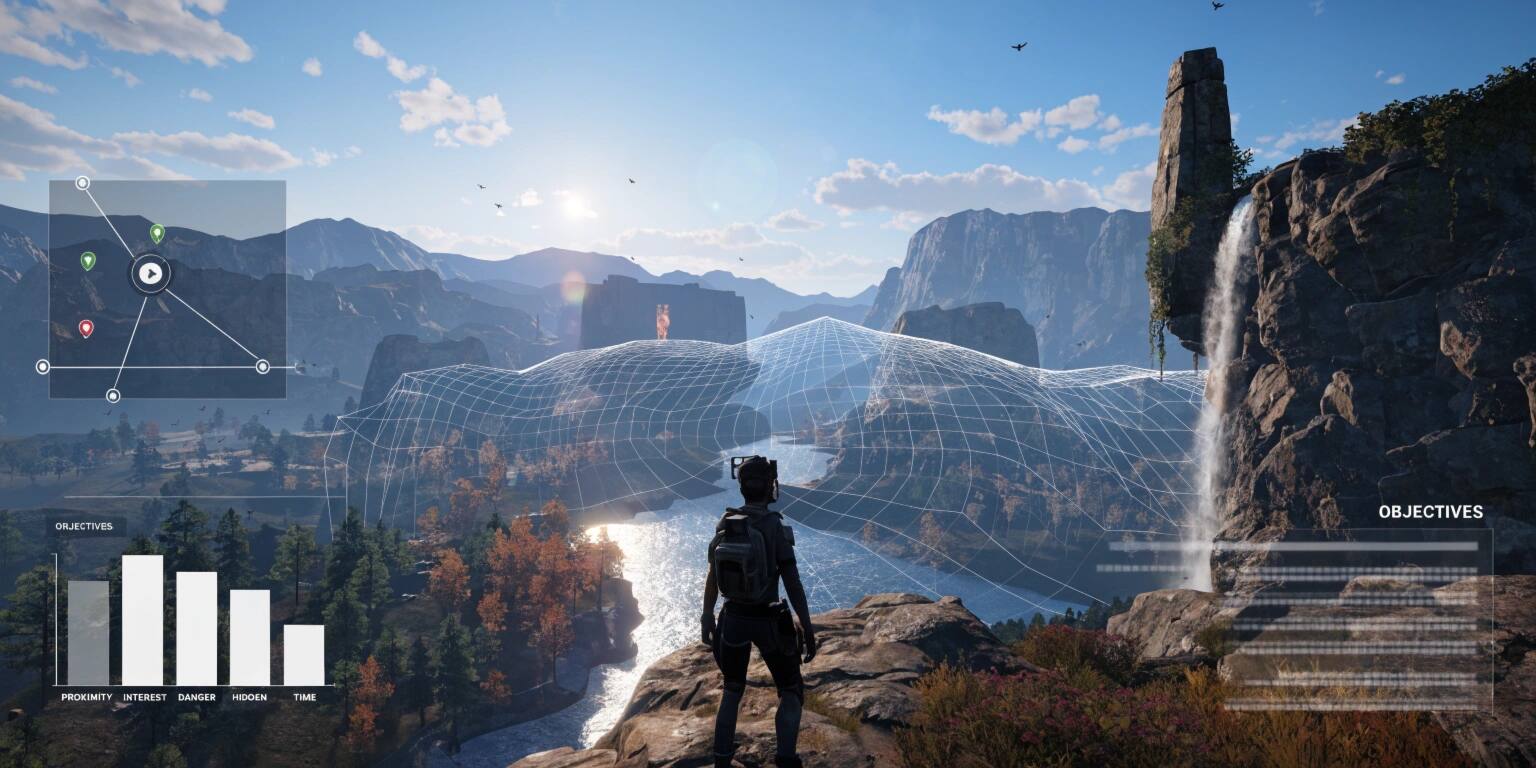
Learn how navigation systems enable intelligent movement, pathfinding, and exploration in massive open world games through AI, nav meshes, streaming, and procedural technologies.
Modern open world games have evolved into massive, highly detailed virtual environments filled with dynamic NPCs, vehicles, wildlife, quests, and real-time player interactions. Games today are no longer limited to small maps or linear gameplay. Instead, they offer enormous worlds where players can explore freely across cities, forests, deserts, oceans, and procedurally generated landscapes.
Behind these immersive experiences lies one of the most technically challenging systems in game development: navigation systems.
Navigation systems are responsible for helping characters, NPCs, vehicles, and AI entities move intelligently through complex environments. In massive open world games, navigation becomes significantly more difficult because worlds are larger, constantly changing, and filled with dynamic obstacles.
Without efficient navigation systems, AI behavior appears unrealistic, movement becomes inefficient, and gameplay immersion suffers dramatically.
What Are Navigation Systems in Games?
Navigation systems are frameworks that allow game entities to determine how to move from one location to another intelligently.
These systems handle:
- Pathfinding
- Obstacle avoidance
- Terrain traversal
- Dynamic movement
- NPC routing
- Vehicle navigation
- Crowd simulation
Navigation systems are essential for:
- Enemy AI
- Companion movement
- Civilian behaviors
- Wildlife simulation
- Autonomous vehicles
- Quest navigation systems
In open world environments, these systems must operate efficiently across massive terrains while maintaining real-time performance.
Why Massive Open Worlds Create Navigation Challenges
Large-scale game worlds introduce unique technical difficulties that smaller games do not face.
1. Scale and Complexity
Massive open worlds may contain:
- Thousands of NPCs
- Multiple cities
- Dynamic weather systems
- Interactive objects
- Vertical environments
- Procedural terrain generation
The navigation system must calculate movement efficiently without overloading CPU and memory resources.
2. Dynamic Environments
Modern games feature constantly changing worlds.
Examples include:
- Destroyed buildings
- Moving vehicles
- Dynamic obstacles
- Player-created structures
- Weather-related terrain changes
Static navigation systems struggle in environments that change continuously.
3. Real-Time Performance Requirements
Games require navigation decisions to happen instantly.
Players expect:
- Smooth NPC movement
- Realistic reactions
- Accurate enemy pursuit
- Seamless traversal
Even small delays can break immersion and negatively affect gameplay quality.
Pathfinding Algorithms in Open World Games
Pathfinding algorithms form the core of navigation systems.
A* (A-Star) Pathfinding
One of the most widely used algorithms is the A* pathfinding algorithm.
It calculates the shortest and most efficient route between two points while considering:
- Obstacles
- Terrain costs
- Traversal difficulty
A* is highly effective for:
- NPC movement
- Enemy pursuit
- Quest navigation
However, in extremely large worlds, traditional A* can become computationally expensive.
Navigation Meshes (NavMesh)
Most modern open world games rely heavily on Navigation Meshes or NavMeshes.
A NavMesh is a simplified representation of walkable areas within the game world.
Instead of calculating movement across every terrain polygon, the AI navigates through optimized navigation zones.
Benefits include:
- Faster pathfinding
- Lower computational cost
- Better scalability
- More realistic movement
Game engines like Unity Technologies and Epic Games provide built-in NavMesh systems for developers.
Hierarchical Pathfinding
In massive open worlds, developers often use hierarchical navigation systems.
The world is divided into:
- Regions
- Zones
- Local navigation clusters
Instead of calculating paths across the entire world at once, AI first determines high-level routes before calculating smaller local paths.
This significantly improves performance and scalability.
Dynamic Navigation Systems
Modern open world games increasingly rely on dynamic navigation.
Dynamic navigation systems update paths in real time based on environmental changes.
Examples include:
- Traffic rerouting
- NPC crowd avoidance
- Collapsing bridges
- Player-built obstacles
- Combat-driven movement changes
Dynamic systems create more believable and adaptive AI behavior.
Procedural Generation and Navigation
Many large-scale games now use procedural generation to create environments automatically.
Games with procedural worlds require navigation systems capable of:
- Generating navigation data dynamically
- Updating terrain traversal rules
- Adapting to newly created structures
Procedural navigation is particularly important in:
- Survival games
- Sandbox environments
- Space exploration games
- Roguelike open worlds
The navigation system must work even when the world itself changes unpredictably.
Crowd Simulation in Open Worlds
Massive open world cities often contain hundreds or thousands of NPCs moving simultaneously.
Crowd simulation systems help manage:
- Pedestrian flow
- Traffic behavior
- Group movement
- Collision avoidance
Without optimization, large crowds can severely impact game performance.
Developers use techniques such as:
- Agent prioritization
- Level-of-detail AI
- Simplified distant simulation
- Behavior prediction
to maintain smooth gameplay performance.
Streaming and Navigation Integration
Open world games often use world streaming systems that load and unload areas dynamically as players move.
Navigation systems must integrate closely with streaming systems because:
- Navigation data may not always be loaded
- AI entities may move between regions
- Distant areas require simplified simulation
Efficient streaming prevents memory overload while maintaining seamless exploration.
Games like Grand Theft Auto V and The Witcher 3: Wild Hunt demonstrate sophisticated world streaming and navigation integration techniques.
AI Behavior and Environmental Awareness
Modern navigation systems go beyond simple movement.
Advanced AI now considers:
- Environmental hazards
- Tactical positioning
- Visibility systems
- Cover mechanics
- Terrain advantages
- Weather effects
For example:
- Enemies may avoid dangerous terrain
- Wildlife may flee from predators
- NPCs may seek shelter during storms
This creates more immersive and intelligent gameplay experiences.
Machine Learning and Future Navigation Systems
Artificial intelligence and machine learning are beginning to influence navigation technologies.
Future navigation systems may use:
- Reinforcement learning
- Predictive movement models
- Adaptive AI routing
- Self-learning NPC behavior
AI-driven navigation could allow NPCs to:
- Learn from player behavior
- Adapt to changing worlds
- Develop realistic movement patterns dynamically
This represents the next evolution of open world AI systems.
Challenges Developers Still Face
Despite technological advancements, developers still face major challenges:
- CPU limitations
- Memory optimization
- Multiplayer synchronization
- Real-time recalculation complexity
- Cross-platform performance balancing
Creating believable AI movement at massive scale remains one of the hardest problems in game development.
Conclusion
Navigation systems are among the most critical technologies powering modern massive open world games. From AI pathfinding and NavMeshes to procedural generation and real-time crowd simulation, these systems enable immersive and intelligent exploration experiences.
As open worlds continue growing in size and complexity, navigation technology must evolve alongside them. Future advancements in AI, procedural systems, and machine learning will likely redefine how virtual worlds are explored and experienced.
For game developers, building scalable and adaptive navigation systems is no longer optional—it is essential for creating believable, high-performance, and truly immersive open world environments.
We build scalable web, mobile, and game products for clients worldwide — combining modern frameworks, cloud infrastructure, and best engineering practices.
.jpg)