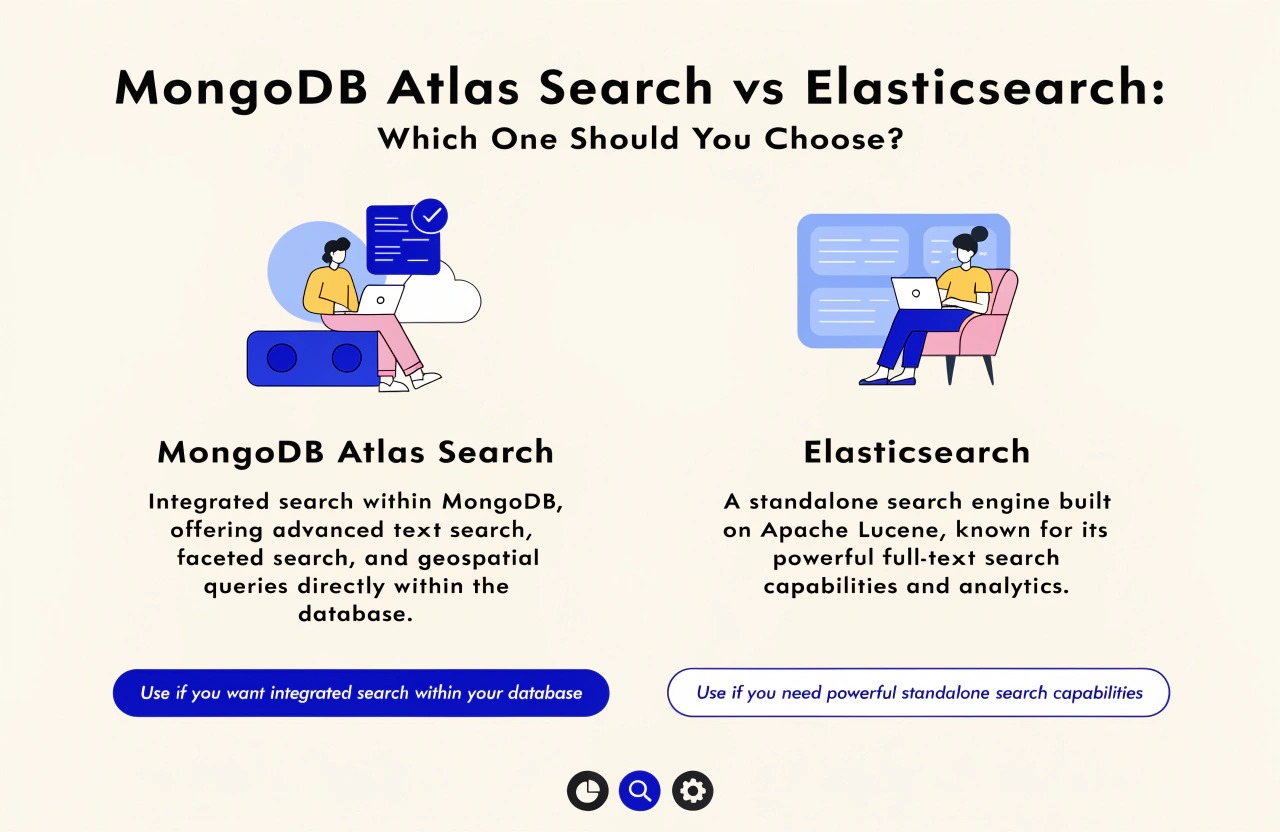
MongoDB Atlas Search vs Elasticsearch: Which One Should You Choose?
Modern applications demand powerful search capabilities. Whether you're building an eCommerce platform, SaaS product, social media application, or enterprise portal, users expect lightning-fast and accurate search results. Two of the most popular technologies for implementing full-text search are MongoDB Atlas Search and Elasticsearch.
While both solutions provide excellent search functionality, they differ significantly in architecture, deployment, performance, maintenance, and scalability. Understanding these differences can help businesses make an informed technology decision.
What is MongoDB Atlas Search?
MongoDB Atlas Search is a fully managed full-text search service built directly into MongoDB Atlas. Powered by Apache Lucene, it enables developers to perform advanced search operations without maintaining a separate search infrastructure.
Since Atlas Search is integrated with MongoDB, developers can use their existing database while adding sophisticated search capabilities with minimal configuration.
Key Features
- Native MongoDB integration
- Full-text search
- Autocomplete functionality
- Fuzzy search
- Faceted search
- Synonym support
- Highlighting
- Vector Search for AI applications
- Managed cloud service
What is Elasticsearch?
Elasticsearch is an open-source distributed search and analytics engine based on Apache Lucene. It is designed for high-speed searching, real-time analytics, and processing massive amounts of structured and unstructured data.
Elasticsearch is commonly used with the Elastic Stack, including Kibana, Logstash, and Beats, making it an excellent choice for enterprise analytics and monitoring.
Key Features
- Distributed architecture
- Advanced search capabilities
- Real-time indexing
- Aggregations
- Machine learning features
- Log analytics
- Monitoring dashboards
- Geospatial search
- Security features
Ease of Setup
MongoDB Atlas Search
Setup is extremely simple because search indexes are created directly within MongoDB Atlas. No additional servers or synchronization processes are required.
Ideal for:
- Startups
- Small teams
- SaaS products
- Rapid development
Elasticsearch
Requires a separate Elasticsearch cluster along with data synchronization between MongoDB (or another database) and Elasticsearch.
This increases operational complexity but provides greater flexibility.
Performance Comparison
MongoDB Atlas Search
Performs exceptionally well for applications where operational data already resides in MongoDB.
Advantages include:
- Lower latency
- No synchronization delay
- Simplified architecture
- Real-time search updates
Elasticsearch
Excels when handling:
- Billions of documents
- Complex analytics
- Large-scale log processing
- Enterprise reporting
- Massive search workloads
For enterprise-scale search, Elasticsearch generally offers better performance.
Scalability
Atlas Search
Automatically scales with MongoDB Atlas clusters.
Best suited for:
- Medium-sized applications
- SaaS platforms
- Growing businesses
- Cloud-native products
Elasticsearch
Designed specifically for horizontal scaling across hundreds of nodes.
Suitable for:
- Enterprise systems
- Search-heavy platforms
- Large marketplaces
- Big data applications
Search Features Comparison
Feature
MongoDB Atlas
Search Elasticsearch
Full-text Search✅✅
Autocomplete✅✅
Fuzzy Search✅✅
Synonyms✅✅
Faceted Search✅✅
Geospatial
SearchLimited
Excellen tAggregations Basic Advanced Analytics Moderate Excellent Machine Learning Basic Advanced Vector Search Excellent Excellent
AI and Vector Search
Artificial Intelligence has transformed search experiences.
MongoDB Atlas Search includes integrated Vector Search, making it easier to develop:
- AI chatbots
- Recommendation engines
- Semantic search
- Retrieval-Augmented Generation (RAG)
- LLM-powered applications
Elasticsearch also supports vector search and semantic retrieval but often requires additional configuration and tuning.
Cost Comparison
MongoDB Atlas Search
Pricing is included within MongoDB Atlas resources.
Benefits:
- Predictable billing
- Lower maintenance costs
- No additional infrastructure
- Reduced DevOps effort
Elasticsearch
Costs vary depending on:
- Cluster size
- Nodes
- Storage
- Managed Elastic Cloud subscription
- Infrastructure maintenance
While Elasticsearch may become expensive at scale, it provides enterprise-grade capabilities.
Maintenance
Atlas Search
Maintenance is minimal.
MongoDB handles:
- Updates
- Scaling
- Backups
- Monitoring
- Infrastructure
Elasticsearch
Requires ongoing administration:
- Cluster health monitoring
- Node management
- Version upgrades
- Index optimization
- Data lifecycle management
Organizations usually require dedicated DevOps resources.
Best Use Cases
Choose MongoDB Atlas Search if you need:
- Fast development
- Cloud-native applications
- Integrated database and search
- Reduced operational overhead
- AI-powered applications
- Startup-friendly infrastructure
Choose Elasticsearch if you need:
- Enterprise search
- Log analytics
- Security monitoring
- Massive search clusters
- Advanced aggregations
- Complex analytics dashboards
Final Verdict
Both MongoDB Atlas Search and Elasticsearch are powerful technologies, but the right choice depends on your project requirements.
If your application already uses MongoDB Atlas and you want a simple, fully managed search solution with modern AI capabilities, MongoDB Atlas Search is the ideal option. It minimizes infrastructure management while delivering excellent search performance.
On the other hand, if your organization requires enterprise-grade analytics, distributed search across massive datasets, extensive customization, and advanced reporting, Elasticsearch remains the industry standard.
Ultimately, startups and mid-sized businesses often benefit from the simplicity of MongoDB Atlas Search, while large enterprises handling complex search and analytics workloads may find Elasticsearch to be the better long-term investment.