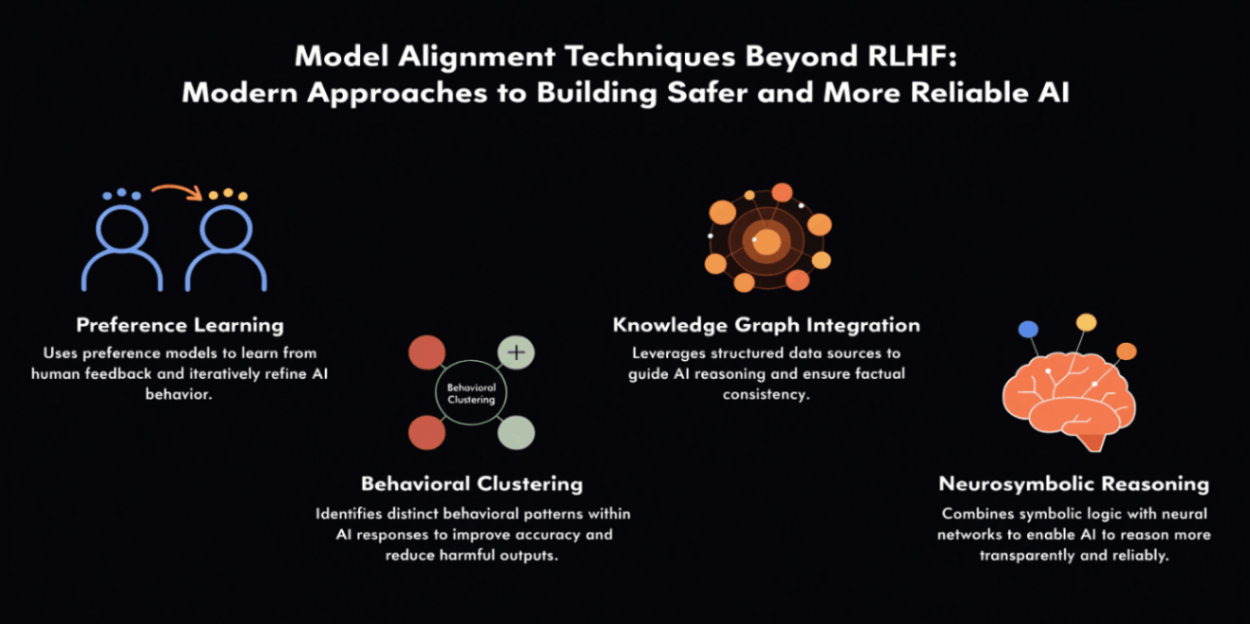
AI alignment is moving beyond traditional RLHF. Techniques such as DPO, Constitutional AI, RLAIF, process supervision, debate, and self-rewarding models offer scalable ways to improve LLM safety, reasoning, reliability, and controllability.
Large language models can generate remarkably capable responses, but capability alone does not guarantee that their behavior matches human expectations. Models may produce harmful, misleading, biased, or unreliable outputs even when they perform well on standard benchmarks. Model alignment aims to make AI systems more helpful, safe, honest, reliable, and consistent with human intentions.
Reinforcement Learning from Human Feedback (RLHF) became one of the most influential approaches for improving language-model behavior. However, traditional RLHF has important limitations. Collecting high-quality human preference data can be expensive and slow, reward models can introduce biases, and reinforcement-learning pipelines can be technically complex.
These challenges have encouraged researchers to explore alignment techniques beyond RLHF.
Direct Preference Optimization
Direct Preference Optimization (DPO) is one of the most prominent alternatives to conventional RLHF. Instead of training a separate reward model and then using reinforcement learning to optimize against that reward, DPO directly trains the language model using preference comparisons.
Given a preferred response and a rejected response, the model learns to increase the probability of the preferred output relative to the rejected one.
This simplifies the training pipeline and can make preference optimization easier to implement. Variants such as IPO, KTO, ORPO, and related preference-learning methods further explore ways to improve alignment without relying on traditional reinforcement-learning loops.
Constitutional AI
Constitutional AI introduces explicit principles or rules that guide model behavior. Rather than relying entirely on human reviewers to identify problematic responses, the model can critique and revise its own outputs according to a predefined constitution.
For example, principles may encourage the model to avoid harmful content, provide truthful information, respect user autonomy, or explain uncertainty.
This approach can reduce dependence on large amounts of direct human labeling while making alignment objectives more explicit and interpretable.
RLAIF and AI Feedback
Reinforcement Learning from AI Feedback (RLAIF) replaces or supplements human feedback with feedback generated by another AI model.
An evaluator model can compare responses according to criteria such as helpfulness, harmlessness, factuality, or instruction-following. The resulting preferences can then be used for optimization.
RLAIF offers an important scalability advantage because AI systems can generate feedback much faster than human annotators. However, it introduces a critical challenge: the evaluator itself must be reliable. Poor evaluator judgments can propagate errors into the trained model.
Process Supervision
Traditional preference training often evaluates the final answer. Process supervision instead focuses on the steps taken to reach that answer.
This is particularly useful for mathematical reasoning, programming, scientific problem-solving, and other tasks where intermediate reasoning matters.
By rewarding correct intermediate steps rather than only the final result, process supervision can encourage models to develop more reliable reasoning patterns and reduce the likelihood of arriving at correct answers through flawed processes.
Self-Rewarding Models
Another emerging direction is self-rewarding AI, where a model generates evaluations of its own outputs and uses those evaluations as training signals.
The basic idea is that increasingly capable models may be able to act as both the generator and evaluator. This could significantly reduce the need for external annotation.
However, self-evaluation creates a potential feedback loop. If a model consistently rewards undesirable behavior, iterative training could reinforce those weaknesses. Strong evaluation methods and independent validation therefore remain essential.
Debate and Adversarial Alignment
AI debate involves multiple models or agents arguing for competing answers while another evaluator determines which argument is more convincing.
The goal is to make complex reasoning easier to inspect and evaluate. An adversarial model can also challenge another model's claims, identify weaknesses, and expose hidden assumptions.
Related approaches include red teaming, adversarial testing, critique-and-revision systems, and automated safety evaluations.
Why Alignment Needs Multiple Techniques
No single alignment technique solves every problem.
Preference optimization can improve instruction-following, but it does not automatically guarantee factual accuracy. Constitutional methods provide explicit behavioral principles, but principles themselves may be incomplete. AI feedback improves scalability, but evaluator models can inherit biases. Process supervision improves reasoning reliability, but it may be difficult to apply to every domain.
Modern alignment therefore increasingly resembles a layered system.
A production AI application may combine supervised fine-tuning, preference optimization, safety classifiers, process-level evaluation, red teaming, retrieval validation, human review, and continuous monitoring.
The Future of Model Alignment
The future of alignment is likely to involve increasingly automated yet carefully supervised feedback systems. Researchers are exploring scalable oversight, mechanistic interpretability, uncertainty estimation, adversarial evaluation, agent-based debate, and improved preference-learning algorithms.
The most important shift is moving from alignment as a single training stage toward alignment as an ongoing engineering discipline.
Models must be evaluated before deployment, monitored during production, and continuously tested against new failure modes. Alignment should also account for the application context because the risks of a medical assistant, coding agent, educational chatbot, and autonomous system can be very different.
Conclusion
RLHF remains an important milestone in AI alignment, but it is no longer the only path available. DPO, Constitutional AI, RLAIF, process supervision, self-rewarding models, debate, and adversarial evaluation provide complementary approaches for improving model behavior.
The strongest AI systems will likely combine several of these techniques rather than depending on a single alignment method. As language models become more capable and increasingly integrated into real-world applications, scalable, measurable, and continuously evaluated alignment will become essential for building trustworthy AI.
We build scalable web, mobile, and game products for clients worldwide — combining modern frameworks, cloud infrastructure, and best engineering practices.