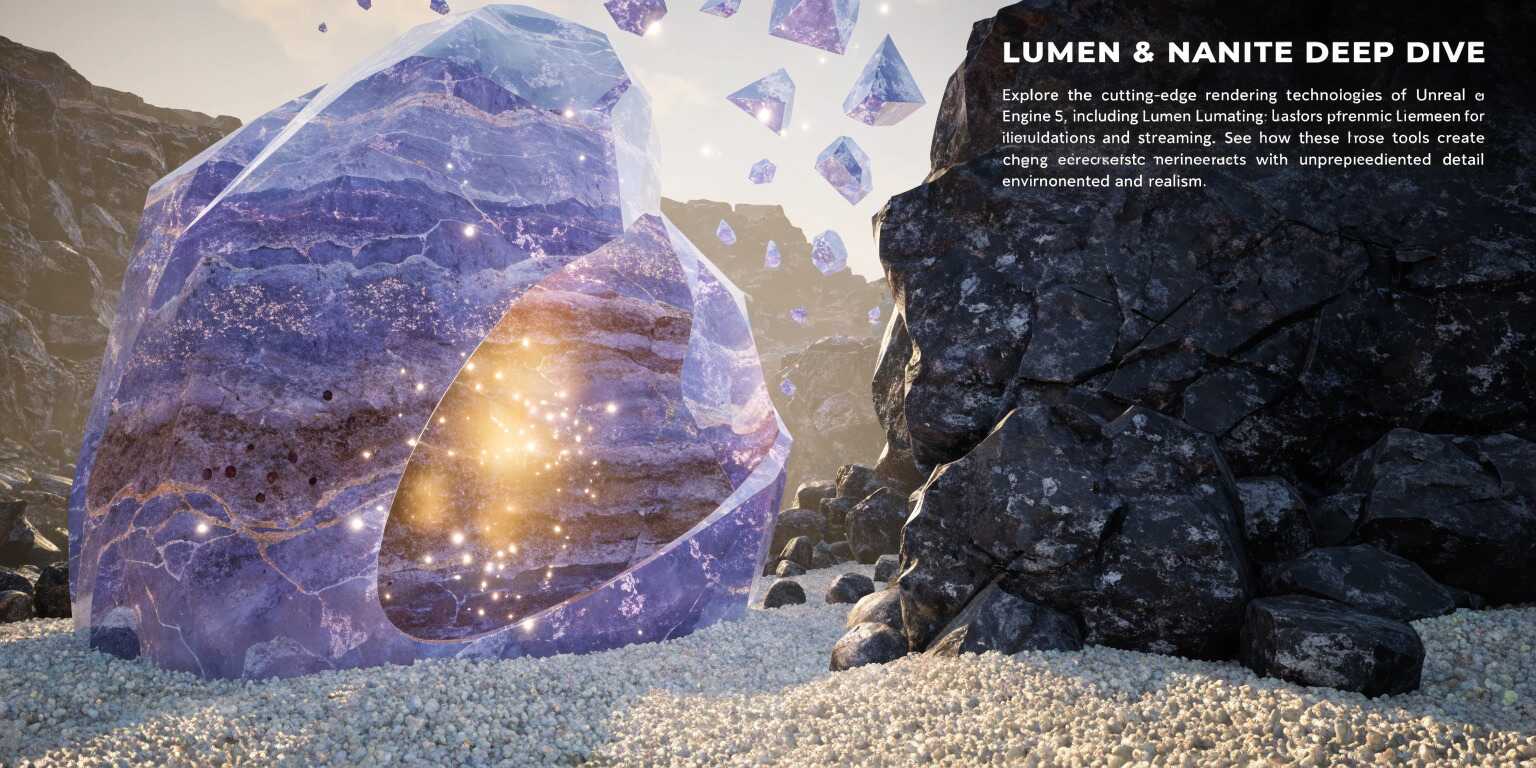
Lumen and Nanite are two of Unreal Engine 5’s most important rendering technologies. Lumen delivers dynamic global illumination and reflections, while Nanite enables highly detailed virtualized geometry, helping developers create expansive, photorealistic environments with less traditional asset optimization.
Unreal Engine 5 introduced a major shift in real-time rendering with technologies designed to reduce traditional limitations in game development. Two of its most important systems are Lumen and Nanite.
Lumen focuses primarily on dynamic global illumination and reflections, while Nanite provides a virtualized geometry system capable of rendering extremely detailed meshes efficiently.
Together, these technologies allow developers to build environments with significantly higher visual complexity while reducing some of the manual optimization traditionally required in game production.
What Is Nanite?
Nanite is Unreal Engine 5's virtualized geometry system. It is designed to render extremely detailed geometric assets while automatically managing the level of detail required for different parts of the scene.
Traditional game development often requires artists to create multiple versions of a model, known as LODs, to maintain performance at different viewing distances.
Nanite changes this workflow by allowing developers to use highly detailed meshes and letting the engine determine how much geometric detail needs to be rendered.
This can be particularly useful for environments containing rocks, buildings, statues, architectural assets, and other objects with complex geometry.
How Nanite Virtualized Geometry Works
Nanite breaks geometry into small clusters and manages which clusters need to be processed based on factors such as camera position and visibility.
Instead of treating an entire high-resolution model as a single object, the system can stream and render the geometric detail that is actually required.
This approach helps reduce unnecessary work when extremely detailed geometry is present outside the camera view or appears very small on screen.
For developers, the result can be a more streamlined asset workflow.
Benefits of Nanite
One of Nanite's biggest advantages is geometric detail.
Artists can work with high-resolution assets without manually creating as many traditional LOD variants.
Nanite can also improve environment-building workflows by making highly detailed scanned assets and complex meshes more practical for real-time projects.
This is especially useful for games that aim for cinematic or photorealistic visuals.
However, Nanite is not a universal replacement for optimization. Developers still need to consider materials, textures, lighting, animation, memory usage, and platform limitations.
What Is Lumen?
Lumen is Unreal Engine 5's dynamic global illumination and reflection system.
Traditional baked lighting requires developers to precompute lighting information. While baked lighting can be efficient during gameplay, changing environments or dynamic objects can make the workflow more complicated.
Lumen provides a dynamic approach that allows lighting and indirect illumination to respond to changes in the scene.
For example, when a light source changes position or a door opens and alters the lighting environment, Lumen can update the resulting illumination dynamically.
Understanding Global Illumination
Global illumination refers to how light interacts with surfaces beyond direct illumination from a light source.
Imagine sunlight entering a room through a window. The light does not simply stop when it hits the floor. It can bounce from the floor onto walls and other surfaces.
These indirect lighting interactions contribute significantly to realistic rendering.
Lumen attempts to reproduce these effects dynamically, allowing environments to respond more naturally to changes in lighting.
Lumen Reflections
Lumen also provides a reflection system that works alongside its global illumination capabilities.
Reflections are particularly important for surfaces such as polished floors, glass-like materials, water, and metallic objects.
Instead of relying entirely on traditional reflection techniques, Lumen provides a more unified approach to dynamic lighting and reflections.
The quality and performance of reflections can vary depending on project settings and hardware capabilities.
Lumen and Nanite Working Together
The real power of UE5's rendering approach becomes more apparent when Lumen and Nanite are used together.
Nanite handles extremely detailed geometry, while Lumen manages dynamic lighting and reflections.
Consider a detailed ancient temple environment. Nanite can efficiently represent complex architectural geometry, statues, rocks, and environmental assets.
Lumen can then provide dynamic lighting as the sun moves across the environment or as gameplay changes the available light sources.
This combination can produce highly detailed and visually responsive scenes.
Performance Considerations
Although Lumen and Nanite simplify certain workflows, they do not eliminate performance considerations.
Developers should profile scenes regularly using Unreal Engine's profiling and rendering tools.
Performance can be affected by:
- Scene complexity
- Number of visible objects
- Material complexity
- Screen resolution
- Lighting configuration
- Reflection settings
- Shadow quality
- GPU capabilities
- CPU workload
- Memory bandwidth
A visually impressive scene can still become expensive if multiple rendering systems are pushed beyond the target hardware's capabilities.
Optimizing Nanite Projects
Developers should still optimize assets even when using Nanite.
Remove unnecessary geometry, avoid excessive material complexity, and use appropriate texture resolutions.
Nanite is primarily a geometry optimization and virtualization technology. It does not automatically optimize every part of an asset.
Textures, materials, skeletal animation, transparency, and visual effects can still become performance bottlenecks.
Optimizing Lumen
Lumen settings should be selected based on the target platform.
Developers can adjust quality settings and scalability options to balance visual quality and frame rate.
It is also important to understand that dynamic lighting can become expensive in complex scenes.
Profiling should be used to determine whether lighting, reflections, shadows, materials, or another subsystem is responsible for performance issues.
When Should Developers Use Lumen and Nanite?
Lumen and Nanite are particularly attractive for projects targeting modern hardware and high-fidelity visuals.
They can be useful for:
- AAA-style games
- Open-world games
- Cinematic experiences
- Architectural visualization
- Virtual production
- Realistic simulation
- High-end PC and console projects
For lower-end or highly constrained platforms, developers may need different rendering strategies or carefully tuned scalability settings.
The Future of Real-Time Rendering
Lumen and Nanite represent a broader movement toward reducing the gap between offline-quality assets and real-time rendering.
As hardware becomes more capable, game engines can increasingly automate processes that previously required extensive manual optimization.
The long-term impact is not simply better graphics. These systems can also change how artists, technical artists, and programmers collaborate during production.
Artists can focus more heavily on creating detailed assets, while the engine handles more of the complexity involved in displaying those assets efficiently.
Conclusion
Lumen and Nanite have fundamentally changed how developers can approach high-fidelity rendering in Unreal Engine 5.
Nanite enables virtualized high-detail geometry, while Lumen provides dynamic global illumination and reflections. Together, they make it possible to create highly detailed and visually responsive environments with workflows that can be significantly more streamlined than traditional approaches.
However, developers should not treat these technologies as automatic solutions to every performance problem. Profiling, scalability configuration, material optimization, texture management, and platform-specific testing remain essential.
When used strategically, Lumen and Nanite provide a powerful foundation for creating immersive, photorealistic, and technically ambitious real-time experiences.
We build scalable web, mobile, and game products for clients worldwide — combining modern frameworks, cloud infrastructure, and best engineering practices.
.jpg)