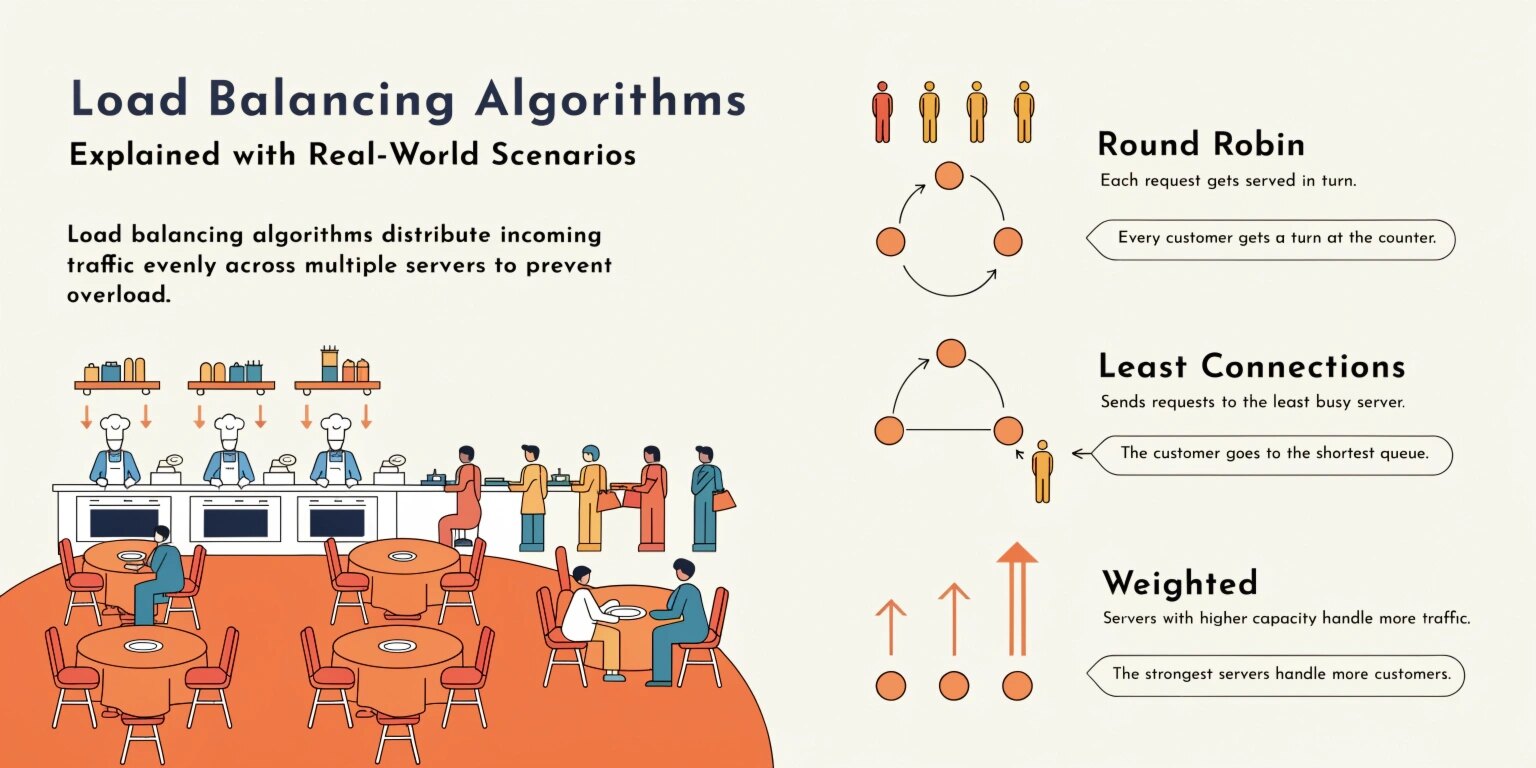
Load balancing ensures applications remain fast, reliable, and scalable by distributing incoming requests efficiently. Discover the most common load balancing algorithms, their advantages, use cases, and real-world implementation scenarios.
As web applications continue to grow in scale and complexity, handling thousands or even millions of user requests simultaneously has become a critical challenge. Relying on a single server is no longer sufficient for modern applications because it creates performance bottlenecks and single points of failure. This is where load balancing becomes essential.
A load balancer distributes incoming network traffic across multiple servers, ensuring that no single server becomes overwhelmed. Beyond improving performance, load balancing enhances application availability, fault tolerance, and scalability. However, the effectiveness of a load balancer depends largely on the algorithm it uses to distribute requests.
This article explores the most widely used load balancing algorithms, explains how they work, and illustrates their practical applications through real-world scenarios.
What Is Load Balancing?
Load balancing is the process of distributing incoming client requests across multiple servers or computing resources.
Its primary objectives are to:
- Improve application performance
- Prevent server overload
- Increase fault tolerance
- Enhance availability
- Optimize resource utilization
- Support horizontal scaling
Load balancers can operate at different layers of the network stack and are commonly used in cloud environments, Kubernetes clusters, enterprise applications, and large-scale web platforms.
Why Load Balancing Matters
Without load balancing, a surge in traffic can overwhelm a single server, leading to:
- Slow response times
- Application crashes
- Service downtime
- Poor user experience
- Revenue loss
By intelligently distributing requests, load balancing ensures consistent performance even during periods of heavy traffic.
Round Robin Algorithm
Round Robin is one of the simplest and most commonly used load balancing algorithms.
How It Works
Incoming requests are distributed sequentially among available servers.
For example:
- Request 1 → Server A
- Request 2 → Server B
- Request 3 → Server C
- Request 4 → Server A
The cycle repeats continuously.
Real-World Scenario
A company hosts a marketing website on three identical web servers.
Since all servers have similar hardware and process requests at roughly the same speed, Round Robin provides an easy and effective distribution strategy.
Advantages
- Simple to implement
- Even request distribution
- Low computational overhead
Limitations
- Assumes all servers have equal capacity
- Ignores current server workload
Weighted Round Robin
In many environments, servers have different hardware capabilities.
Weighted Round Robin assigns each server a weight based on its capacity.
Example
Suppose three servers have the following weights:
- Server A: Weight 5
- Server B: Weight 3
- Server C: Weight 2
Server A receives more requests because it has greater processing power.
Real-World Scenario
An e-commerce platform uses newer high-performance servers alongside older legacy machines. Weighted Round Robin maximizes the use of stronger servers while preventing less powerful systems from becoming overloaded.
Least Connections Algorithm
Rather than distributing requests equally, Least Connections sends new traffic to the server with the fewest active client connections.
Real-World Scenario
A video conferencing application maintains long-lived user sessions. Some servers may already handle many active meetings, while others remain relatively idle. Least Connections directs new users to the least busy server, improving overall performance.
Advantages
- Excellent for long-running sessions
- Better workload distribution
- Improved resource utilization
Limitations
- Requires continuous monitoring of active connections
- Slightly higher computational overhead
Least Response Time Algorithm
This algorithm selects the server with the lowest response time and the fewest active connections.
Real-World Scenario
A financial trading platform requires extremely low latency. Even if servers have similar workloads, network congestion or hardware differences may affect response times. Selecting the fastest server helps maintain a responsive user experience.
Advantages
- Optimizes user experience
- Adapts to changing server performance
- Suitable for latency-sensitive applications
IP Hash Algorithm
IP Hash uses the client's IP address to determine which server should handle the request.
The same client is consistently directed to the same backend server.
Real-World Scenario
An online shopping platform stores user sessions locally on application servers instead of using centralized session storage. IP Hash ensures returning users are routed to the same server, preserving session continuity.
Advantages
- Session persistence
- Predictable routing
- Reduced session management complexity
Limitations
- Uneven traffic distribution if client IPs are not evenly distributed
- Less effective in environments with many users behind shared IP addresses
Random Algorithm
As the name suggests, requests are assigned randomly.
Although simple, randomness often produces reasonably balanced distributions over time.
Real-World Scenario
A lightweight internal application with low traffic may use random load balancing because implementation simplicity outweighs optimization requirements.
Resource-Based Load Balancing
Advanced cloud platforms monitor real-time resource usage such as:
- CPU utilization
- Memory consumption
- Network bandwidth
- Disk activity
Requests are directed toward servers with the most available resources.
Real-World Scenario
A machine learning inference platform processes AI requests with varying computational demands. Resource-based balancing prevents GPU-intensive workloads from overwhelming individual nodes.
Adaptive Load Balancing
Adaptive algorithms continuously monitor application health and dynamically adjust traffic distribution based on real-time conditions.
These systems consider:
- Server health
- Historical performance
- Response latency
- Error rates
- Resource availability
Adaptive load balancing is increasingly common in cloud-native architectures.
Load Balancing in Kubernetes
Kubernetes automatically distributes traffic among healthy pods using Services and Ingress controllers.
Popular technologies include:
- NGINX Ingress Controller
- HAProxy
- Traefik
- Envoy Proxy
Combined with auto-scaling, Kubernetes provides highly resilient application deployment.
Choosing the Right Algorithm
The best algorithm depends on application requirements.
- Round Robin: Best for identical servers with short requests.
- Weighted Round Robin: Suitable for mixed hardware environments.
- Least Connections: Ideal for applications with long-lived sessions.
- Least Response Time: Perfect for latency-sensitive services.
- IP Hash: Useful when session persistence is required.
- Resource-Based: Recommended for dynamic cloud workloads.
- Adaptive: Best for enterprise-scale distributed systems.
Understanding workload characteristics is essential before selecting a strategy.
Best Practices
To maximize load balancing effectiveness:
- Monitor server health continuously.
- Enable automatic failover.
- Use health checks to remove unhealthy servers.
- Combine load balancing with auto-scaling.
- Optimize application caching.
- Deploy across multiple availability zones.
- Regularly analyze traffic patterns and performance metrics.
These practices improve resilience, scalability, and user satisfaction.
Future Trends
Load balancing continues to evolve alongside cloud computing and AI.
Emerging trends include:
- AI-driven traffic routing
- Predictive load balancing
- Edge load balancing
- Global server load balancing (GSLB)
- Service mesh traffic management
- Multi-cloud traffic optimization
- Energy-aware workload distribution
These innovations enable applications to adapt automatically to changing traffic conditions while optimizing performance and resource efficiency.
Conclusion
Load balancing is a fundamental component of modern web infrastructure, ensuring applications remain fast, reliable, and highly available under varying traffic conditions. From simple Round Robin distribution to intelligent adaptive algorithms powered by real-time analytics, each approach serves a specific purpose based on workload characteristics.
By understanding the strengths and limitations of different load balancing algorithms, developers and architects can design scalable systems that deliver consistent user experiences, reduce downtime, and efficiently utilize infrastructure resources. As cloud-native technologies continue to advance, intelligent load balancing will remain a cornerstone of resilient and high-performing applications.
We build scalable web, mobile, and game products for clients worldwide — combining modern frameworks, cloud infrastructure, and best engineering practices.