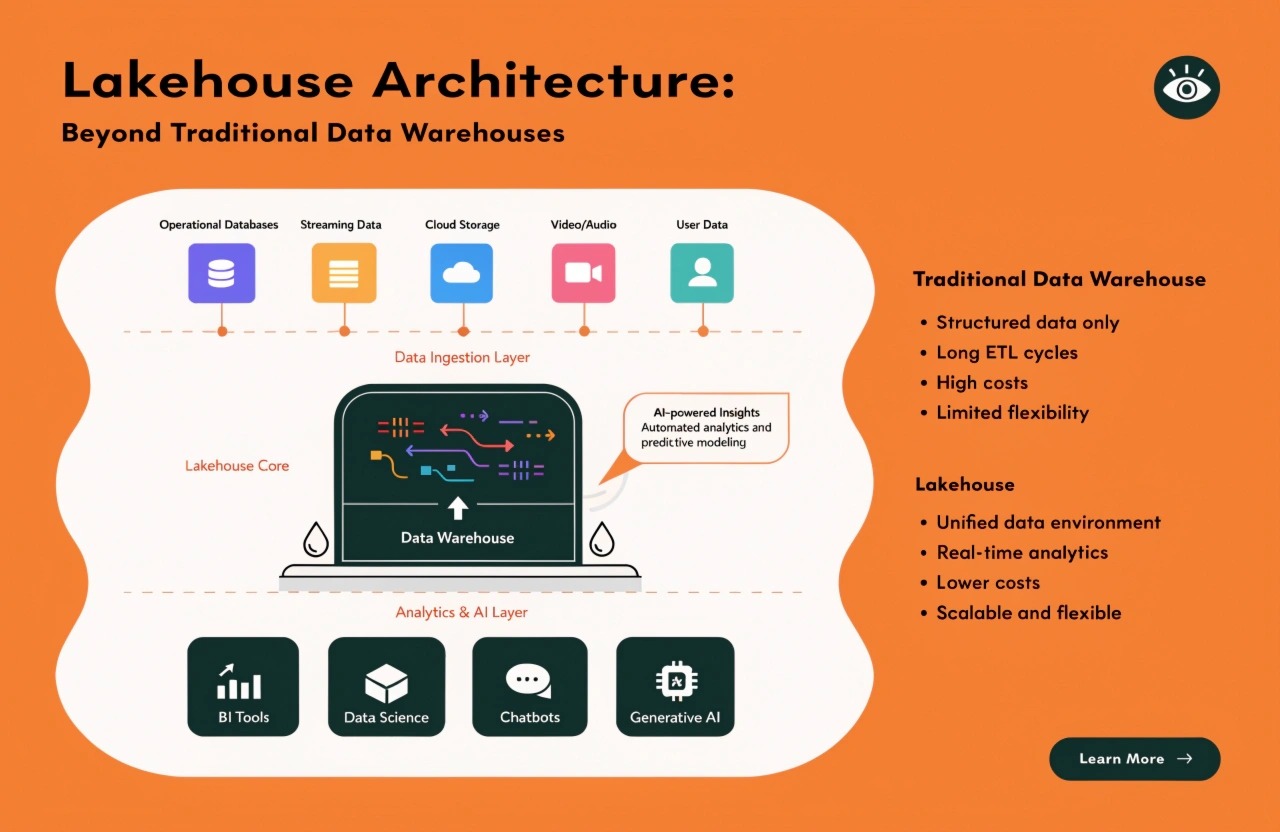
Lakehouse architecture combines the scalability of data lakes with the reliability of data warehouses, enabling organizations to manage diverse data, perform advanced analytics, and support AI and machine learning through a unified data platform.
Introduction
In today's digital world, data has become one of the most valuable assets for businesses. Organizations generate enormous amounts of information through websites, mobile applications, customer interactions, business transactions, IoT devices, and digital platforms. Managing this information efficiently is essential for making informed decisions, improving customer experiences, and maintaining a competitive advantage.
Traditional data warehouses have long helped businesses organize structured data and generate reports. However, the growing demand for advanced analytics, artificial intelligence (AI), and machine learning (ML) has exposed certain limitations in conventional data management systems.
This is where lakehouse architecture comes into the picture. It combines the flexibility and scalability of data lakes with the data management capabilities and reliability associated with data warehouses. This modern approach helps businesses create a unified foundation for analytics, reporting, and AI-driven applications.
What Is Lakehouse Architecture?
Lakehouse architecture is a modern data management approach that brings together the capabilities of data lakes and data warehouses within a unified platform.
A data lake stores large volumes of raw information in various formats, including structured, semi-structured, and unstructured data. A data warehouse, on the other hand, organizes data for reliable querying, business intelligence, and reporting.
A lakehouse combines these strengths while introducing features such as transactional consistency, schema enforcement, data versioning, and efficient query processing.
For example, an e-commerce business can store customer activity logs, product images, purchase records, and website analytics in a lakehouse. Different teams can use the same underlying data for sales reports, customer behavior analysis, demand forecasting, and machine learning models.
Instead of maintaining completely separate environments for storage and analytics, organizations can reduce unnecessary data movement and simplify their data infrastructure.
Traditional Data Warehouses vs. Data Lakes vs. Lakehouses
Understanding the differences between these architectures helps businesses choose the right solution for their requirements.
Traditional data warehouses: These systems are designed primarily for structured data, SQL queries, reporting, and business intelligence. They offer strong data consistency and organized analytical workflows but may require additional systems for unstructured data and certain advanced analytics workloads.
Data lakes: Data lakes provide flexible, scalable storage for structured, semi-structured, and unstructured information. They are suitable for big data processing, data science, and machine learning. However, without appropriate management and governance, data lakes can become difficult to maintain and trust.
Lakehouse architecture: A lakehouse combines flexible storage with warehouse-like management features. It supports diverse data types, analytical queries, and AI workloads within a more unified environment.
The most suitable approach depends on factors such as data volume, performance requirements, governance needs, existing infrastructure, and budget.
Key Components of Lakehouse Architecture
A lakehouse typically consists of several interconnected components.
1. Data Storage Layer
The storage layer holds raw and processed data in scalable storage systems, often using cloud object storage or distributed storage infrastructure. Open file formats such as Parquet are commonly used to support efficient analytical processing.
2. Metadata and Transaction Layer
A table format or transaction layer manages information about tables, schemas, and data changes. Technologies such as Delta Lake and Apache Iceberg can provide capabilities including ACID transactions, schema evolution, and time travel, depending on the implementation.
These features help maintain data consistency and support reliable analytical workflows.
3. Data Processing and Integration
Data enters the platform through batch processing, streaming pipelines, APIs, databases, and other sources. Data engineering tools transform and organize information so that it can be used for reporting, analytics, and operational applications.
4. Analytics and Query Engine
SQL engines and distributed processing frameworks allow analysts and applications to query large datasets. Organizations can use this layer for business intelligence, dashboard development, and complex analytical tasks.
5. Governance and Security
Governance capabilities help organizations manage access permissions, data lineage, quality, auditing, and compliance. These controls are essential when multiple teams and applications share the same data platform.
Benefits of Lakehouse Architecture
Lakehouse architecture offers several advantages for modern organizations.
Unified data management: Businesses can manage diverse datasets through a common architecture, reducing the need to maintain separate copies across disconnected systems.
Scalability and flexibility: Cloud-based implementations can scale storage and processing resources according to workload requirements, helping organizations accommodate growing data volumes.
Support for AI and machine learning: Data scientists can access historical records, raw datasets, and prepared analytical tables to develop, train, and evaluate machine learning models.
Improved data reliability: Transaction management, schema controls, and data validation can improve consistency and reduce errors in analytical workflows.
Cost optimization: Using scalable storage and reducing unnecessary duplication may lower infrastructure and maintenance costs. Actual savings depend on query patterns, processing requirements, and platform pricing.
Faster decision-making: Bringing reporting, analytics, and data science closer together can reduce delays caused by moving information between different systems.
Real-World Applications of Lakehouse Architecture
Lakehouse architecture can support a wide range of industries and business functions.
In e-commerce, organizations can combine purchase histories, product information, website activity, and inventory data to understand customer preferences and forecast demand.
In healthcare, properly governed data platforms can support research, operational reporting, and analytical studies while requiring strict privacy and regulatory controls.
In finance, lakehouses can help consolidate transaction records and support risk analysis, fraud detection, and regulatory reporting.
In software and IT services, companies can analyze application logs, customer usage, system performance, and support records to improve product reliability and customer experiences.
In manufacturing, combining sensor data, maintenance records, and production information can support predictive maintenance and operational optimization.
These examples demonstrate how lakehouses can help businesses transform large amounts of data into useful insights.
Challenges and Implementation Considerations
Although lakehouse architecture offers significant benefits, implementing it requires careful planning.
Organizations must select suitable storage formats, processing engines, table formats, and governance tools. Poorly designed pipelines can lead to inconsistent datasets, duplicated information, and unreliable reports.
Performance optimization is another important consideration. Large analytical queries may require partitioning strategies, file optimization, caching, and workload management.
Security must also be built into the architecture. Businesses should establish access controls, encryption, auditing, retention policies, and appropriate data privacy practices.
Additionally, teams need the right technical skills to manage data engineering, cloud infrastructure, analytics, and governance.
A practical implementation strategy begins with a clearly defined business problem, a small pilot project, measurable performance goals, and gradual expansion as the platform demonstrates value.
The Future of Lakehouse Architecture
The future of lakehouse architecture is closely connected to the growth of AI, real-time analytics, cloud computing, and open data technologies.
As organizations adopt generative AI and retrieval-augmented generation (RAG), reliable access to governed enterprise data becomes increasingly important. Lakehouse platforms can provide a foundation for preparing datasets, managing analytical information, and connecting data workflows with AI applications.
Open table formats and interoperability are also helping organizations reduce dependence on individual technologies. However, compatibility and capabilities vary across platforms, so businesses should evaluate their requirements before making architectural decisions.
Rather than replacing every traditional data warehouse, lakehouse architecture offers another option for organizations seeking to modernize their data environments. Some businesses may benefit from a lakehouse, while others may continue using a warehouse or adopt a hybrid approach.
Conclusion
Lakehouse architecture represents an important evolution in modern data management. By combining flexible storage with reliable data management and analytical capabilities, it helps organizations support business intelligence, data science, and AI-driven innovation through a more unified approach.
For businesses planning their digital transformation, the key is to evaluate existing systems, identify data challenges, and choose an architecture that aligns with their long-term objectives. With appropriate governance, performance optimization, and implementation planning, a lakehouse can become a valuable foundation for turning complex data into meaningful business insights.
We build scalable web, mobile, and game products for clients worldwide — combining modern frameworks, cloud infrastructure, and best engineering practices.