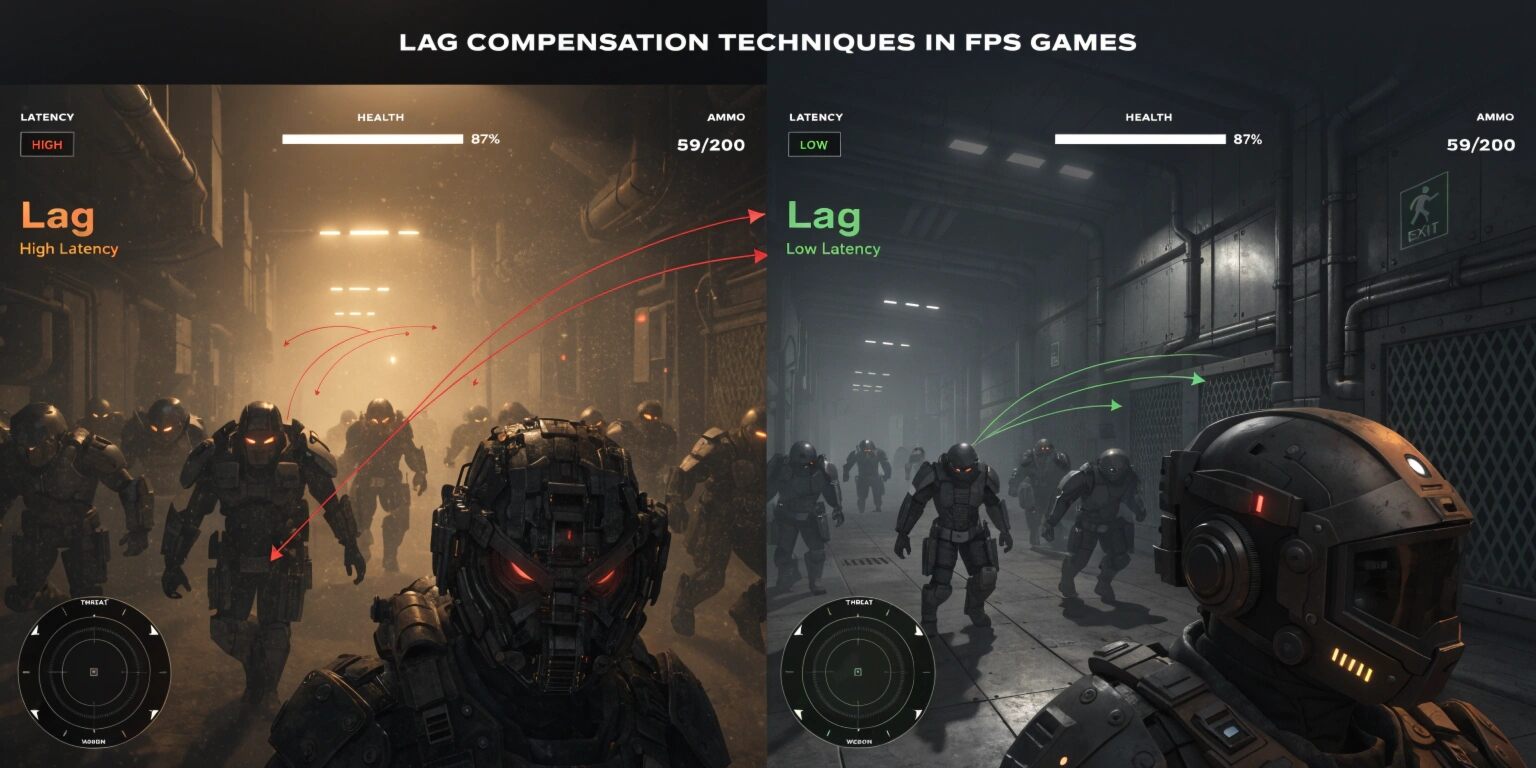
In first-person shooters (FPS), milliseconds determine outcomes. A 30–50ms delay can mean the difference between landing a headshot and losing a round. Yet in online environments, latency is unavoidable. The challenge for developers is clear: how do you ensure fairness when players connect from different regions with varying ping?
The answer lies in lag compensation.
Lag compensation is a collection of networking techniques that minimize the visible and competitive impact of latency. Modern competitive shooters such as Counter-Strike 2 and Call of Duty: Warzone rely on sophisticated systems to maintain competitive integrity across global player bases.
Let’s break down the core techniques that power these systems.
1. Authoritative Server Model
Competitive FPS games typically use an authoritative server architecture. The server maintains the “true” game state, processes player inputs, validates hits, and prevents cheating.
Clients send:
- Movement inputs
- Shooting events
- Ability usage
The server verifies and resolves outcomes. This prevents client-side manipulation but introduces latency. Therefore, additional compensation layers are required to keep gameplay responsive.
2. Client-Side Prediction
Without prediction, player movement would feel sluggish. Imagine pressing “W” and waiting 50ms before your character moves.
Client-side prediction solves this by immediately simulating movement locally before server confirmation. When the server response arrives, the client reconciles differences.
Steps:
- Player inputs movement.
- Client simulates instantly.
- Server processes and sends authoritative position.
- Client corrects discrepancies smoothly.
This keeps controls responsive while preserving server authority.
3. Server Reconciliation
Prediction alone is insufficient. Network conditions may cause divergence between client and server states.
Server reconciliation ensures consistency by:
- Replaying unacknowledged inputs
- Correcting positional errors
- Smoothing visual corrections
Without reconciliation, players would experience teleporting or rubber-banding effects.
Competitive shooters like Valorant are known for aggressive reconciliation systems combined with high tick-rate servers to maintain precision.
4. Hitbox Rewinding (Lag Compensation Proper)
One of the most critical systems in FPS games is hitbox rewinding.
Here’s the problem:
- Player A sees Player B at position X.
- Player A shoots.
- Due to latency, the server receives the shot slightly later.
- By that time, Player B has moved.
Without compensation, the shot would miss unfairly.
Solution: The server stores historical positional data for each player. When a shot arrives, the server:
- Calculates the shooter’s latency.
- Rewinds the target’s hitbox to where it was when the shooter fired.
- Evaluates hit detection in that past state.
This makes the hit registration align with what the shooter actually saw.
Games like Apex Legends rely heavily on this technique for fast-paced engagements.
5. Interpolation and Extrapolation
To render other players smoothly, clients use interpolation.
Instead of rendering the most recent server update immediately, the client displays slightly older states and blends between them. This avoids jitter caused by packet arrival inconsistencies.
Interpolation:
- Smooths movement
- Reduces visual stutter
- Adds slight visual delay for stability
Extrapolation, on the other hand, predicts future movement when packets are missing—but can introduce visible corrections if predictions are wrong.
Balancing interpolation delay is critical. Too much delay increases perceived latency; too little causes jitter.
6. Tick Rate Optimization
Tick rate determines how often the server updates the game state per second.
Common values:
- 64 tick
- 128 tick
- 60 tick (console-focused shooters)
Higher tick rates:
- Improve hit registration precision
- Reduce time between updates
- Increase server load
Competitive communities often demand higher tick rates for improved responsiveness, as seen in discussions around Counter-Strike 2.
7. Peeker’s Advantage Mitigation
Peeker’s advantage occurs when a player moving around a corner sees an opponent before the opponent sees them due to latency and update ordering.
Mitigation strategies include:
- Favor-the-shooter models
- Favor-the-defender adjustments
- Server-side latency caps
- Movement speed tuning
Design decisions here directly impact competitive fairness and player perception.
8. Anti-Cheat Considerations
Lag compensation must not create exploit opportunities. If the server trusts clients too much, players can manipulate latency to gain advantages.
Modern systems:
- Validate timestamps
- Cap maximum rewind windows
- Detect abnormal network patterns
- Combine with kernel-level anti-cheat solutions
Balancing fairness and security is a delicate engineering challenge.
Design Tradeoffs
Lag compensation always involves tradeoffs:
PriorityOutcomeFavor shooterMore satisfying hit registrationFavor defenderMore consistent defensive gameplayLower interpolationReduced latency, more jitterHigher interpolationSmoother visuals, increased delay
The correct balance depends on your game’s design philosophy.
Final Thoughts
Lag compensation is not a single feature—it is a layered architecture of prediction, reconciliation, historical rewinding, and careful server authority design.
Without it, competitive FPS games would be unplayable across real-world networks. With it, players thousands of kilometers apart can compete as if they were on a LAN connection.
As esports ecosystems continue to grow, networking sophistication is becoming as important as gameplay design itself. In modern FPS development, engineering fairness under latency is one of the most critical—and technically demanding—challenges studios face.