Discover proven strategies to reduce Customer Acquisition Cost (CAC) in SaaS businesses. Learn how SEO, product-led growth, referrals, automation, and conversion optimization improve profitability and accelerate sustainable business growth.
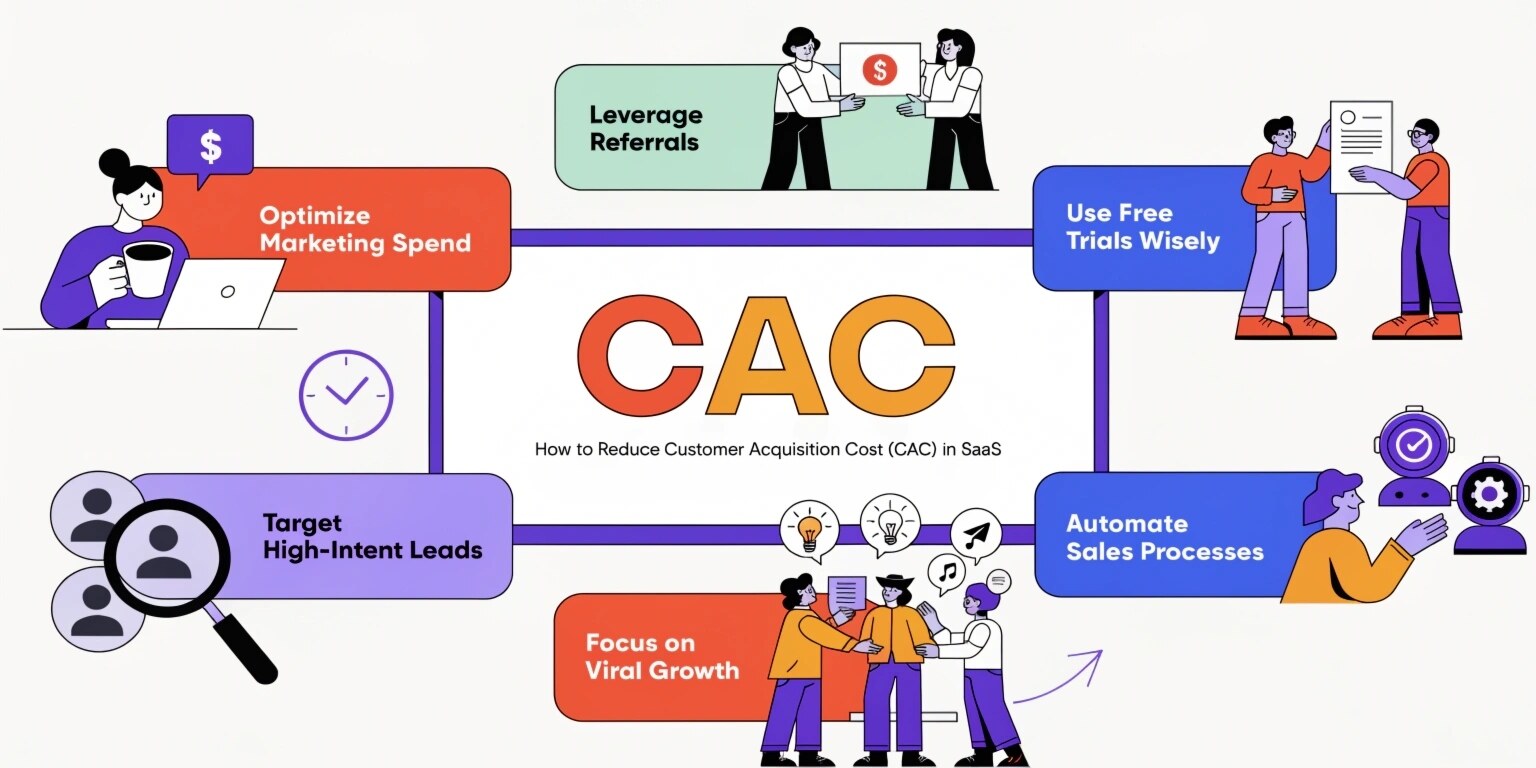
Customer Acquisition Cost (CAC) is one of the most important metrics for any Software as a Service (SaaS) business. It represents the total cost of acquiring a new customer, including expenses related to marketing, sales, advertising, software tools, and operational activities. While acquiring customers is essential for growth, high acquisition costs can quickly erode profitability and make scaling difficult.
Successful SaaS companies focus not only on increasing customer numbers but also on acquiring them efficiently. Reducing CAC allows businesses to maximize return on investment (ROI), improve cash flow, and achieve sustainable long-term growth. The key is to optimize every stage of the customer journey—from awareness and lead generation to conversion and retention.
This article explores practical strategies that SaaS businesses can implement to reduce Customer Acquisition Cost while maintaining healthy growth.
What Is Customer Acquisition Cost (CAC)?
Customer Acquisition Cost is calculated by dividing the total sales and marketing expenses by the number of new customers acquired during a specific period.
Formula:
CAC = Total Sales & Marketing Costs ÷ Number of New Customers
For example, if a SaaS company spends $50,000 on marketing and sales in a month and acquires 250 new customers, its CAC is $200 per customer.
Monitoring this metric helps businesses evaluate the efficiency of their growth strategies.
Why Reducing CAC Matters
A lower CAC provides several business advantages:
- Higher profit margins
- Faster return on marketing investments
- Improved scalability
- Better cash flow management
- Increased competitiveness
- Higher Customer Lifetime Value (CLV) to CAC ratio
- Sustainable long-term growth
Reducing acquisition costs without sacrificing lead quality enables businesses to invest more in product innovation and customer success.
Invest in Content Marketing
Content marketing is one of the most cost-effective channels for attracting qualified leads over time.
Effective content includes:
- Educational blog posts
- Technical tutorials
- Case studies
- Whitepapers
- Industry reports
- Webinars
- Videos
- Downloadable guides
High-quality content builds trust, improves organic visibility, and generates inbound leads with lower acquisition costs than paid advertising.
Improve SEO Performance
Search Engine Optimization (SEO) helps attract users actively searching for solutions.
Focus on:
- Keyword research
- Technical SEO
- Fast website performance
- High-quality backlinks
- Optimized landing pages
- Internal linking
- Mobile-friendly design
- Structured content
Strong SEO reduces dependence on paid campaigns while delivering consistent, long-term traffic.
Adopt Product-Led Growth (PLG)
Product-Led Growth allows the product itself to drive customer acquisition through free trials, freemium plans, or interactive demos.
Benefits include:
- Lower sales costs
- Faster onboarding
- Better product adoption
- Higher conversion rates
- Increased word-of-mouth referrals
Allowing users to experience product value before purchasing often shortens the sales cycle.
Optimize Landing Pages
Small improvements in conversion rates can significantly reduce CAC.
Optimize landing pages by:
- Writing compelling headlines
- Highlighting customer benefits
- Displaying testimonials
- Including clear calls to action
- Simplifying forms
- Improving page speed
- Conducting A/B testing
A higher conversion rate means more customers acquired from the same marketing investment.
Use Marketing Automation
Automation improves efficiency while reducing manual effort.
Automate processes such as:
- Lead nurturing
- Email campaigns
- Customer segmentation
- Follow-up sequences
- CRM updates
- Behavioral tracking
Marketing automation enables teams to engage more prospects without increasing operational costs.
Build Referral Programs
Satisfied customers are powerful advocates.
Referral programs encourage existing users to recommend your product by offering incentives such as discounts, account credits, or exclusive features.
Benefits include:
- Lower acquisition costs
- Higher-quality leads
- Faster trust-building
- Improved customer loyalty
Referral-generated customers often convert more quickly and remain loyal for longer.
Strengthen Customer Retention
Reducing churn indirectly lowers CAC because retaining existing customers is generally more cost-effective than acquiring new ones.
Retention strategies include:
- Excellent customer support
- Personalized onboarding
- Regular product updates
- Educational resources
- Customer success programs
- Usage analytics
Long-term customer relationships increase Customer Lifetime Value and improve overall profitability.
Measure Marketing Performance
Track key performance indicators (KPIs) to identify high-performing channels and eliminate inefficient spending.
Important metrics include:
- CAC
- Customer Lifetime Value (CLV)
- Conversion Rate
- Cost Per Lead (CPL)
- Return on Ad Spend (ROAS)
- Organic Traffic
- Email Open Rate
- Trial-to-Paid Conversion Rate
Data-driven decisions help optimize marketing budgets and maximize results.
Common Mistakes to Avoid
Many SaaS businesses increase CAC unnecessarily by:
- Targeting overly broad audiences
- Relying solely on paid advertising
- Ignoring SEO
- Neglecting customer retention
- Using generic messaging
- Failing to optimize landing pages
- Overlooking marketing analytics
Avoiding these mistakes improves acquisition efficiency and overall marketing effectiveness.
Future Trends
Customer acquisition continues to evolve with advances in AI and automation.
Emerging trends include:
- AI-powered lead scoring
- Predictive marketing analytics
- Hyper-personalized customer journeys
- Conversational AI for sales
- Interactive product demonstrations
- Account-Based Marketing (ABM)
- Intent-driven marketing campaigns
- Privacy-first marketing strategies
Businesses adopting these innovations will gain a competitive advantage while reducing acquisition costs.
Conclusion
Reducing Customer Acquisition Cost is essential for building a profitable and scalable SaaS business. By combining content marketing, SEO, product-led growth, referral programs, marketing automation, conversion optimization, and customer retention strategies, companies can acquire high-quality customers more efficiently.
Rather than focusing solely on increasing marketing spend, successful SaaS businesses continuously optimize every stage of the customer journey. A balanced approach that prioritizes customer value, operational efficiency, and data-driven decision-making leads to sustainable growth, stronger profitability, and long-term competitive success.
We build scalable web, mobile, and game products for clients worldwide — combining modern frameworks, cloud infrastructure, and best engineering practices.