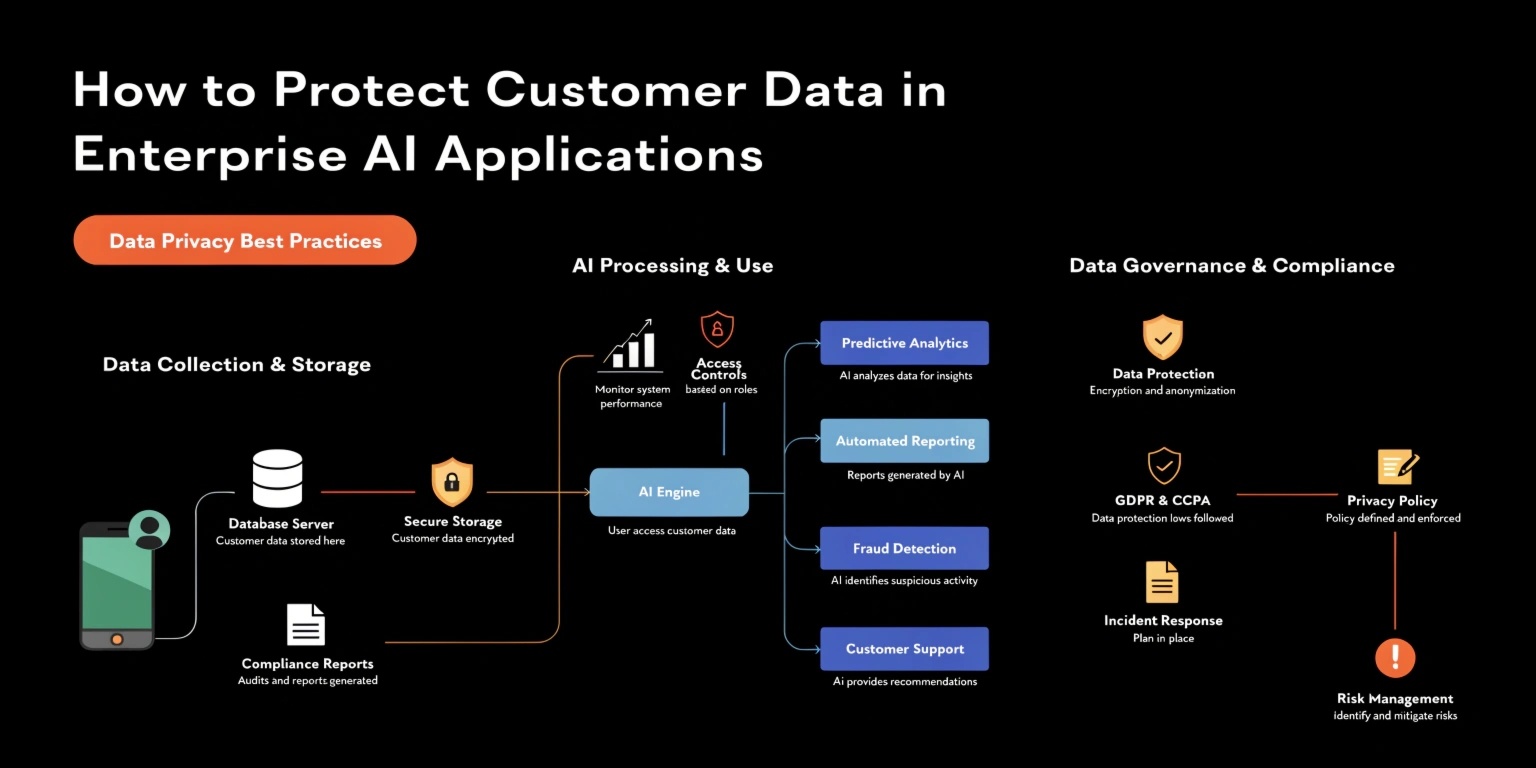
Protecting customer data in enterprise AI applications requires encryption, strict access controls, data minimization, secure model integration, and continuous monitoring. A structured AI security strategy helps enterprises reduce data leakage risks, support compliance, and build trustworthy AI solutions.
Artificial intelligence is transforming enterprise operations through intelligent chatbots, document analysis, personalized recommendations, automated workflows, and predictive analytics. However, these applications often process sensitive information, including customer names, contact details, financial records, support conversations, and business documents.
If this information is mishandled, organizations may face data breaches, regulatory penalties, financial losses, and reputational damage. Protecting customer data must therefore be a core part of enterprise AI development rather than a security measure added after deployment.
A strong strategy combines secure architecture, responsible data handling, access management, continuous monitoring, and clear governance policies.
1. Understand What Customer Data Your AI Processes
The first step is to identify the information entering, leaving, and being stored by an AI application.
Data may come from customer relationship management systems, enterprise databases, uploaded documents, support tickets, APIs, or user prompts. Different sources may contain different levels of sensitivity.
Classify information into categories such as public, internal, confidential, and highly sensitive. Identify personal information, payment details, authentication credentials, and confidential business records that require additional safeguards.
Create a data-flow map showing where information is collected, processed, transmitted, stored, and deleted. This helps teams identify unnecessary data exposure and determine which security controls are needed at each stage.
2. Apply Data Minimization and Masking
Enterprise AI systems should process only the information necessary to complete a task.
For example, a customer-support assistant may need an order number and delivery status but not the customer's complete payment details or identity documents.
Before sending data to an AI model, remove unnecessary fields and replace sensitive values with masked identifiers where practical. Techniques such as redaction, tokenization, and pseudonymization can reduce exposure.
For analytics and model development, use appropriately anonymized or synthetic datasets when possible. Remember that pseudonymized data may still be identifiable, and anonymization must be assessed for re-identification risks.
Data minimization reduces the amount of sensitive information exposed if a system, account, or external service is compromised.
3. Encrypt Data in Transit and at Rest
Encryption is a fundamental safeguard for customer information.
Use modern transport encryption, such as properly configured TLS, when data moves between users, enterprise systems, AI services, and databases. Encrypt stored information in databases, file storage, backups, and other relevant systems.
Encryption keys should be managed securely, with restricted permissions, rotation policies, and appropriate separation from the data they protect. A dedicated key management service or hardware security module may be suitable for higher-risk environments.
Organizations should also protect logs, cached responses, vector databases, and temporary files. These locations can contain sensitive information even when the primary database is well secured.
Encryption reduces exposure, but it does not replace access controls or secure application design.
4. Enforce Strong Identity and Access Controls
Not every employee, application, or AI agent should have access to every customer record.
Apply the principle of least privilege: grant each user and service only the permissions required for its role. Use role-based or attribute-based access controls, multifactor authentication, and centralized identity management where appropriate.
For AI applications using retrieval-augmented generation (RAG), enforce permissions during document retrieval. The model should not retrieve confidential files simply because they exist in the connected knowledge base.
Likewise, AI agents that can call tools, update records, or trigger transactions should use narrowly scoped credentials. Require explicit authorization for sensitive actions and human approval for high-impact operations when appropriate.
5. Secure Prompts, Model Inputs, and Outputs
Generative AI introduces risks that traditional application security controls may not fully address.
Users may accidentally include confidential information in prompts, while malicious inputs may attempt to manipulate a model into revealing protected data or performing unauthorized actions. This can include prompt injection, particularly when a system processes untrusted documents or external content.
To reduce these risks:
- Treat user prompts and retrieved documents as untrusted input.
- Separate system instructions from user-provided content.
- Validate model outputs before using them in downstream systems.
- Prevent sensitive data from being returned to unauthorized users.
- Apply output filtering and data loss prevention checks where appropriate.
- Restrict tools and actions available to the model.
Prompt filtering alone is not sufficient. Strong authorization, isolation, validation, and controlled tool execution are essential layers of defense.
6. Evaluate Third-Party AI Providers
Many enterprises rely on external AI APIs or cloud-based model platforms. Before sharing customer information with a provider, evaluate its security practices and contractual commitments.
Review data retention, model-training usage, data residency, subprocessors, deletion procedures, incident notification requirements, and available security certifications. Confirm whether the selected service configuration meets your organization's privacy and regulatory obligations.
Do not assume that every AI service automatically excludes submitted data from model training or retains no prompts. Verify the provider's current terms, product settings, and enterprise agreement.
Where necessary, use private networking, dedicated deployments, approved regional processing, or self-hosted models. The appropriate option depends on the sensitivity of the data, operational requirements, and risk tolerance.
7. Establish AI Data Governance and Compliance
Technical safeguards should be supported by clear policies defining who may access data, how AI systems can use it, and how long information should be retained.
Assign ownership for data security, AI risk management, and incident response. Maintain records of model versions, data sources, access permissions, and significant configuration changes.
Conduct privacy impact assessments or other relevant risk assessments before deploying high-risk AI applications. Apply applicable legal requirements, which may include India's Digital Personal Data Protection framework, the EU General Data Protection Regulation, or sector-specific obligations depending on the organization and its customers.
Compliance requirements vary by jurisdiction and use case, so organizations should obtain appropriate legal and privacy guidance rather than relying on technical controls alone.
8. Monitor, Test, and Respond to Security Incidents
AI security requires continuous oversight after deployment.
Monitor unusual access patterns, excessive data retrieval, unexpected tool calls, suspicious prompt activity, and attempts to extract confidential information. Protect audit logs from unauthorized access and avoid storing complete sensitive prompts when they are not needed.
Conduct penetration testing, access-control testing, red-team exercises, and AI-specific evaluations. Test whether one customer can access another customer's information and whether the system exposes confidential content through responses, logs, caches, or retrieval results.
Prepare an incident response plan covering containment, investigation, customer communication, evidence preservation, and legally required notifications. Regular testing helps teams identify weaknesses before attackers or accidental failures exploit them.
Conclusion
Protecting customer data in enterprise AI applications requires a coordinated approach that combines data minimization, encryption, least-privilege access, secure model integration, vendor assessment, governance, and continuous monitoring.
Organizations should evaluate the complete AI data lifecycle, from initial collection and model inputs to generated outputs, storage, logging, and deletion. They should also treat AI-specific threats as part of a broader cybersecurity program.
By building security and privacy into the architecture from the beginning, enterprises can reduce the risk of data leakage, strengthen customer trust, and deploy AI solutions more responsibly. The goal is not simply to make AI powerful, but to make it secure, accountable, and appropriate for handling sensitive business information.
We build scalable web, mobile, and game products for clients worldwide — combining modern frameworks, cloud infrastructure, and best engineering practices.