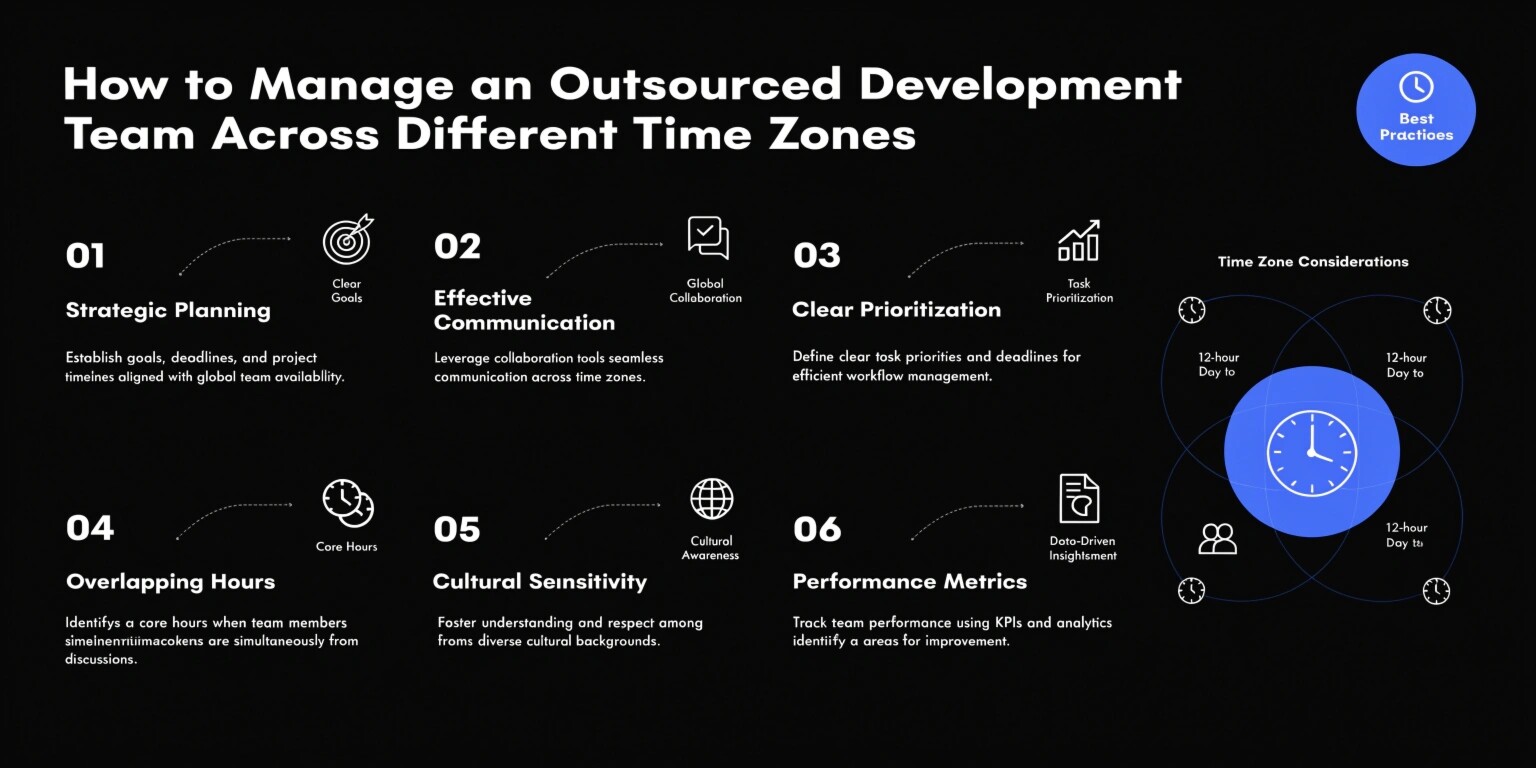
Managing an outsourced development team across different time zones requires structured communication, clear documentation, realistic deadlines, and effective project management. With asynchronous workflows, overlapping work hours, and shared goals, businesses can improve productivity, reduce delays, and deliver successful software projects.
Outsourcing software development allows businesses to access specialized talent, control development costs, and accelerate product delivery. However, managing an outsourced development team across different time zones can create challenges involving communication, project coordination, delayed feedback, and missed deadlines.
For example, a company based in the United States may work with developers in India or another country. When one team finishes its workday, the other team may just be starting. Without an organized workflow, even simple decisions can delay development.
The solution is not to make everyone work the same hours. Instead, businesses should establish clear communication practices, structured workflows, and measurable expectations that allow teams to collaborate effectively across time zones.
1. Establish Clear Goals and Project Expectations
Before development begins, define the project's objectives, scope, deliverables, deadlines, and quality standards.
Every team member should understand what needs to be developed, why it matters, and how success will be measured. Break large requirements into smaller tasks with clear acceptance criteria.
For example, instead of assigning a broad task such as "develop the user dashboard," define the required screens, API integrations, validation rules, and expected behavior.
Document responsibilities using a responsibility matrix or task ownership system. This reduces confusion and helps outsourced developers make progress without repeatedly waiting for clarification.
2. Create a Time Zone Management Strategy
Start by identifying each team's working hours, public holidays, and preferred communication windows.
Choose a reasonable period of overlapping working hours for discussions that require real-time collaboration. Even a short overlap can be sufficient when used strategically.
For example, a business team in Europe working with developers in India could schedule important discussions during mutually convenient afternoon hours in India and morning hours in Europe, depending on the specific locations and daylight-saving changes.
Use shared calendars that display multiple time zones. Always specify the time zone when scheduling meetings, particularly when team members work across regions that observe daylight saving time.
Avoid expecting developers to attend frequent meetings outside their normal working hours. Sustainable schedules improve engagement and reduce burnout.
3. Prioritize Asynchronous Communication
Asynchronous communication allows team members to exchange information without requiring an immediate response.
It is especially valuable when working with teams that have limited overlapping hours.
Use project management tools, written updates, recorded demonstrations, and documented decisions to keep work moving. A developer should be able to understand the next task without waiting for someone in another country to come online.
A useful daily update can include:
- Tasks completed
- Work currently in progress
- Blockers or dependencies
- Decisions required
- Planned next steps
Keep updates concise and specific. For urgent issues, establish a separate escalation channel and clearly define what qualifies as urgent.
4. Use the Right Collaboration and Project Management Tools
The right tools create a shared workspace where distributed teams can access the information they need.
Common options include:
- Jira or Linear: Manage tasks, backlogs, sprints, and development priorities.
- Slack or Microsoft Teams: Coordinate conversations and team announcements.
- GitHub or GitLab: Review code, manage pull requests, and track technical changes.
- Confluence or Notion: Maintain requirements, technical documentation, and meeting decisions.
- Google Meet or Zoom: Conduct scheduled discussions and demonstrations.
Choose tools based on project complexity, security requirements, and team preferences. Avoid spreading critical information across too many disconnected platforms.
Establish a single source of truth for project status, task ownership, technical decisions, and delivery dates.
5. Build a Reliable Handover Process
When teams operate in different time zones, one team's end of day can become another team's starting point.
A structured handover helps developers continue work without unnecessary delays.
At the end of a working day, team members should document completed work, code changes, unresolved issues, testing results, and the next recommended actions.
For example, a frontend developer may complete a user interface and document the API dependencies that a backend developer needs to address. The backend developer can then continue the integration during their working hours.
Use pull request descriptions, task comments, short screen recordings, and technical notes to make handovers practical and repeatable.
6. Align Agile Sprints and Delivery Milestones
Agile practices can help outsourced development teams adapt to changing requirements while maintaining visibility.
Plan sprints around achievable outcomes rather than the number of hours developers are online. Define sprint goals, prioritize the backlog, and ensure tasks have clear requirements before assigning them.
Conduct sprint planning, reviews, and retrospectives at times that are reasonable for the participants. If a single meeting time consistently disadvantages one region, rotate meeting times or use asynchronous updates for routine discussions.
Track milestones such as completed features, tested integrations, and release readiness. Regularly review dependencies that could block progress across teams.
7. Measure Outcomes Instead of Online Activity
Monitoring whether developers are online does not necessarily indicate whether they are productive.
Instead, assess progress through meaningful delivery and quality indicators, such as:
- Completion of agreed milestones
- Lead time for development changes
- Pull request review turnaround
- Defect rates and rework
- Sprint goal achievement
- Release reliability
Use these metrics to identify bottlenecks and improve the development process, not simply to rank individual employees.
Discuss missed targets constructively. Delays may result from unclear requirements, external dependencies, changing priorities, or insufficient review capacity rather than individual performance alone.
8. Maintain Documentation and Code Quality Standards
Strong documentation reduces dependency on real-time conversations.
Maintain updated architecture diagrams, API specifications, coding standards, setup instructions, testing procedures, and deployment guidelines.
Use version control, peer reviews, automated tests, and continuous integration to maintain consistent quality across locations.
Security requirements should also be documented. Define access permissions, credential handling, data protection expectations, and procedures for reporting security issues.
These practices ensure that work remains understandable and maintainable, even when team members cannot communicate immediately.
9. Build Trust and Respect Cultural Differences
Successful outsourcing relationships depend on more than task assignments and deadlines.
Different teams may have different communication styles, feedback expectations, public holidays, and approaches to decision-making. Discuss these differences openly instead of making assumptions.
Encourage developers to raise concerns early and ask questions when requirements are unclear. Provide constructive feedback, recognize achievements, and include outsourced team members in relevant technical discussions.
Trust grows when both parties communicate honestly, follow through on commitments, and treat each other as partners rather than merely service providers.
Conclusion
Managing an outsourced development team across different time zones requires deliberate planning, reliable documentation, asynchronous communication, and clear accountability.
Businesses should establish shared goals, schedule limited overlapping hours, create structured handovers, use suitable collaboration tools, and measure results through delivery and quality rather than online presence.
By combining effective project management with trust, flexibility, and consistent technical standards, organizations can reduce communication delays and improve collaboration across distributed teams.
The ultimate goal is to build a workflow where developers can make meaningful progress regardless of location or working hours, helping businesses deliver reliable software and establish successful long-term outsourcing partnerships.
We build scalable web, mobile, and game products for clients worldwide — combining modern frameworks, cloud infrastructure, and best engineering practices.