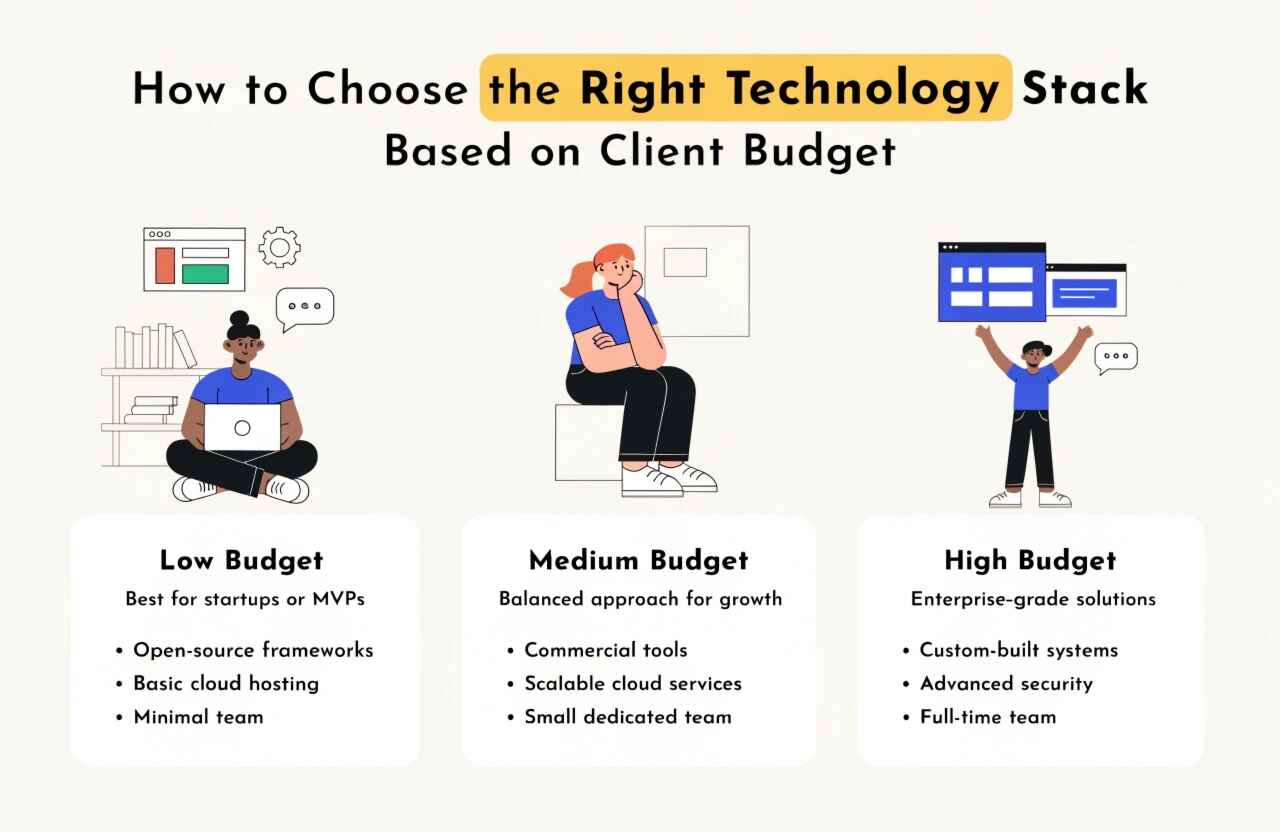
Choosing the right technology stack requires balancing client budget, project complexity, scalability, and maintenance costs. Learn how to select suitable frontend, backend, database, and cloud technologies to build secure, efficient, and cost-effective software solutions.
Introduction
Choosing the right technology stack is one of the most important decisions in software development. A technology stack includes the programming languages, frameworks, databases, development tools, and infrastructure used to build and maintain an application. The right combination helps businesses deliver reliable digital products while managing development expenses and future growth.
However, every client has different financial resources, business objectives, and technical requirements. A startup developing its first application may prioritize affordability and speed, while an established enterprise may focus on security, performance, and scalability.
At Daydreamsoft Infotech LLP, understanding client requirements and budget limitations is an important step toward recommending practical software development solutions. The goal is not simply to select the cheapest technologies but to find a stack that delivers the best long-term value.
1. Understand the Client's Budget and Business Goals
Before selecting any technology, determine the client's available budget and business priorities. A clear understanding of these factors helps developers avoid unnecessary expenses and unrealistic project expectations.
Discuss the following questions with the client:
- What problem will the application solve?
- Who are the target users?
- What features are essential for the first release?
- How many users are expected initially?
- Does the client require future integrations or expansion?
- What budget is available for development, hosting, and maintenance?
For example, a small business that needs a basic company website may not require a complex backend architecture. A customer-facing platform with payments, user accounts, and real-time notifications may need a more comprehensive solution.
Defining the budget early helps development teams recommend technologies that match the project's actual requirements.
2. Select Technologies According to Project Complexity
Different projects require different technology stacks. Choosing technologies based on popularity rather than project requirements can increase development time and maintenance expenses.
For a simple website, HTML, CSS, JavaScript, and a suitable content management system may be sufficient. For a dynamic web application, frameworks such as React or Angular can support interactive user experiences.
Backend requirements can be handled using technologies such as Node.js, Python with Django, PHP with Laravel, or ASP.NET Core. Each option has different strengths depending on the application's functionality, existing infrastructure, and available development expertise.
For mobile applications, Flutter and React Native can support cross-platform development from a shared codebase. Native technologies such as Swift for iOS and Kotlin for Android may be appropriate when platform-specific functionality or advanced performance requirements justify separate development efforts.
The best choice depends on the features required, delivery timeline, developer availability, and expected application lifecycle.
3. Evaluate Total Cost of Ownership
One common mistake is considering only the initial development cost. A technology stack also creates ongoing expenses related to hosting, licensing, maintenance, security updates, monitoring, and future improvements.
Consider these major cost components:
Development costs: Include developer availability, implementation complexity, testing, and integration.
Infrastructure costs: Depend on server capacity, storage, bandwidth, database usage, and cloud services.
Maintenance costs: Cover bug fixes, dependency updates, performance improvements, and security patches.
Licensing costs: Some tools and platforms have subscription fees, usage-based charges, or commercial licensing requirements.
Scaling costs: Increase as traffic, data volumes, and application complexity grow.
Open-source technologies can reduce licensing expenses, but they still require skilled development and ongoing maintenance. Similarly, managed cloud services may cost more initially but reduce operational workload.
Comparing the total cost of ownership over several years provides a more realistic basis for technology decisions.
4. Choose a Suitable Frontend and Backend
The frontend and backend should work together efficiently without introducing unnecessary complexity.
For budget-conscious web projects, React can be useful for building reusable user interfaces, while Vue may offer a straightforward learning curve for certain applications. Angular can be suitable for larger applications that benefit from its structured development approach.
For backend development, Node.js can support applications requiring JavaScript across the frontend and backend. Django offers an integrated framework with built-in capabilities that can accelerate many Python-based projects. Laravel can be productive for PHP applications, while ASP.NET Core is suitable for many enterprise and business applications.
These are not fixed budget categories. Actual costs depend on the team's expertise, project requirements, integrations, and existing systems.
Whenever possible, choose technologies that the development team can maintain confidently. Using an unfamiliar framework solely because it appears cheaper can increase debugging time and project risk.
5. Select the Right Database and Cloud Infrastructure
Database and infrastructure choices can significantly influence performance and operating expenses.
Relational databases such as PostgreSQL and MySQL are useful when applications require structured data, relationships, and transactional consistency. MongoDB may suit applications with flexible document-based data models.
The choice should reflect the data structure, consistency requirements, query patterns, security needs, and expected workload rather than popularity alone.
For hosting, small applications may begin with shared hosting, a virtual private server, or a suitable managed platform. Larger applications may require cloud services with monitoring, automated backups, load balancing, and flexible scaling.
Cloud platforms such as AWS, Microsoft Azure, and Google Cloud provide extensive capabilities, but unnecessary services can increase costs. Start with an appropriately sized infrastructure, monitor actual usage, and scale when measurable business requirements justify it.
6. Build an MVP Instead of Developing Every Feature Immediately
When a client's budget is limited, developing a Minimum Viable Product (MVP) can be an effective strategy.
An MVP includes the essential features needed to validate a product idea and gather feedback from real users. Instead of investing heavily in every proposed feature, the development team focuses on functionality that delivers immediate business value.
For example, an e-commerce MVP might include product listings, a shopping cart, secure checkout, and basic order management. Advanced analytics, loyalty programs, and complex automation can be introduced later.
This approach helps businesses control initial spending, validate market demand, and prioritize future investment using actual user feedback.
However, budget reductions should not compromise essential security, data protection, testing, or reliability.
7. Prioritize Scalability, Security, and Maintainability
A low-cost technology stack is not necessarily the most economical option over time. If an application becomes difficult to maintain or cannot handle growing demand, rebuilding it may cost more than making a suitable initial investment.
Choose technologies that support secure development practices, regular updates, reliable monitoring, and straightforward maintenance.
Avoid unnecessary microservices, complex deployment pipelines, and expensive infrastructure when a simpler architecture can meet current requirements. A well-structured monolithic application may be a practical starting point for many projects, with architectural changes introduced as genuine needs emerge.
Similarly, select technologies with appropriate documentation, community support, and available developers. These factors can reduce dependency on individual team members and improve long-term sustainability.
8. Compare Options Before Making the Final Decision
Before finalizing the technology stack, compare shortlisted options against a consistent set of criteria.
Evaluate estimated development time, infrastructure expenses, team expertise, security requirements, integration capabilities, scalability, and maintenance effort.
A small proof of concept can help verify performance, compatibility, and technical feasibility before committing to a larger implementation.
Explain the trade-offs clearly to the client. If a requested feature exceeds the available budget, discuss alternatives such as reducing initial scope, adopting managed services, or delivering the application in phases.
Transparent communication builds trust and ensures that technical decisions support business objectives.
Conclusion
Choosing the right technology stack based on client budget requires balancing immediate affordability with long-term performance, security, scalability, and maintenance. There is no single technology stack that suits every project.
By understanding business requirements, evaluating total ownership costs, selecting appropriate development tools, and prioritizing essential features, development teams can deliver effective software within realistic financial limits.
At Daydreamsoft Infotech LLP, a thoughtful technology selection process can help businesses turn their ideas into practical digital solutions. The ultimate objective is to invest in technologies that solve real problems, support future growth, and deliver sustainable business value.
We build scalable web, mobile, and game products for clients worldwide — combining modern frameworks, cloud infrastructure, and best engineering practices.