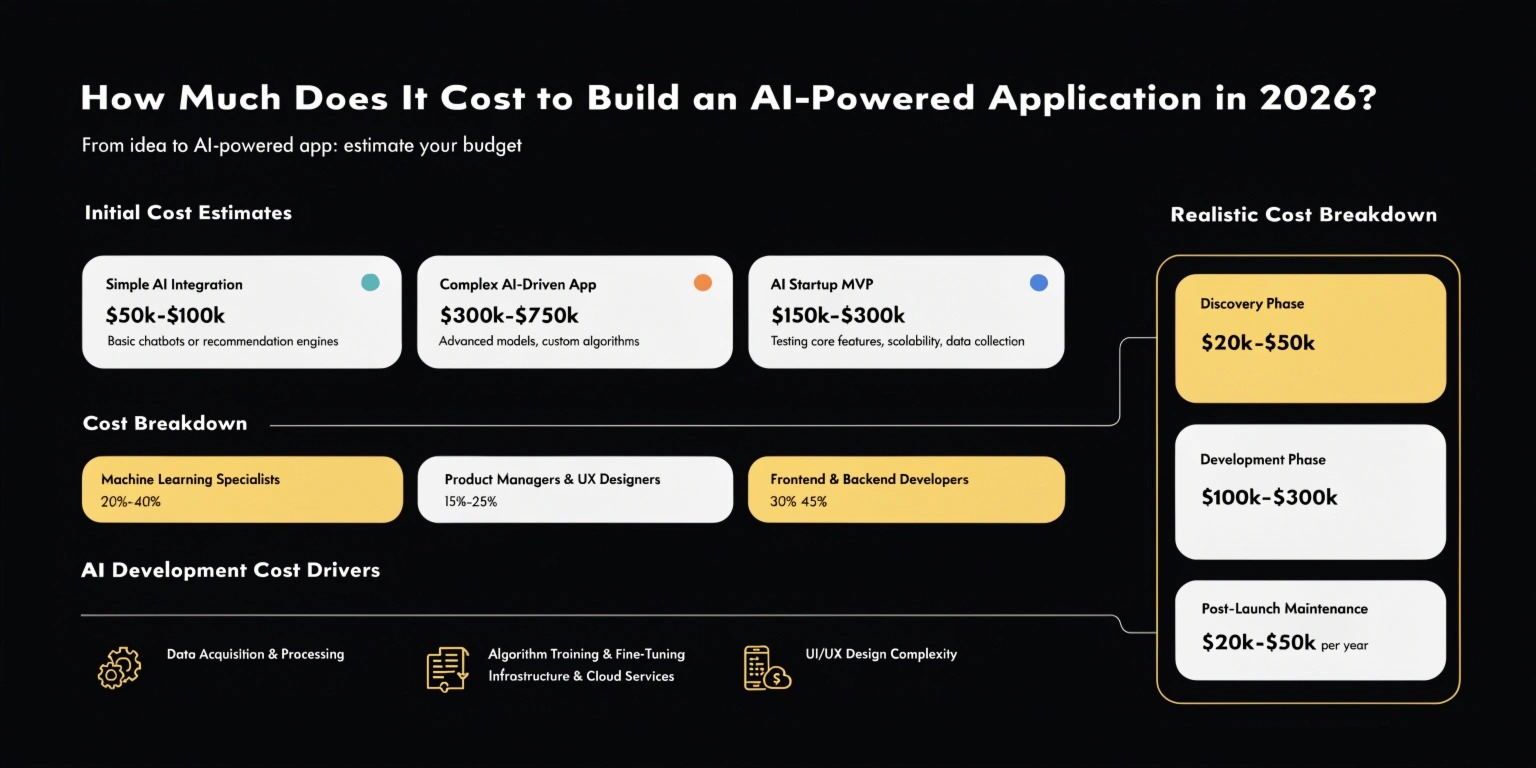
Building an AI-powered application in 2026 can cost anywhere from a few thousand dollars for a simple AI integration to hundreds of thousands for a sophisticated enterprise platform. Development complexity, AI capabilities, infrastructure, security, and ongoing maintenance determine the final investment.
Artificial intelligence has become a major part of modern software development in 2026. Businesses are integrating AI into mobile applications, web platforms, customer support systems, analytics tools, healthcare software, and enterprise workflows. From intelligent chatbots to applications powered by large language models (LLMs), AI creates opportunities to automate processes, improve customer experiences, and develop new digital products.
However, one of the first questions businesses ask is: How much does it cost to build an AI-powered application in 2026?
The answer depends on the application's complexity, required AI capabilities, technology stack, development team, infrastructure, and long-term operational requirements. Understanding these factors helps businesses plan realistic budgets and avoid unexpected expenses.
1. Estimated Cost of AI Application Development in 2026
AI application development costs vary significantly depending on functionality and technical complexity. The following figures are illustrative estimates in US dollars, not fixed market prices.
Application Type Estimated Development Cost
Basic AI-enabled application $5,000–$15,000
AI chatbot or virtual assistant $10,000–$30,000
AI-powered mobile application $20,000–$60,000
AI analytics or recommendation platform $30,000–$80,000
Custom LLM application with RAG $25,000–$100,000
Advanced AI platform with custom models $80,000–$250,000+
Enterprise AI solution $150,000–$500,000+
These ranges represent potential project budgets and can overlap. A straightforward application using an existing AI API may cost considerably less than a similar-looking product requiring custom model training, complex integrations, strict compliance, and high-volume infrastructure.
2. Key Factors That Affect AI App Development Costs
Several factors determine the total development budget.
Application complexity: An app that generates text using an existing model is generally simpler than one that processes documents, images, audio, and real-time data across multiple workflows.
AI capabilities: Natural language processing, computer vision, predictive analytics, speech recognition, and agentic AI each have different implementation requirements.
Platform requirements: Developing for a single web platform may cost less than building applications for iOS, Android, and web with synchronized functionality.
Third-party integrations: Payment gateways, CRM systems, enterprise databases, authentication services, and external APIs increase development effort.
Security and compliance: Applications handling sensitive business or customer information may require additional access controls, audit logs, data protection, and compliance reviews.
3. AI Model Integration vs. Custom Model Development
Choosing the right AI approach can significantly affect project costs.
Existing AI models and APIs
Using established AI APIs allows developers to integrate capabilities such as text generation, summarization, translation, and conversational assistance without training a model from scratch. This approach can reduce initial development time and infrastructure requirements.
However, API usage may generate recurring costs based on tokens, requests, or other provider-specific pricing units.
Retrieval-Augmented Generation (RAG)
RAG connects an AI model to external knowledge sources, allowing applications to retrieve relevant information before generating responses. It is useful for internal knowledge assistants, document search, and customer support applications.
Implementation costs depend on document processing, retrieval quality, permissions, data pipelines, and evaluation requirements.
Custom machine learning models
Training or extensively adapting a model requires additional data preparation, experimentation, computing resources, and specialized engineering expertise. This approach may be justified when existing models cannot meet specific accuracy, privacy, latency, or domain requirements.
Businesses should evaluate these options before committing to a large AI development budget.
4. Development Team and Hourly Rates
The development team's experience and location can influence project costs considerably.
Typical project roles may include:
AI/ML engineers
Backend developers
Frontend or mobile developers
UI/UX designers
Data engineers
QA engineers
DevOps or cloud engineers
Project managers
For illustration, development rates may range from approximately $20–$50 per hour for some teams in India to $75–$200 or more per hour for teams in higher-cost markets. Actual rates vary by expertise, engagement model, and project requirements.
A small project may require only a few specialists, while a complex enterprise application may need a multidisciplinary team throughout development and deployment.
5. AI Infrastructure and API Costs
Development expenses are only part of the total investment. Running an AI application creates ongoing infrastructure and service costs.
Common expenses include:
AI model API usage
Cloud hosting
Database services
Vector database infrastructure
File and object storage
Monitoring and logging
Data processing
Security services
Backup and disaster recovery
Applications with frequent AI requests or large input and output volumes may experience substantial recurring costs.
To manage expenses, businesses should monitor usage, select models based on task complexity, cache suitable results, optimize prompts, and establish usage limits.
6. AI Application Development Timeline
Development timelines depend on scope, team size, data readiness, and integration complexity.
Project Type Indicative Timeline
Basic AI prototype 2–4 weeks
AI chatbot or assistant 4–8 weeks
AI-enabled mobile or web app 8–16 weeks
Custom RAG platform 8–20 weeks
Enterprise AI platform 4–12 months or longer
These estimates are planning guidelines, not guarantees. Security reviews, data migration, model evaluation, and regulatory requirements can extend delivery schedules.
7. Maintenance and Long-Term Costs
After launch, AI applications require continuous monitoring and improvement.
Maintenance may include bug fixes, model updates, dependency upgrades, infrastructure optimization, security patches, performance improvements, and evaluation of AI-generated outputs.
As a preliminary budgeting guideline, businesses may reserve around 15%–25% of the initial development cost annually for software maintenance. AI-specific operating expenses, including API usage and cloud infrastructure, should be budgeted separately because they depend heavily on actual usage.
8. How to Reduce AI Development Costs
Businesses can control expenses without compromising essential quality by following these practices:
Start with an MVP: Develop the smallest useful version and validate demand before expanding functionality.
Use existing models: Avoid custom model training unless business requirements justify it.
Prioritize features: Focus development resources on features that solve important user problems.
Choose efficient models: Use less expensive models for simple tasks and more capable models when necessary.
Optimize infrastructure: Monitor utilization and avoid paying for unnecessary resources.
Prepare data early: Clean, well-structured data can reduce integration and troubleshooting effort.
Test continuously: Automated testing and AI evaluation help identify problems before deployment.
Plan operating costs: Estimate expected usage and monitor spending after launch.
Conclusion
The cost of building an AI-powered application in 2026 depends on its functionality, AI architecture, development team, infrastructure, security requirements, and expected user demand. A simple AI-enabled application may require a relatively modest investment, while a sophisticated enterprise platform can require hundreds of thousands of dollars or more.
The most effective approach is to define business objectives, choose an appropriate AI implementation strategy, estimate both development and recurring expenses, and begin with a clearly scoped MVP.
By prioritizing valuable features, using existing AI capabilities where appropriate, and monitoring operational costs, businesses can build scalable AI applications while maintaining better control over their technology investment.
We build scalable web, mobile, and game products for clients worldwide — combining modern frameworks, cloud infrastructure, and best engineering practices.