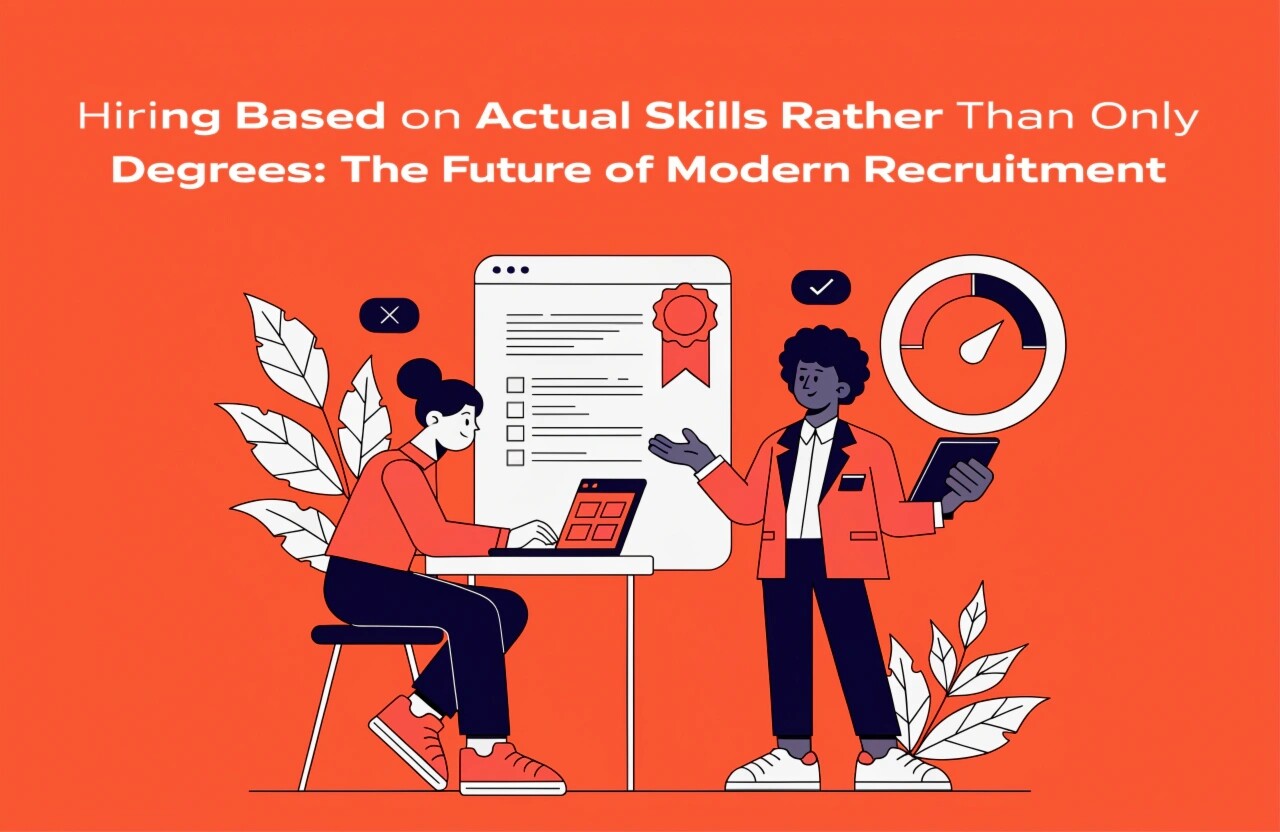
Hiring Based on Actual Skills Rather Than Only Degrees
For many years, academic degrees have played an important role in the recruitment process. A degree was often considered proof that a candidate had the necessary knowledge and qualifications for a particular position. However, the modern workplace is changing rapidly, especially in the technology industry.
Today, having a degree does not always mean that a candidate has the practical skills required to perform a job successfully. Similarly, candidates without a traditional degree may possess exceptional technical knowledge, creativity, problem-solving abilities, and real-world experience.
This is why skills-based hiring is becoming an increasingly important approach for modern businesses.
Why Degrees Alone Are Not Enough
A degree can demonstrate that someone has completed an academic program, but it may not fully demonstrate how effectively that person can perform a specific job.
For example, a software development candidate may have a computer science degree but limited experience building real applications. Another candidate may not have the same academic qualification but may have developed several applications, contributed to projects, solved technical problems, and worked with modern development tools.
From an employer's perspective, the second candidate may be more prepared for the actual responsibilities of the position.
This does not mean degrees are unimportant. Academic education can provide valuable theoretical knowledge and a strong foundation. However, companies should consider degrees as one part of the evaluation process rather than the only deciding factor.
Practical Skills Show Job Readiness
One of the biggest advantages of skills-based recruitment is that it helps companies evaluate whether candidates can actually perform the required work.
Instead of relying exclusively on resumes and educational qualifications, employers can introduce:
- Practical assignments
- Technical assessments
- Coding tests
- Portfolio reviews
- Problem-solving exercises
- Role-specific simulations
- Communication assessments
- Project discussions
- Real-world case studies
For IT companies, practical assessments can be particularly useful. A developer can be asked to solve a programming problem, a UI/UX designer can be evaluated through a design task, and a digital marketing candidate can be asked to create a basic campaign strategy.
These methods provide employers with stronger evidence of a candidate's capabilities.
Skills-Based Hiring Can Reduce Skill Gaps
Technology and business requirements are changing quickly. New programming frameworks, AI tools, cloud platforms, cybersecurity practices, and digital technologies are continuously emerging.
A candidate's academic qualification may not reflect their current capabilities.
Skills-based hiring allows companies to identify candidates who continuously learn and adapt. Someone who has recently learned a new technology through projects, online courses, certifications, or self-study may have highly relevant skills despite having a different educational background.
This approach can help organizations reduce skill gaps and find candidates who are better aligned with current business requirements.
Soft Skills Matter Too
Skills-based hiring should not focus only on technical abilities.
Soft skills are equally important for long-term professional success. Depending on the role, companies should evaluate:
- Communication
- Teamwork
- Problem-solving
- Time management
- Adaptability
- Leadership
- Creativity
- Critical thinking
- Client interaction
- Willingness to learn
For companies working with international clients, communication skills can be especially important. A technically strong employee may still struggle if they cannot clearly understand requirements, communicate progress, or collaborate effectively with clients and team members.
Therefore, a balanced recruitment process should evaluate both technical skills and professional behavior.
Portfolios and Real-World Experience
A candidate's portfolio can provide valuable information that a degree certificate cannot.
Projects demonstrate what candidates have actually created or contributed to. For example, developers can showcase applications, designers can present UI/UX work, animators can share animation reels, and digital marketers can demonstrate campaigns or content strategies.
Internships, freelance projects, open-source contributions, personal projects, and previous employment can also provide evidence of practical experience.
Employers should therefore ask candidates not only, "What did you study?" but also, "What can you actually do?"
A Better Recruitment Process
Moving toward skills-based hiring does not mean completely removing educational qualifications. Instead, companies can create a more balanced evaluation system.
A modern recruitment process could include:
1. Resume Screening:
Review education, experience, certifications, projects, and relevant skills.
2. Initial Communication:
Evaluate communication, professionalism, availability, and basic role suitability.
3. Practical Assessment:
Test skills that are directly related to the position.
4. Technical or Functional Interview:
Discuss previous projects, technical decisions, problem-solving approaches, and practical knowledge.
5. HR Interview:
Evaluate cultural fit, expectations, communication, and career goals.
6. Final Evaluation:
Compare candidates based on their overall capabilities rather than one qualification alone.
This approach can help employers make more informed hiring decisions.
The Future of Recruitment Is Skills-Focused
As technology continues to transform industries, employers will increasingly need people who can learn, adapt, and apply knowledge effectively.
The future of recruitment is therefore likely to focus more heavily on what candidates can do rather than simply what certificates they possess.
Degrees can provide valuable foundations, but practical skills demonstrate readiness. The strongest recruitment strategies combine education, experience, technical ability, soft skills, and practical performance.
For businesses, this can lead to better hiring decisions, stronger teams, improved productivity, and reduced skill gaps.
For candidates, it creates an opportunity to demonstrate their capabilities through projects, portfolios, certifications, practical experience, and continuous learning.
Ultimately, the goal of recruitment should not simply be to find candidates with impressive qualifications. It should be to find people who can perform, learn, solve problems, collaborate, and contribute to the organization's success.
That is why skills-based hiring is becoming one of the most important approaches to modern talent acquisition.