Headless CMS like Strapi and Sanity enable flexible, scalable content management by separating frontend and backend. This blog explains architecture, benefits, and real-world use cases for modern businesses.
Introduction
The way businesses manage content has evolved rapidly with the rise of modern web applications, mobile apps, and omnichannel experiences. Traditional content management systems (CMS) like WordPress often struggle to meet the flexibility and scalability demands of today’s digital ecosystem. This is where headless CMS architecture comes into play.
Headless CMS platforms such as Strapi and Sanity are transforming how developers and businesses manage and deliver content. By decoupling the backend from the frontend, these systems offer unmatched flexibility, speed, and scalability.
What is Headless CMS Architecture?
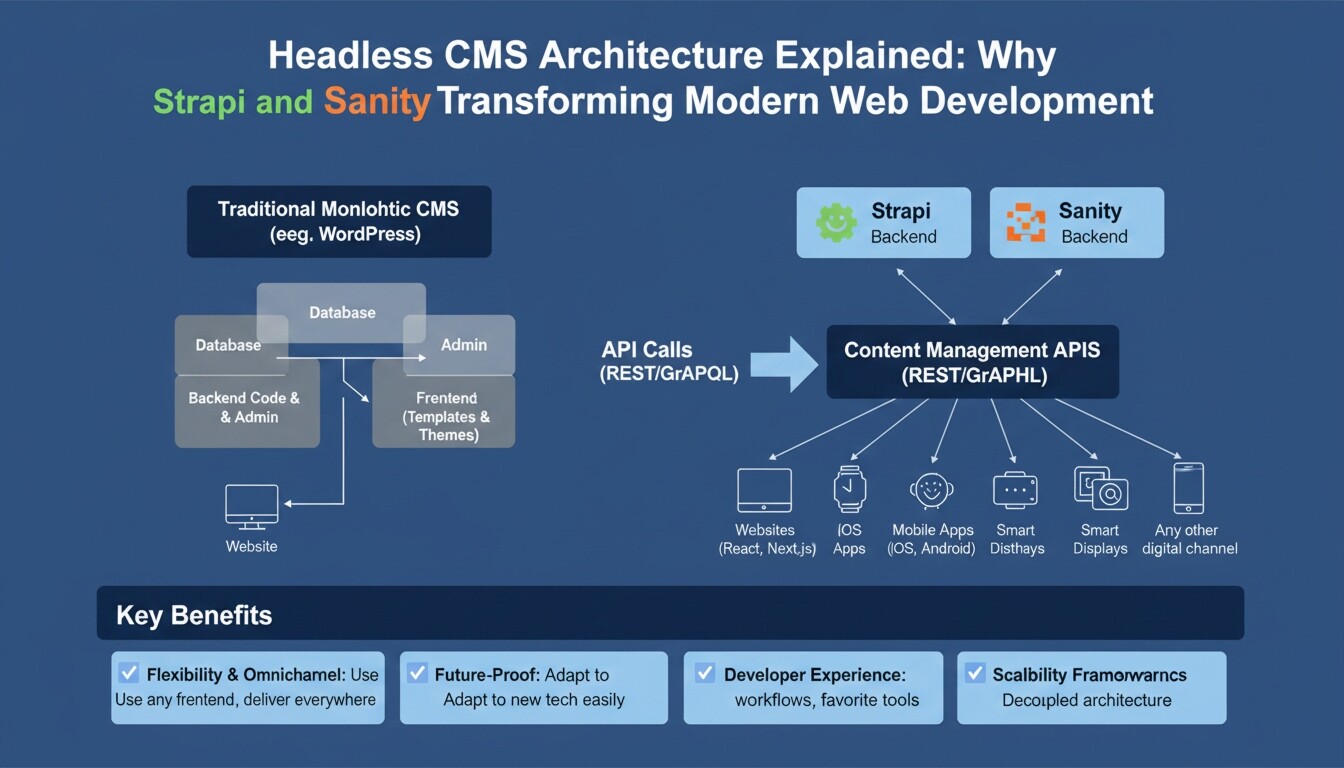
A headless CMS is a backend-only content management system that stores and manages content while delivering it via APIs (Application Programming Interfaces). Unlike traditional CMS platforms, it does not dictate how content is presented.
In simple terms:
- Backend (Body) → Content storage and management
- Frontend (Head) → Presentation layer (website, app, etc.)
This separation allows developers to use any frontend technology like React, Angular, or Vue while pulling content via APIs.
Key Features of Headless CMS
- API-First Approach
- Content is delivered through REST or GraphQL APIs, making integration seamless.
- Frontend Flexibility
- Developers are free to choose frameworks without CMS limitations.
- Omnichannel Content Delivery
- Content can be reused across websites, mobile apps, IoT devices, and more.
- Scalability
- Ideal for growing applications with high performance demands.
Strapi vs Sanity: Overview
Strapi
Strapi is an open-source headless CMS that gives developers full control over their backend. It is self-hosted and highly customizable.
Key Advantages:
- Open-source and free to use
- Full control over data and infrastructure
- Custom APIs and plugins
- Easy integration with databases
Best For:
Businesses wanting complete control and customization.
Sanity
Sanity is a cloud-based headless CMS known for its real-time content editing and structured content approach.
Key Advantages:
- Real-time collaboration
- Hosted infrastructure
- Flexible content modeling
- Powerful query system (GROQ)
Best For:
Teams that prioritize collaboration and fast content updates.
Architecture Breakdown
A typical headless CMS architecture includes:
Content Repository
Stores structured content like text, images, and metadata.
API Layer
Provides access to content via REST or GraphQL APIs.
Frontend Layer
Built using modern frameworks like React or Next.js.
CDN (Content Delivery Network)
Ensures fast content delivery globally.
This architecture allows independent scaling of frontend and backend systems, improving performance and reliability.
Benefits of Headless CMS
1. Flexibility
Developers are not restricted by templates or themes, allowing complete creative freedom.
2. Faster Development
Frontend and backend teams can work independently, speeding up development cycles.
3. Improved Performance
Content is delivered via APIs and CDNs, ensuring faster load times.
4. Future-Proof
Easily adapt to new technologies without migrating the entire system.
5. Better Security
Decoupling reduces attack surfaces compared to traditional CMS.
Use Cases
- E-commerce Platforms
- Deliver product content across web, mobile, and marketplaces.
- Mobile Applications
- Use a single backend to serve multiple apps.
- Digital Marketing Websites
- Quickly update and distribute content across channels.
- SaaS Platforms
- Manage dynamic content efficiently.
Headless CMS vs Traditional CMS
FeatureTraditional CMSHeadless CMSArchitectureMonolithicDecoupledFlexibilityLimitedHighPerformanceModerateHighScalabilityLimitedExcellentFrontend ControlRestrictedFull
Challenges to Consider
While headless CMS offers many advantages, it also comes with some challenges:
- Requires more development expertise
- No built-in frontend
- Initial setup can be complex
However, for most modern applications, the benefits outweigh these limitations.
Conclusion
Headless CMS architecture is no longer just a trend—it is becoming the standard for modern digital experiences. Platforms like Strapi and Sanity empower developers and businesses to build scalable, flexible, and high-performing applications.
If your business is aiming for omnichannel delivery, faster performance, and future-ready technology, adopting a headless CMS could be a game-changing decision.
We build scalable web, mobile, and game products for clients worldwide — combining modern frameworks, cloud infrastructure, and best engineering practices.