Main Content
In software development, choosing the right project engagement model can significantly impact the success of a client relationship. For a Business Development Executive (BDE), understanding different pricing and engagement models is essential when discussing requirements, preparing proposals, and helping clients select the most suitable approach.
The three most common models are fixed-price, hourly, and dedicated-team projects. Each model has different advantages, limitations, pricing structures, and use cases. A BDE should not recommend a model simply because it is easier to sell. Instead, the recommendation should be based on the client's requirements, project scope, budget, timeline, and expected level of flexibility.
1. Fixed-Price Projects
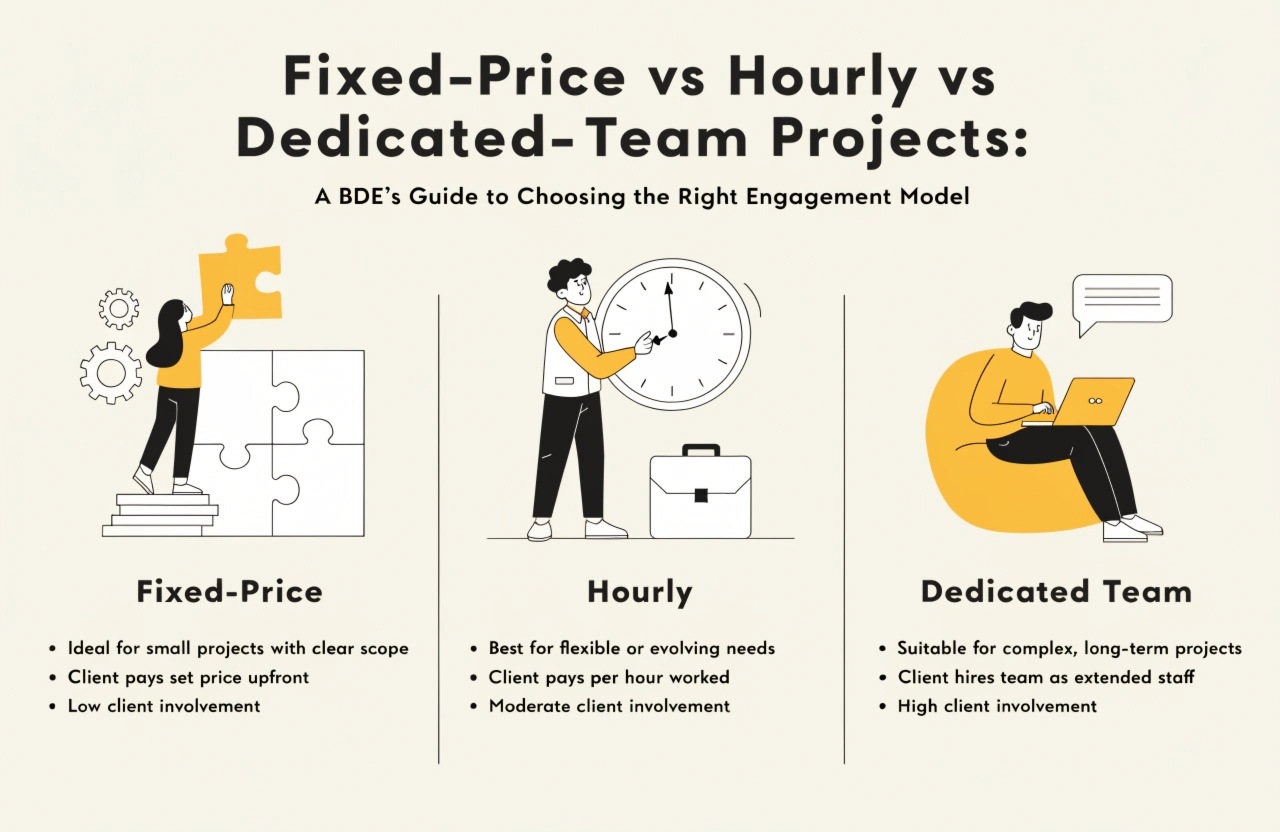
A fixed-price model works best when the project requirements are clearly defined before development begins.
Under this approach, the client and development company agree on the project scope, deliverables, estimated timeline, and total price. For example, if a client needs a basic corporate website with specific pages and features, the development company can estimate the work and provide a fixed quotation.
Advantages include:
- Clear project budget
- Defined deliverables
- Easier financial planning
- Predictable project scope
- Suitable for smaller and well-defined projects
However, fixed-price projects can become challenging when requirements frequently change. Additional features may require a change request, revised timeline, and additional cost.
For a BDE, the key responsibility is to ensure that the scope is clearly documented before presenting the quotation. Misunderstanding requirements at the beginning can lead to scope creep, delays, and client dissatisfaction.
2. Hourly Projects
The hourly model provides greater flexibility. Instead of agreeing to one fixed project price, the client pays based on the actual development hours used.
This approach is useful when requirements are expected to evolve or when the client wants to continuously improve an existing product.
For example, an e-commerce company may require ongoing development, bug fixing, API integrations, UI improvements, and new features. Since the requirements may change regularly, an hourly engagement can be more practical than fixing the entire scope in advance.
Advantages include:
- High flexibility
- Easy accommodation of changing requirements
- Suitable for ongoing development
- Transparent effort-based billing
- Works well with Agile development
The major concern for clients can be budget uncertainty. A BDE should therefore explain how hours will be tracked, how estimates will be communicated, and how priorities will be managed.
3. Dedicated-Team Projects
A dedicated-team model is suitable for clients who need a long-term development team rather than support for one specific project.
Under this model, the client gets access to a team consisting of professionals such as developers, designers, QA engineers, project managers, or other specialists according to their requirements.
For example, a startup developing a SaaS platform may need a React developer, backend developer, UI/UX designer, and QA engineer for several months. Instead of defining every feature upfront, the client can work with a dedicated team and continuously prioritize development.
Advantages include:
- Long-term collaboration
- Greater flexibility
- Direct communication with the development team
- Easier scaling of resources
- Suitable for evolving products
- Better control over development priorities
For BDEs, this model can also create stronger long-term client relationships because the engagement can grow as the client's business grows.
How Should a BDE Choose the Right Model?
A BDE should begin by asking the right questions instead of immediately discussing pricing.
Important questions include:
Is the project scope clearly defined?
If yes, a fixed-price model may be appropriate.
Are requirements likely to change?
If yes, hourly or dedicated-team models may provide greater flexibility.
Is the client looking for short-term delivery or long-term development?
Short-term projects may fit fixed-price or hourly engagement, while long-term product development may benefit from a dedicated team.
Does the client have a fixed budget?
A fixed-price approach can provide better cost predictability when requirements are stable.
Does the client need continuous technical support?
Hourly or dedicated-team models may be more suitable for ongoing development and maintenance.
Comparing the Three Models
Factor Fixed-Price Hourly Dedicated Team
Scope Clearly defined Flexible Flexible
Budget Predictable Variable Recurring
Changes Limited Easy Easy
Best For Defined projects Evolving tasks Long-term products
Flexibility Low High Very High
Long-Term Collaboration Moderate High Very High
The BDE’s Role Goes Beyond Selling
A successful BDE in the IT industry should act as a business consultant, not simply a salesperson. Clients may not always understand technical project structures, development processes, or pricing models. It is the BDE's responsibility to simplify these concepts and recommend an engagement model that aligns with the client's business objectives.
The wrong model can create problems even when the development team is technically strong. A project with constantly changing requirements may struggle under a rigid fixed-price agreement, while a small and clearly defined project may become unnecessarily complicated under a dedicated-team model.
Conclusion
Fixed-price, hourly, and dedicated-team projects each have their own advantages. The best choice depends on the project's scope, complexity, budget, timeline, flexibility, and long-term goals.
For a BDE, understanding these models is an important part of effective client communication and project selling. Rather than focusing only on closing a deal, BDEs should identify the client's actual needs and recommend the engagement model that offers the best balance of cost, flexibility, transparency, and business value.
When BDEs make the right recommendation from the beginning, they can reduce misunderstandings, improve client confidence, support smoother project execution, and build stronger long-term relationships with clients.