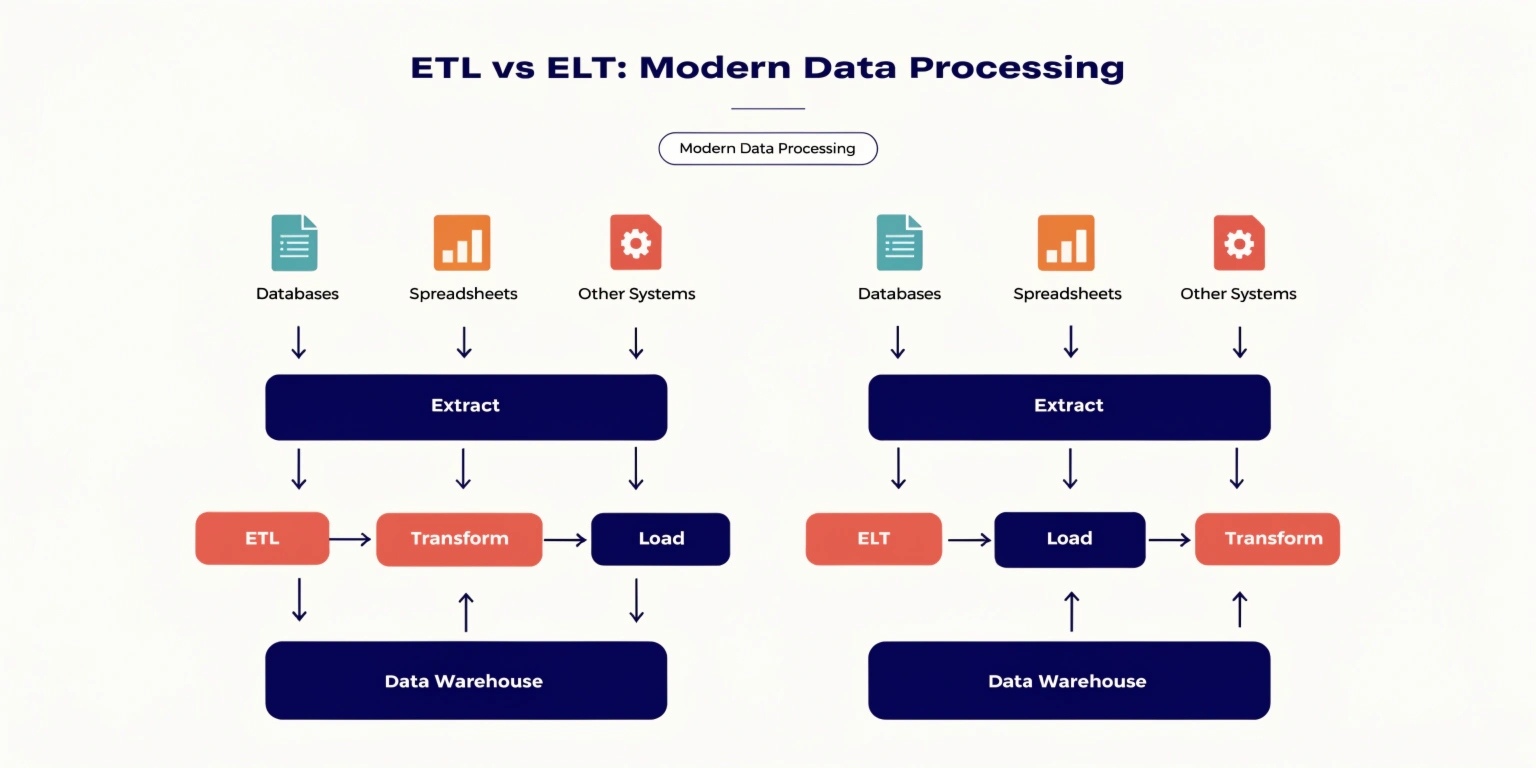
ETL and ELT are two approaches to building data pipelines. ETL transforms data before loading it into a target system, while ELT loads raw data first and transforms it within the destination platform. Modern cloud data architectures increasingly favor ELT for scalability and flexibility.
Organizations generate enormous amounts of data from applications, websites, mobile devices, databases, APIs, transactions, IoT systems, and third-party platforms. Turning this raw information into useful business intelligence requires reliable data-processing pipelines.
Two of the most established approaches are ETL and ELT.
Although their names differ by only one letter, their architectures and operational characteristics can be significantly different.
ETL stands for:
Extract → Transform → Load
ELT stands for:
Extract → Load → Transform
Understanding the distinction is essential for designing modern data platforms, analytics systems, reporting infrastructure, and machine-learning pipelines.
What Is ETL?
ETL is the traditional approach to data integration.
The process consists of three stages.
Extract
Data is collected from one or more sources.
Examples include:
- Relational databases
- CRM systems
- APIs
- CSV files
- Enterprise applications
- Transaction systems
Transform
The extracted data is processed before reaching the destination.
Transformations may include:
- Cleaning
- Filtering
- Deduplication
- Aggregation
- Type conversion
- Validation
- Data enrichment
Load
The transformed data is then loaded into a target data warehouse or database.
The architecture can be represented as:
Sources → ETL Engine → Transformations → Data Warehouse
What Is ELT?
ELT changes the order of the final two stages.
The process becomes:
Extract → Load → Transform
Raw data is first loaded into a modern data warehouse, lake, or lakehouse.
Transformations then occur within the destination platform.
This approach has become increasingly popular with cloud-based data platforms because modern infrastructure can provide substantial storage and compute capacity.
Key Difference Between ETL and ELT
The primary difference is where transformation occurs.
In ETL, transformation happens before loading.
In ELT, transformation happens after loading.
This seemingly simple architectural difference can have significant implications for scalability, flexibility, governance, and processing costs.
ETL Architecture
A typical ETL pipeline might look like:
Source Systems
↓
Extraction
↓
Transformation Engine
↓
Validation
↓
Data Warehouse
↓
Analytics
The transformation engine performs much of the data-processing work before the information reaches the warehouse.
This approach was particularly useful when data warehouses had limited storage and processing capabilities.
ELT Architecture
An ELT architecture might look like:
Source Systems
↓
Extraction
↓
Raw Data Storage
↓
Cloud Warehouse / Lakehouse
↓
Transformation
↓
Analytics / ML
Raw data remains available in the destination system, allowing teams to transform it differently for different analytical requirements.
Why ELT Became Popular
Cloud data platforms changed the economics and architecture of data processing.
Modern warehouses can provide scalable compute and storage resources.
Instead of maintaining a large external transformation infrastructure, organizations can load raw data into their cloud environment and perform transformations there.
This enables a more flexible architecture.
ETL Advantages
ETL remains useful for many workloads.
Strong Pre-Load Data Processing
Organizations can ensure data is cleaned and validated before entering the target system.
Controlled Data Exposure
Sensitive information can potentially be filtered or masked before it reaches downstream storage.
Mature Architecture
ETL has been used for decades and is supported by numerous enterprise tools and practices.
Useful for Legacy Systems
Organizations with traditional data warehouses may already have established ETL pipelines.
ETL Limitations
Traditional ETL can introduce several challenges.
Limited Flexibility
Once data is transformed before loading, some original information may no longer be available.
Infrastructure Complexity
Transformation processing may require separate compute infrastructure.
Scaling Challenges
Large transformations can require significant engineering effort to scale efficiently.
Longer Pipeline Development
Complex transformation logic can make pipelines more difficult to maintain.
ELT Advantages
ELT provides several benefits for modern data architectures.
Scalability
Cloud platforms can dynamically scale processing resources for large datasets.
Raw Data Preservation
Organizations can retain source-level information before transformation.
Faster Data Ingestion
Data can often be loaded quickly and transformed afterward.
Flexible Transformations
Different teams can transform the same raw dataset for different purposes.
For example, marketing teams and financial teams may use the same customer data but apply different transformation logic.
ELT Limitations
ELT is not automatically the right choice for every organization.
Increased Storage Requirements
Raw data may require substantial storage capacity.
Governance Complexity
Keeping large amounts of raw data introduces additional security and governance requirements.
Compute Costs
Repeated transformations can increase cloud processing costs if workloads are not optimized.
Data Quality Risks
If transformation and validation are delayed, poor-quality data may exist within the analytical environment.
ETL vs ELT Performance
Performance depends on architecture, workload, data volume, transformation complexity, and infrastructure.
Traditional ETL can be effective when data must be heavily processed before reaching the destination.
ELT can perform extremely well when the destination platform provides scalable compute.
Instead of asking which method is inherently faster, teams should evaluate:
- Data volume
- Transformation complexity
- Query patterns
- Processing frequency
- Infrastructure
- Cost
- Latency requirements
Batch Processing
Both ETL and ELT can support batch processing.
For example, an organization might process sales information every night.
The pipeline could:
Extract → Process → Load
or:
Extract → Load → Transform
depending on architectural requirements.
Batch processing remains common for financial reporting, historical analytics, and large-scale data integration.
Real-Time Data Processing
Modern applications increasingly require near-real-time analytics.
For example:
- Fraud detection
- Customer behavior tracking
- IoT monitoring
- Operational dashboards
- Recommendation systems
Neither ETL nor ELT automatically guarantees real-time processing.
Organizations may need event-streaming architectures, incremental processing, change-data capture, or stream-processing systems.
The choice between ETL and ELT should therefore be considered alongside the overall data architecture.
Data Lakes and Lakehouses
ELT is particularly compatible with data lakes and lakehouse architectures.
Raw information can be stored in its original form and transformed when required.
This supports multiple workloads, including:
- Business intelligence
- Data science
- Machine learning
- Exploratory analytics
- Historical analysis
A lakehouse can combine aspects of data lakes and data warehouses to provide structured analytical capabilities over large datasets.
Data Governance
Governance is critical in both architectures.
Organizations should establish policies for:
- Data ownership
- Access control
- Retention
- Encryption
- Data classification
- Quality
- Lineage
- Compliance
ELT environments may require particularly strong controls because raw data is retained within the analytical platform.
Data Quality
Data quality should not be postponed simply because an architecture uses ELT.
Organizations should implement validation checks for:
- Missing values
- Invalid formats
- Duplicate records
- Unexpected schema changes
- Referential integrity
- Business rules
Automated data-quality testing can identify problems before they affect dashboards or downstream applications.
Schema Evolution
Data sources frequently change.
A software application may add a field, rename a column, or modify a data type.
Modern pipelines should be designed to handle schema evolution safely.
ELT architectures can provide greater flexibility because raw data can be retained, allowing teams to revisit transformations when source structures change.
Cost Optimization
Cloud-based data platforms often charge based on storage, compute, or query usage.
ELT pipelines should therefore be designed carefully.
Optimization techniques include:
- Incremental transformations
- Partitioning
- Query optimization
- Materialized datasets
- Caching
- Eliminating unnecessary recomputation
- Lifecycle-based storage management
The goal is not simply to minimize storage or compute costs independently but to optimize total pipeline economics.
When Should You Choose ETL?
ETL can be appropriate when:
- Data must be transformed before storage.
- Sensitive information needs filtering.
- Legacy warehouse infrastructure is involved.
- Strong pre-load validation is required.
- Transformation infrastructure already exists.
- Data volumes are manageable within existing systems.
Industries with strict data-processing requirements may continue to use ETL for specific workloads.
When Should You Choose ELT?
ELT is often suitable when:
- Cloud data warehouses are available.
- Large amounts of raw data need to be retained.
- Analytics requirements change frequently.
- Multiple teams need the same source data.
- Scalable cloud compute is available.
- Data science and machine-learning workloads are important.
Many modern analytics platforms use ELT as a core architectural pattern.
ETL and ELT Can Coexist
Organizations do not necessarily need to choose one approach for everything.
A hybrid architecture can use ETL for sensitive or operational datasets while using ELT for large-scale analytical workloads.
For example:
Sensitive Transaction Data → ETL → Controlled Warehouse
Application Events → ELT → Cloud Data Platform
This approach allows teams to choose the architecture based on individual workload requirements.
Modern Data Pipeline Best Practices
Regardless of architecture, reliable pipelines should include:
- Automated monitoring
- Data-quality validation
- Schema management
- Error handling
- Retry mechanisms
- Data lineage
- Access control
- Encryption
- Pipeline testing
- Observability
Data pipelines are production systems and should be treated with the same engineering discipline as application infrastructure.
Conclusion
ETL and ELT represent two different approaches to moving and processing data.
ETL follows:
Extract → Transform → Load
ELT follows:
Extract → Load → Transform
Traditional ETL remains valuable when data must be transformed or controlled before reaching its destination. However, ELT has become increasingly popular because modern cloud data platforms provide scalable storage and computational capabilities.
The right choice depends on data volume, security requirements, infrastructure, transformation complexity, latency expectations, governance needs, and cost.
Rather than treating ETL and ELT as competing technologies, modern data teams should view them as architectural patterns that can be combined when appropriate. The strongest data-processing strategy is the one that delivers reliable, governed, scalable, and accessible data for analytics, applications, and machine-learning workloads.
We build scalable web, mobile, and game products for clients worldwide — combining modern frameworks, cloud infrastructure, and best engineering practices.