Edge AI and IoT integration are transforming industries by enabling intelligent decision-making directly on connected devices. Learn how this powerful combination improves efficiency, security, and real-time responsiveness.
The rapid growth of connected devices has transformed how businesses collect, process, and utilize data. The Internet of Things (IoT) has enabled billions of devices to communicate, monitor environments, and automate processes. At the same time, Artificial Intelligence (AI) has unlocked the ability to analyze data, recognize patterns, and make intelligent decisions.
Traditionally, IoT devices sent data to centralized cloud platforms for processing. However, the increasing volume of data and the demand for real-time responses have exposed the limitations of cloud-dependent architectures. This challenge has led to the emergence of Edge AI, a technology that brings artificial intelligence directly to edge devices.
The integration of Edge AI and IoT is creating a new generation of intelligent systems capable of making decisions closer to where data is generated. This combination is reshaping industries, improving operational efficiency, and enabling real-time automation.
Understanding Edge AI
Edge AI refers to the deployment of artificial intelligence models directly on devices or edge infrastructure rather than relying entirely on cloud servers.
These devices can include:
- Smart cameras
- Industrial sensors
- Autonomous vehicles
- Medical devices
- Smartphones
- Smart home systems
Instead of transmitting raw data to the cloud for analysis, Edge AI processes information locally and generates immediate insights.
This approach significantly reduces latency while improving efficiency and privacy.
What Is IoT?
The Internet of Things (IoT) is a network of interconnected devices that collect, exchange, and act upon data.
Examples include:
- Smart thermostats
- Wearable devices
- Industrial machinery
- Smart meters
- Connected vehicles
- Environmental monitoring systems
IoT devices generate vast amounts of data that can be used to optimize operations, improve customer experiences, and automate decision-making.
However, processing all this information in the cloud can create performance bottlenecks.
Why Edge AI and IoT Are a Perfect Match
The integration of AI and IoT, often called AIoT (Artificial Intelligence of Things), addresses many limitations of traditional IoT architectures.
Reduced Latency
In cloud-based systems, data must travel to remote servers before decisions are made.
This process can introduce delays.
With Edge AI:
- Data is processed locally.
- Decisions are made instantly.
- Response times are significantly improved.
This is crucial for applications such as autonomous vehicles and industrial automation.
Improved Bandwidth Efficiency
IoT devices generate enormous amounts of data.
Transmitting every data point to the cloud can be expensive and inefficient.
Edge AI filters and analyzes data locally, sending only relevant information to central systems.
This reduces:
- Network traffic
- Cloud storage costs
- Communication overhead
Enhanced Privacy and Security
Sensitive information often remains on the device instead of being transmitted externally.
Benefits include:
- Reduced data exposure
- Improved regulatory compliance
- Better privacy protection
This is especially important in healthcare and financial applications.
Increased Reliability
Edge devices can continue operating even when internet connectivity is limited or unavailable.
This ensures uninterrupted service in critical environments.
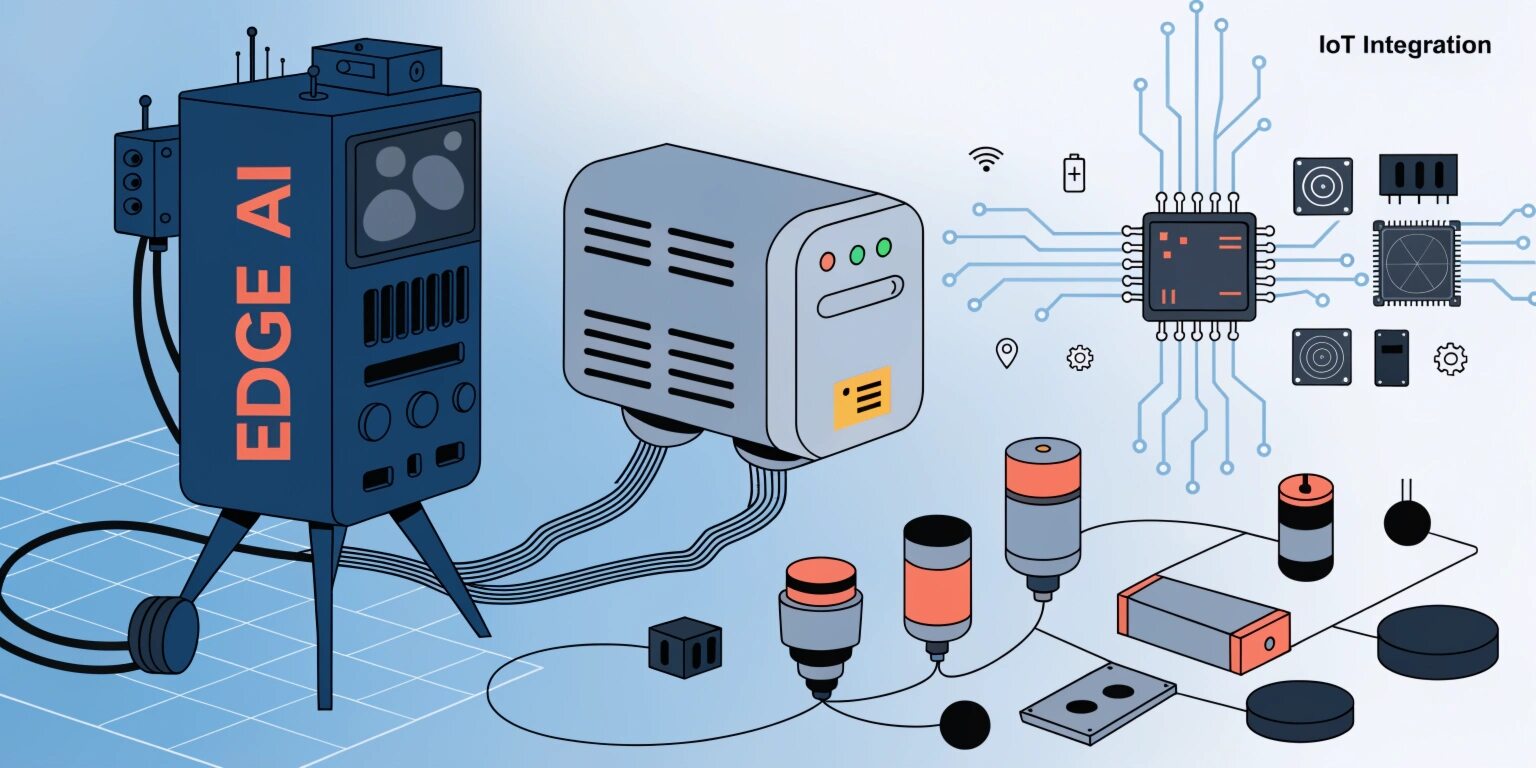
Key Components of Edge AI and IoT Integration
IoT Sensors
Sensors collect environmental and operational data.
Examples include:
- Temperature sensors
- Motion detectors
- Cameras
- GPS modules
- Pressure sensors
Edge Devices
Edge hardware performs local processing and AI inference.
Examples:
- NVIDIA Jetson
- Raspberry Pi
- Intel Movidius
- Edge gateways
AI Models
Machine learning models analyze data and generate predictions or decisions.
Common applications include:
- Object detection
- Predictive maintenance
- Anomaly detection
- Speech recognition
Cloud Platforms
While processing occurs at the edge, cloud systems still provide:
- Long-term storage
- Model training
- Fleet management
- Centralized monitoring
The cloud and edge complement each other rather than compete.
Real-World Applications
Smart Manufacturing
Manufacturing facilities use Edge AI-powered IoT systems to monitor equipment and predict failures before they occur.
Benefits include:
- Reduced downtime
- Lower maintenance costs
- Increased productivity
Healthcare
Medical devices can analyze patient data in real time.
Examples:
- Heart monitoring systems
- Wearable health trackers
- Remote patient monitoring devices
This enables faster interventions and improved patient outcomes.
Smart Cities
Cities deploy connected sensors and Edge AI to manage:
- Traffic flow
- Public safety
- Waste management
- Energy consumption
Real-time analytics improve urban efficiency.
Retail
Retailers use smart cameras and AI-powered sensors to:
- Track customer behavior
- Manage inventory
- Reduce theft
- Optimize store layouts
Autonomous Vehicles
Self-driving vehicles require instant decision-making.
Edge AI processes sensor data locally to:
- Detect obstacles
- Navigate roads
- Prevent collisions
Cloud latency would make these decisions too slow.
Challenges of Edge AI and IoT Integration
Despite its benefits, implementation comes with challenges.
Hardware Limitations
Edge devices often have constrained processing power and memory.
Developers must optimize AI models for efficiency.
Security Risks
Distributed devices create larger attack surfaces.
Organizations must implement:
- Encryption
- Secure boot mechanisms
- Device authentication
Model Management
Updating AI models across thousands of edge devices can be complex.
Effective lifecycle management is essential.
Scalability
Managing large fleets of connected devices requires robust infrastructure and monitoring capabilities.
Best Practices for Successful Implementation
Optimize Models for Edge Deployment
Use lightweight models designed for resource-constrained environments.
Implement Strong Security Controls
Secure devices, networks, and communication channels.
Monitor Device Health
Continuously track performance and operational status.
Use Hybrid Architectures
Combine edge processing with cloud capabilities for maximum flexibility and efficiency.
Automate Model Updates
Establish processes for remote deployment and management of AI models.
The Future of Edge AI and IoT
The future of AIoT is incredibly promising.
Emerging trends include:
- 5G-enabled edge computing
- Federated learning
- Autonomous industrial systems
- Smart robotics
- Intelligent transportation networks
- Real-time digital twins
As hardware becomes more powerful and AI models become more efficient, edge intelligence will continue to expand across industries.
Organizations that embrace these technologies will gain significant competitive advantages through improved automation, faster decision-making, and enhanced operational efficiency.
Conclusion
The integration of Edge AI and IoT is transforming the way organizations process data and make decisions. By bringing intelligence closer to data sources, businesses can reduce latency, improve security, lower operational costs, and enable real-time automation.
From manufacturing and healthcare to smart cities and autonomous vehicles, Edge AI-powered IoT systems are driving innovation across countless industries. As technology continues to evolve, the combination of edge computing, artificial intelligence, and connected devices will become a cornerstone of the next generation of intelligent digital ecosystems.
For businesses looking to remain competitive in an increasingly connected world, investing in Edge AI and IoT integration is no longer a future consideration—it is a strategic necessity.
We build scalable web, mobile, and game products for clients worldwide — combining modern frameworks, cloud infrastructure, and best engineering practices.