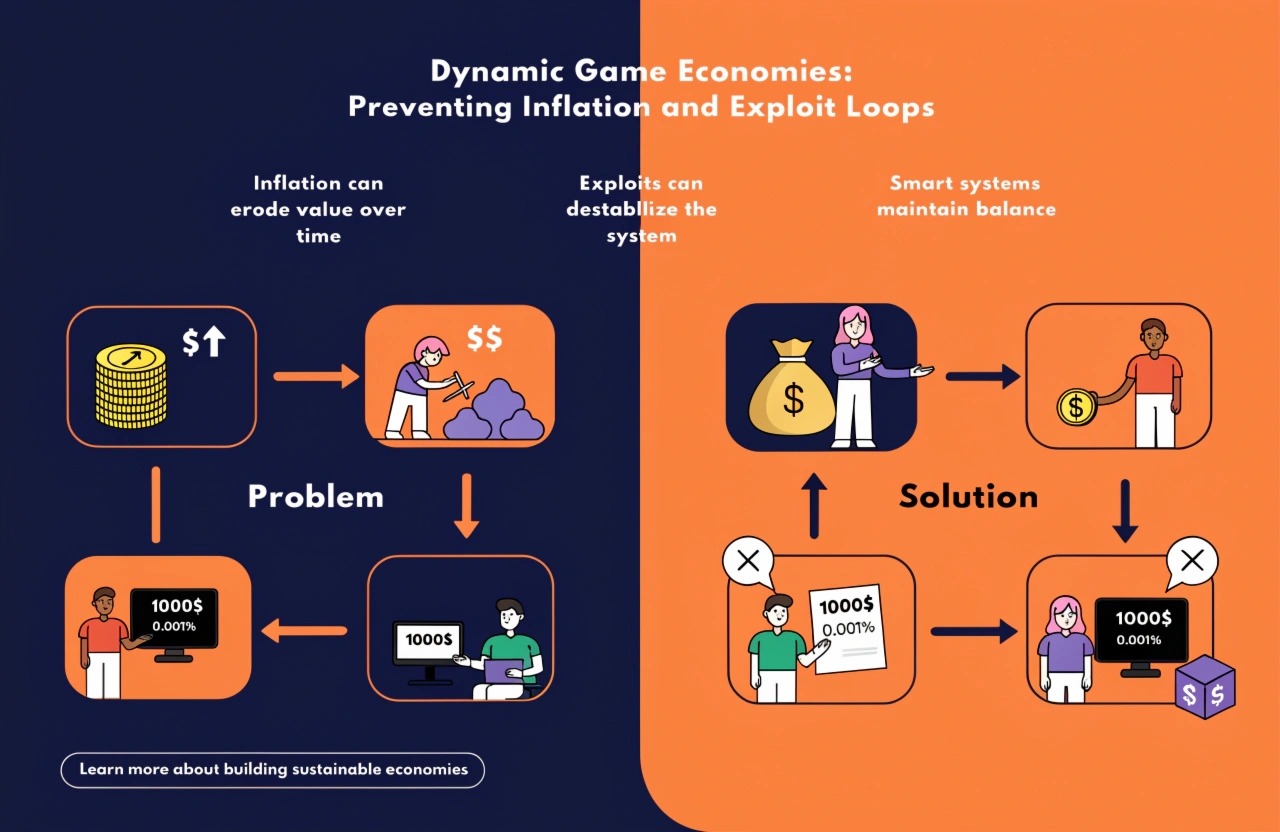
Dynamic game economies help developers control virtual currency inflation, prevent exploit loops, balance rewards, and maintain fair progression. Discover practical techniques for designing sustainable in-game economies that improve player engagement and long-term game health.
Introduction
Modern video games are more than entertainment experiences. Many feature complex virtual economies where players earn currencies, purchase items, trade resources, upgrade characters, and compete for valuable rewards. From mobile games to multiplayer online worlds, these systems directly influence player progression, engagement, and long-term retention.
However, managing a virtual economy becomes challenging as player behavior changes, new content is introduced, and unexpected exploits emerge. Excessive rewards can cause inflation, while repetitive strategies that generate unlimited resources can damage game balance.
Dynamic game economies provide developers with a structured approach to monitoring and adjusting economic systems based on player activity, resource availability, and gameplay conditions. By combining thoughtful game design, analytics, and controlled adjustments, developers can create fair, engaging, and sustainable gaming experiences.
What Is a Dynamic Game Economy?
A dynamic game economy is an in-game system in which currencies, resources, rewards, prices, and progression mechanisms are monitored and adjusted according to defined rules and observed gameplay conditions.
Unlike a completely static economy, a dynamic system can respond to changes in player behavior and resource circulation. For example, if players accumulate too much gold through repetitive missions, developers might introduce additional resource-consuming activities or adjust future reward rates.
Dynamic does not mean changing everything constantly. Frequent, unpredictable adjustments can frustrate players and undermine trust. Instead, effective systems use measurable indicators, clear design rules, and carefully tested changes.
These economies are particularly useful in role-playing games, strategy games, simulation games, multiplayer environments, and live-service titles where players interact with persistent resources over extended periods.
Understanding Inflation in Virtual Economies
Inflation occurs when the amount of currency circulating in a game increases faster than the economy can absorb it, reducing the currency's purchasing power.
For example, imagine a multiplayer game where players initially earn 100 gold coins per mission. Over time, developers introduce stronger rewards, daily bonuses, and repeatable farming activities. Players begin accumulating thousands of coins, but the prices of essential items remain unchanged.
If gold becomes abundant, players may purchase everything easily, reducing the value of progression and rewards. In player-to-player marketplaces, increased purchasing power may also contribute to rising prices for scarce items.
Inflation can weaken progression systems, reduce the satisfaction of earning rewards, and make new players feel disadvantaged compared with established players.
Common Causes of Game Inflation
Several factors can contribute to inflation:
- Excessive currency rewards from quests, events, or repeatable missions.
- Unbalanced daily login bonuses and promotional rewards.
- Automated farming or bot activity that generates resources continuously.
- Poorly designed trading systems that enable uncontrolled currency circulation.
- Limited opportunities to spend accumulated currency.
- Exploits that allow players to duplicate valuable items or resources.
Identifying the source of inflation is essential before changing rewards or prices.
Designing Effective Currency Sinks
One of the most reliable methods for controlling inflation is introducing currency sinks. A currency sink removes currency from circulation rather than transferring it between players.
Examples include equipment repairs, crafting fees, cosmetic purchases, housing upgrades, fast travel costs, and optional convenience services.
Suppose players collectively earn 100,000 gold coins each day, but only spend 60,000. The economy gains a net 40,000 coins daily. If this imbalance continues, accumulated currency may eventually weaken the value of gold.
Developers can introduce appealing spending opportunities that encourage players to use their savings naturally. The goal is not to punish players for earning rewards but to maintain a healthy balance between currency entering and leaving the economy.
Currency sinks should also respect different play styles. Essential progression should not become unnecessarily expensive, and cosmetic or optional purchases can provide additional spending opportunities without creating excessive barriers.
Preventing Exploit Loops
An exploit loop occurs when players repeatedly abuse a game mechanic to generate disproportionate rewards, bypass intended progression, or obtain resources with little meaningful effort.
For example, a player might repeatedly restart a mission to collect its completion reward without completing the intended challenge. Another exploit could involve duplicating items through a trading interaction or combining multiple reward systems to claim the same bonus several times.
These exploits can damage the economy by introducing unintended quantities of currency or valuable items.
Strategies to Eliminate Exploit Loops
1. Validate rewards on the server
For online games, important transactions and reward calculations should be validated by authoritative server-side logic. Client-side values alone should not determine whether a player receives currency or rare items.
2. Apply transaction safeguards
Trading, crafting, purchases, and reward claims should use reliable transaction handling. Idempotency controls, appropriate database transactions, and duplicate-request protection can prevent repeated requests from granting the same reward multiple times.
3. Monitor unusual behavior
Analytics systems can identify suspicious patterns, such as unusually high currency generation, repeated mission resets, abnormal trade volumes, or reward claims that exceed expected limits.
4. Test edge cases
Quality assurance teams should test simultaneous requests, network interruptions, reconnect scenarios, boundary values, and unexpected sequences of player actions.
5. Establish recovery procedures
Developers should maintain audit logs and carefully designed rollback or correction procedures. When an exploit is discovered, teams can investigate its impact and respond proportionately rather than penalizing legitimate players.
Using Analytics to Balance the Economy
Game analytics help developers understand whether economic systems are functioning as intended.
Important metrics include currency generation, currency spending, average player balances, item prices, mission completion rates, trading volumes, and progression speed.
Developers should segment these metrics by player experience, game mode, region, and progression stage where appropriate. An experienced player accumulating substantial wealth may be behaving normally, while a new account generating the same amount within minutes may require investigation.
Economy simulations can also help teams predict how reward adjustments, new items, and seasonal events might affect resource circulation before changes reach players.
Automated adjustments can be useful, but major economic changes should be tested and monitored carefully. Sudden price increases or reward reductions can feel unfair if players do not understand the reasons behind them.
Building a Fair and Sustainable Economy
A successful game economy balances several competing goals: rewarding effort, supporting progression, encouraging meaningful choices, and preserving long-term engagement.
Developers should provide new players with accessible progression paths while ensuring experienced players have worthwhile goals. Limited-time events should introduce excitement without permanently flooding the economy with valuable resources.
Transparency is equally important. When major changes affect rewards, prices, or trading rules, clear communication helps players understand the reasoning behind those decisions.
Economic controls should also avoid unnecessarily restricting legitimate player creativity. Trading, crafting, collecting, and strategic resource management can be important parts of the experience. The objective is to remove harmful imbalances without eliminating the activities players enjoy.
Conclusion
Dynamic game economies are essential for maintaining balanced and engaging experiences in modern games. By monitoring resource circulation, designing effective currency sinks, securing reward systems, and using analytics to identify abnormal behavior, developers can reduce inflation and prevent exploit loops before they cause lasting damage.
The most effective approach combines careful economic design with technical safeguards, continuous testing, and player-focused decision-making. As games become increasingly connected and content evolves over time, sustainable economy management will remain a critical part of successful game development.
We build scalable web, mobile, and game products for clients worldwide — combining modern frameworks, cloud infrastructure, and best engineering practices.
.jpg)