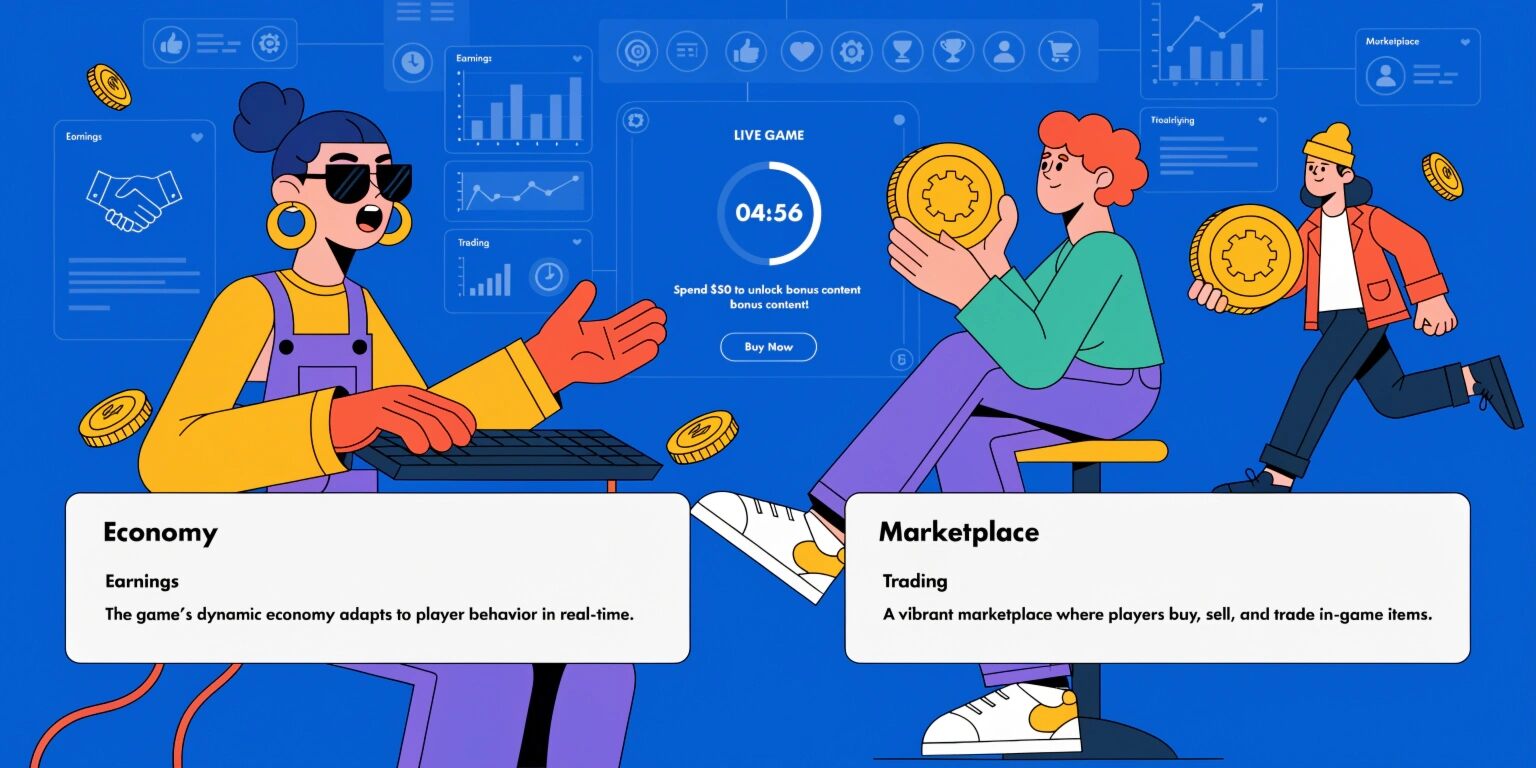
Dynamic economy systems allow live games to adapt currencies, resources, rewards, prices, and progression according to player behavior and market conditions. Effective systems control inflation, maintain meaningful progression, and create sustainable gameplay through carefully designed economic faucets, sinks, and feedback loops.
Live-service games operate for months or even years after launch. During this period, player behavior changes, new content is introduced, currencies accumulate, and the value of resources can shift dramatically. A static economy that works during launch may become unbalanced later. This is why dynamic economy systems are increasingly important in modern live games.
A dynamic economy continuously monitors and adjusts elements such as currencies, resources, rewards, item prices, supply, demand, and progression. The goal is not necessarily to make the economy constantly change, but to ensure that it remains functional as the player population and gameplay environment evolve.
Understanding Game Economy Systems
A game economy consists of everything related to the creation, distribution, consumption, and exchange of valuable resources.
Common economic elements include:
- Soft currencies such as gold or coins
- Premium currencies
- Crafting materials
- Experience points
- Equipment and collectibles
- Consumable resources
- Player-to-player trading
- Marketplace prices
- Rewards and loot
- Upgrade costs
Every economy has faucets and sinks.
Faucets introduce value into the economy. Completing quests, winning matches, selling items, or receiving login rewards can generate currency or resources.
Sinks remove value. Upgrading equipment, crafting items, purchasing cosmetics, repairing equipment, and paying marketplace fees can consume resources.
A healthy economy needs a reasonable relationship between faucets and sinks.
The Problem of Inflation
One of the most common problems in long-running games is inflation.
Suppose players receive 10,000 coins every week but have very few opportunities to spend them. Over time, players accumulate enormous amounts of currency. If new items continue to cost the same amount, the currency gradually loses significance.
Developers can address this through additional sinks.
For example, a live game might introduce:
- Expensive crafting systems
- Cosmetic collections
- Equipment upgrades
- Limited-time events
- Marketplace fees
- Resource conversion systems
- High-level progression systems
These systems provide players with meaningful reasons to spend accumulated resources.
Dynamic Pricing
Dynamic pricing is another powerful component.
Instead of assigning permanent prices to certain items, developers can adjust prices according to supply, demand, player progression, or market conditions.
For example, if a crafting material becomes extremely common after an event, its value may decrease. Conversely, if a rare resource becomes difficult to obtain, demand may increase.
A dynamic pricing system can respond to these changes.
However, automated pricing must be carefully constrained. Extreme price fluctuations can frustrate players and make the economy feel unpredictable.
Player Behavior as an Economic Signal
Modern live games generate enormous amounts of behavioral data.
Developers can monitor:
- Average currency balances
- Currency generation per player
- Currency spending rates
- Item acquisition rates
- Marketplace transactions
- Purchase frequency
- Resource consumption
- Progression speed
- Abandoned content
- Player trading patterns
These metrics can reveal economic problems before they become severe.
For example, if the average player balance increases continuously while spending decreases, the economy may be accumulating excess currency.
If players cannot obtain essential resources quickly enough, progression may become frustrating.
Adaptive Rewards
Rewards can also be dynamically balanced.
Consider an event where players receive a fixed reward regardless of difficulty or participation. Over time, experienced players may accumulate resources much faster than newer players.
A dynamic system can adjust rewards based on factors such as difficulty, progression level, activity, or event participation.
Care must be taken to avoid creating systems that feel manipulative. Players should understand why rewards change and should still feel that their actions have predictable value.
Economic Feedback Loops
A dynamic economy can be designed using feedback loops.
Imagine that a resource becomes scarce. Its value increases, encouraging players to collect it. Increased collection gradually increases supply, which can reduce its value.
This creates a natural balancing mechanism.
Developers can combine these feedback loops with controlled interventions. If the resource becomes excessively scarce, developers might increase drop rates. If it becomes excessively abundant, they might introduce additional consumption opportunities.
Live Operations and Economy Management
Economy balancing is particularly important during live events.
A limited-time event may introduce a new currency, reward system, or collection mechanic. Developers must estimate how much currency players will generate and how quickly they will spend it.
Unexpected player behavior can invalidate these predictions.
For this reason, live-operation teams often monitor economic dashboards during events. If a major imbalance appears, controlled changes can be introduced through server-side configuration.
This is significantly safer than hard-coding every economic value into a game client.
AI and Automated Balancing
Machine learning can eventually support more advanced economic analysis.
Models can identify unusual currency accumulation, predict resource demand, detect abnormal trading behavior, and estimate how economic changes may affect progression.
For example, an anomaly-detection model could identify an unusual increase in currency generation caused by an unintended interaction.
However, automated systems should generally operate within carefully defined boundaries. Fully autonomous economic changes can create unpredictable outcomes if the underlying model misunderstands player behavior.
Preventing Economic Exploits
Dynamic economies also require strong security.
If players can manipulate currency generation, marketplace prices, or trading systems, the entire economy can destabilize.
Server-side validation should therefore verify important transactions.
Developers should monitor:
- Unusual currency generation
- Repeated high-value transactions
- Abnormal marketplace activity
- Duplicate-item exploits
- Rapid account-to-account transfers
- Suspicious resource generation
Economic security is especially important in games where virtual assets have significant value to players.
Designing for Long-Term Stability
A successful dynamic economy should not simply react to every small change. Excessive adjustments can make the game feel unstable.
Instead, developers should establish economic targets such as:
- Desired currency accumulation
- Expected progression speed
- Healthy resource availability
- Target item acquisition frequency
- Sustainable spending rates
- Acceptable marketplace volatility
Developers can then monitor deviations from these targets and introduce controlled adjustments.
The most effective dynamic economies combine careful initial design, real-time analytics, controlled sinks and faucets, predictable rules, and continuous live-operations monitoring.
As live games become increasingly persistent, their economies must evolve alongside their communities. Dynamic economy systems provide developers with the tools to manage this evolution while maintaining meaningful progression and long-term engagement. The objective is not to constantly manipulate prices or rewards, but to create an economic environment that remains understandable, balanced, and sustainable as player behavior and game content change.
We build scalable web, mobile, and game products for clients worldwide — combining modern frameworks, cloud infrastructure, and best engineering practices.
.jpg)