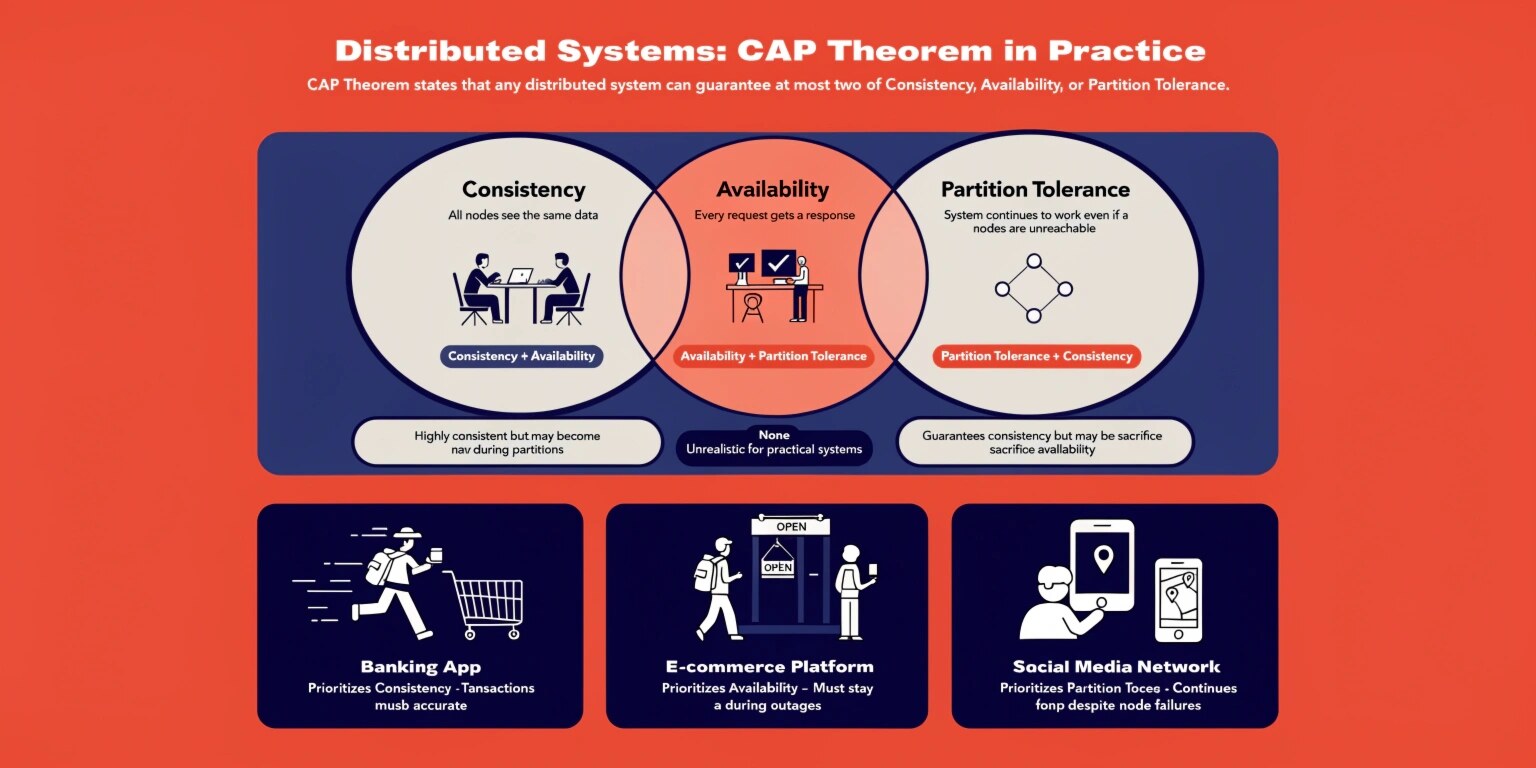
The CAP Theorem explains the trade-offs distributed systems face between consistency, availability, and partition tolerance. Understanding these trade-offs helps architects design databases and applications that remain reliable during network failures while selecting appropriate replication and consistency strategies for real-world workloads.
Modern applications increasingly depend on distributed systems. Global SaaS platforms, payment systems, social networks, cloud applications, streaming services, and eCommerce platforms often operate across multiple servers, regions, and data centers.
Distributing workloads provides scalability and fault tolerance, but it also introduces a fundamental challenge: what happens when different parts of the system cannot communicate?
This is where the CAP Theorem becomes important.
CAP provides a framework for understanding how distributed systems behave when network partitions occur. Rather than being a simple rule that says systems can only choose two out of three properties, CAP is better understood as a description of trade-offs that emerge during a partition.
The three properties are:
- Consistency
- Availability
- Partition Tolerance
Understanding how these concepts interact is essential when designing reliable distributed architectures.
What Is the CAP Theorem?
The CAP Theorem, associated with computer scientist Eric Brewer, states that a distributed data system cannot guarantee both consistency and availability during a network partition.
The three CAP properties are:
Consistency (C): Every successful read receives the most recent applicable write, according to the system's consistency model.
Availability (A): Every request to a non-failing node receives a response, without guaranteeing that the response contains the newest data.
Partition Tolerance (P): The system continues operating despite communication failures that divide nodes into disconnected groups.
The important point is that network partitions are unavoidable possibilities in distributed systems.
Therefore, real-world distributed architectures generally have to tolerate partitions and decide how they will behave when a partition occurs.
Understanding Consistency
Consistency means that clients observe data according to the system's defined consistency guarantees.
Imagine a distributed database containing a user's account balance.
A client updates the balance from:
₹10,000 → ₹8,000
If another client immediately reads the balance and receives ₹10,000 after the update was confirmed, the system may not be providing strong consistency for that operation.
Strong consistency attempts to ensure that successful reads reflect the latest committed value.
However, stronger consistency can require additional coordination between nodes.
Understanding Availability
Availability means that the system continues responding to requests.
Suppose a distributed database contains three nodes and one node becomes unreachable.
An availability-focused architecture may allow the remaining nodes to continue serving requests.
The advantage is resilience from the user's perspective.
However, if the disconnected node contains information that has not yet reached other nodes, the system may return older data.
Availability therefore often comes with a willingness to tolerate temporary inconsistency.
Understanding Partition Tolerance
A network partition occurs when distributed nodes cannot reliably communicate with each other.
For example:
Region A
Node 1
Node 2
X
Network Failure
Region B
Node 3
Node 4
The servers may still be running, but communication between the regions has failed.
A distributed system that continues functioning despite this condition demonstrates partition tolerance.
In geographically distributed systems, partition tolerance is generally considered essential because network failures cannot be completely eliminated.
CP Systems
A CP system prioritizes consistency and partition tolerance.
When a network partition occurs, the system may refuse or delay some operations rather than risk returning conflicting data.
For example, a distributed database handling highly sensitive financial information might prefer to reject writes temporarily if it cannot establish the required consistency guarantees.
The trade-off is reduced availability during certain failures.
CP behavior can be appropriate for workloads where incorrect data is more harmful than temporary unavailability.
Examples include:
- Financial transactions
- Inventory management
- Critical configuration
- Distributed locks
- Certain coordination systems
AP Systems
An AP system prioritizes availability and partition tolerance.
During a network partition, nodes may continue accepting requests even if they cannot immediately synchronize with every other node.
This can result in temporarily different values across nodes.
Once communication is restored, the system can reconcile the differences.
AP-style architectures are often suitable for applications where continuous availability is more important than immediate consistency.
Examples can include:
- Social feeds
- Product recommendations
- Analytics
- Some content systems
- Distributed caching
CP vs AP in Practice
Consider an online shopping application.
Suppose only one item remains in inventory.
Two customers attempt to purchase it simultaneously while a network partition affects the inventory service.
A strongly consistent system might temporarily reject one transaction or stop processing until the required coordination is possible.
An availability-focused system might continue accepting both operations and reconcile the conflict later.
For inventory, overselling may be unacceptable, making stronger consistency attractive.
For a social-media "like" counter, temporary differences may be perfectly acceptable.
The correct decision depends on the business requirement.
Quorum-Based Systems
Many distributed databases use quorum concepts to balance consistency and availability.
Suppose a system replicates data across five nodes.
A write might require acknowledgment from three nodes.
A read might also require responses from three nodes.
Because the read and write quorums overlap, the system can improve the probability that a read observes recent data.
Quorum strategies can provide configurable consistency without requiring every operation to contact every node.
Eventual Consistency
Eventual consistency is common in availability-focused distributed architectures.
It means that if no new updates occur and the system continues operating normally, replicas will eventually converge to the same value.
For example:
Node A: Product price = ₹999
Node B: Product price = ₹1,049
After replication completes:
Node A: ₹1,049
Node B: ₹1,049
During the synchronization period, clients may observe different values.
This can be acceptable for many workloads but not for all.
Strong Consistency vs Eventual Consistency
Strong consistency offers more predictable read behavior but often requires greater coordination.
Eventual consistency can improve scalability and availability but requires applications to tolerate temporary differences.
The choice should be based on business semantics rather than developer preference.
A social notification system may tolerate eventual consistency.
A banking ledger generally requires much stronger guarantees.
CAP Is About Partitions
One common misunderstanding is that a system simply chooses two letters permanently.
In practice, the CAP trade-off becomes particularly important when a partition occurs.
When the network is healthy, a system may provide strong consistency and high availability simultaneously.
During a partition, however, it must determine whether to:
Preserve consistency → potentially sacrifice availability
or
Preserve availability → potentially sacrifice immediate consistency
This distinction makes CAP more useful as an architectural reasoning tool.
Microservices and CAP
Microservice architectures frequently encounter distributed-system challenges.
A single business workflow might involve:
- User service
- Payment service
- Order service
- Inventory service
- Notification service
These services may have independent databases.
A transaction that previously occurred inside one database can become a distributed workflow.
Developers must therefore consider:
- Failure handling
- Retries
- Idempotency
- Eventual consistency
- Message delivery
- Compensation
Distributed transactions can be expensive and complex, so architectures often use patterns such as sagas and asynchronous events.
Database Replication
Replication is fundamental to distributed systems.
Data can be replicated across:
- Multiple servers
- Availability zones
- Regions
- Data centers
Replication improves resilience but introduces synchronization challenges.
Architects need to determine:
- How replicas are updated
- Which node accepts writes
- How conflicts are resolved
- How stale reads are handled
- What happens during failover
These decisions directly influence consistency and availability.
Real-World Failure Scenario
Consider a global application operating in Asia, Europe, and North America.
A network failure separates the European region from the other regions.
If the system requires global consistency before accepting writes, European users may experience rejected or delayed requests.
If the system prioritizes availability, European users may continue operating locally.
When connectivity returns, the system must reconcile any changes created during the partition.
This illustrates the practical nature of CAP trade-offs.
Designing With CAP in Mind
Architects should begin with business requirements rather than selecting a database first.
Ask:
What happens if data is temporarily inconsistent?
What happens if the service becomes unavailable?
Can conflicting updates be merged?
Does every write require immediate global visibility?
Can users continue working offline?
The answers determine the appropriate consistency model.
CAP and User Experience
Distributed-system decisions directly affect user experience.
A highly consistent system may occasionally display:
"Please try again later."
An availability-focused system may continue operating but display slightly stale information.
Neither approach is universally correct.
For example, a banking application may prefer a temporary error over displaying an incorrect balance.
A news application may prefer serving slightly outdated content rather than failing completely.
Common CAP Misconceptions
"CAP Means You Can Only Choose Two"
This is an oversimplification.
The practical issue is the trade-off between consistency and availability when a partition occurs.
"Partition Tolerance Is Optional"
For geographically distributed systems, network failures are unavoidable possibilities, making partition tolerance critical.
"Eventual Consistency Means Bad Data"
Eventual consistency does not necessarily mean incorrect data. It means replicas may temporarily differ before converging.
"One Model Is Always Better"
Consistency requirements depend on the application's business logic.
Beyond CAP
CAP does not describe every aspect of distributed-system behavior.
Other considerations include:
- Latency
- Throughput
- Durability
- Scalability
- Operational complexity
- Failure recovery
- Cost
Another useful framework is PACELC, which considers additional trade-offs that occur when the network is operating normally, particularly between latency and consistency.
Therefore, CAP should be used as one architectural tool rather than the complete definition of distributed-system design.
Practical Decision Framework
A useful approach is:
Step 1: Identify business-critical data.
Step 2: Determine whether stale reads are acceptable.
Step 3: Determine whether temporary unavailability is acceptable.
Step 4: Identify potential partition scenarios.
Step 5: Select appropriate replication and consistency strategies.
Step 6: Design failure recovery.
Step 7: Test the system under realistic network failures.
Chaos testing can be particularly valuable for validating distributed-system assumptions.
Conclusion
The CAP Theorem provides a powerful way to reason about distributed systems under network partitions. It highlights the fundamental trade-off between maintaining consistency and maintaining availability when communication between distributed components fails.
Modern systems typically prioritize partition tolerance and then determine how they want to balance consistency and availability based on business requirements.
Financial systems may prioritize consistency. Social applications may favor availability and eventual consistency. Other systems may use different strategies for different types of data.
The key lesson is that CAP is not simply a database-selection checklist. It is an architectural framework for understanding failure, replication, consistency, and availability.
By identifying which data must remain strongly consistent and which data can tolerate temporary divergence, development teams can build distributed systems that are more scalable, resilient, and aligned with real-world business requirements.
We build scalable web, mobile, and game products for clients worldwide — combining modern frameworks, cloud infrastructure, and best engineering practices.