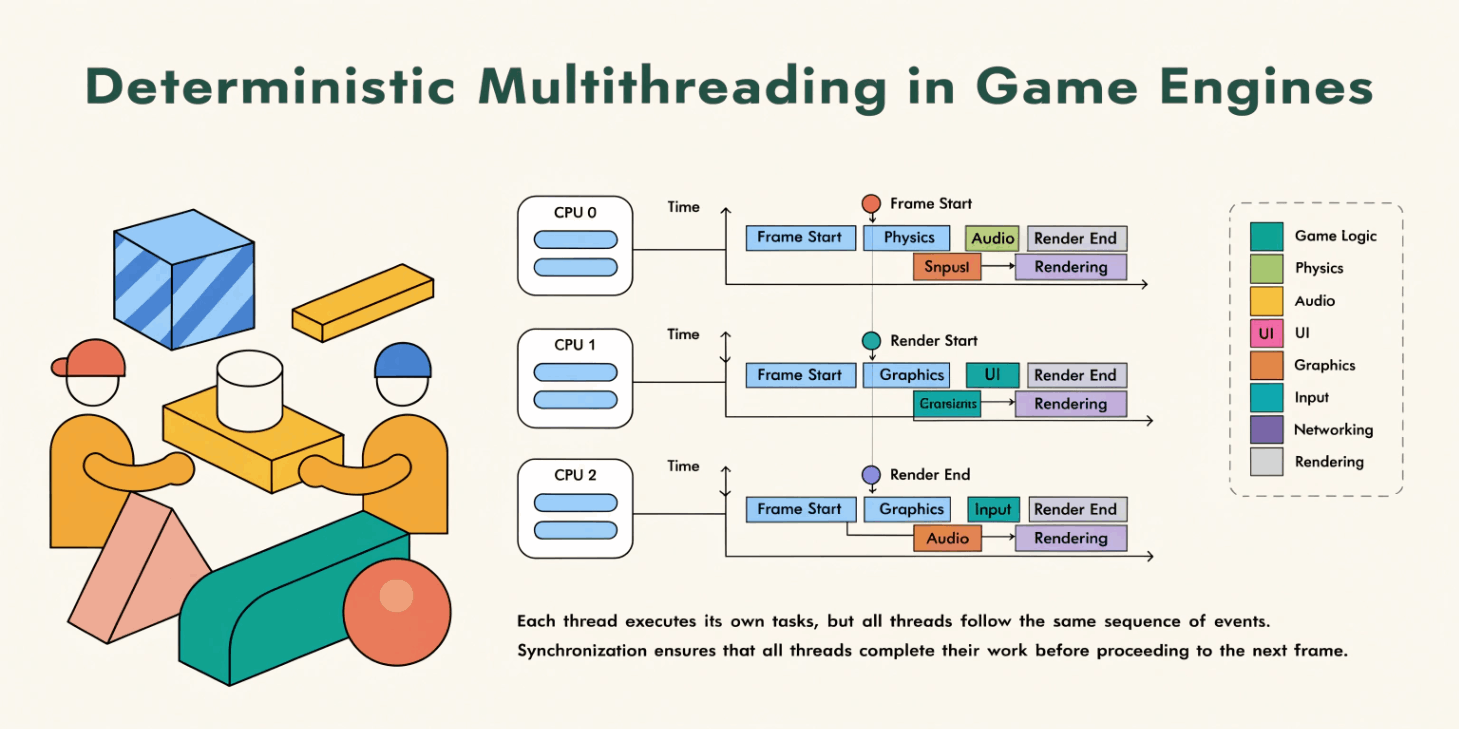
Deterministic multithreading enables game engines to use multiple CPU cores while producing consistent simulation results. By controlling task ordering, data access, timing, and synchronization, developers can improve performance without sacrificing reproducibility for multiplayer networking, physics, replays, testing, and debugging.
Modern game engines need to perform thousands of operations every frame. Physics calculations, animation, AI, navigation, audio processing, particle systems, world streaming, networking, and gameplay logic can all compete for CPU resources. Running everything on a single thread can create performance bottlenecks, which is why modern engines increasingly rely on multithreading and job-based architectures.
However, multithreading introduces a difficult challenge: the same inputs can produce different results when operations execute in different orders. This is known as nondeterministic behavior.
Deterministic multithreading attempts to combine parallel execution with predictable and reproducible results.
What Is Deterministic Multithreading?
A deterministic system produces the same output when given the same inputs and initial state.
For a game simulation, this could mean that running the same sequence of player inputs produces exactly the same:
- Physics state
- Character positions
- AI decisions
- Game events
- Resource values
- Simulation results
The challenge is that multiple threads may execute simultaneously. The operating system, CPU, scheduler, or job system may change the order in which tasks complete.
If two operations modify shared data in different orders, the final state can change.
Why Determinism Matters in Games
Determinism is especially valuable in multiplayer games.
Consider a deterministic lockstep architecture where players send inputs rather than complete world states. Each client runs the same simulation locally.
If every client produces identical results, only input synchronization is required.
Without deterministic behavior, two clients may gradually develop different world states even though they process the same inputs.
Determinism is also useful for:
- Replay systems
- Rollback networking
- Automated testing
- Physics debugging
- Reproducing bugs
- Simulation tools
- Competitive multiplayer
- Server-side verification
The Problem With Thread Scheduling
Suppose two threads update the same numerical value:
Thread A: value = value + 10
Thread B: value = value + 20
If the operations are properly synchronized, the final result can be predictable.
But more complex systems may involve hundreds of tasks accessing related data.
Even when individual operations are technically safe, different execution orders can produce different floating-point results or gameplay outcomes.
The goal is therefore not simply to eliminate crashes or race conditions. A deterministic engine must control the parts of execution that can influence simulation results.
Fixed Timestep Simulation
A fixed timestep is one of the foundations of deterministic simulation.
Instead of allowing simulation time to vary directly with frame duration, the engine processes updates using a consistent timestep.
For example:
Simulation Step = 1/60 second
The renderer may operate at different frame rates, but the simulation advances using controlled time increments.
This makes physics and gameplay calculations more predictable and reduces dependence on rendering performance.
Job Systems and Task Dependencies
Modern engines often use job systems instead of manually creating threads for individual tasks.
A job represents a unit of work that can be scheduled on an available worker thread.
For deterministic execution, jobs should have clearly defined dependencies.
For example:
Input
↓
Gameplay Update
↓
Physics
↓
Animation
↓
Presentation
Independent tasks can execute in parallel, while dependent tasks wait for the required data.
This allows engines to use multiple CPU cores without allowing arbitrary execution order to affect simulation results.
Data Ownership
One of the strongest ways to reduce multithreading problems is to establish clear ownership of data.
Instead of allowing multiple threads to modify the same object, systems can divide data into independent sections.
For example:
- Physics owns physical state.
- Animation owns animation state.
- AI owns decision state.
- Rendering reads prepared data.
Workers can process separate datasets in parallel and combine results during controlled synchronization points.
This reduces locking and makes deterministic behavior easier to reason about.
Avoiding Race Conditions
Race conditions occur when multiple threads access shared data without appropriate coordination.
Developers can reduce these problems through:
- Task dependencies
- Immutable data
- Thread-local storage
- Atomic operations
- Locks where necessary
- Double buffering
- Ownership-based architecture
- Deterministic scheduling
However, synchronization mechanisms can introduce performance costs.
A well-designed job system often minimizes shared mutable state rather than relying heavily on locks.
Floating-Point Determinism
Even with controlled task scheduling, floating-point calculations can create subtle differences.
Floating-point arithmetic can vary because of:
- Operation ordering
- CPU instruction sets
- Compiler optimizations
- Precision differences
- SIMD instructions
For example:
(a + b) + c
may produce a slightly different result from:
a + (b + c)
The difference can be extremely small, but repeated over thousands of simulation steps, it can become significant.
Engines requiring strict determinism may therefore use carefully controlled numerical operations, fixed-point arithmetic in selected systems, or platform-specific deterministic math libraries.
Deterministic Physics
Physics is one of the most challenging areas for deterministic multithreading.
Collision detection, constraint solving, integration, and contact resolution can involve large numbers of interacting objects.
If collision results are processed in different orders, the resulting simulation can diverge.
A deterministic physics architecture therefore needs controlled ordering, stable identifiers, predictable task dependencies, and carefully managed numerical operations.
Not every physics engine guarantees cross-platform bitwise determinism, so developers must understand the specific requirements of their game.
Determinism and Rollback Netcode
Rollback networking has increased the importance of deterministic simulation.
When a player receives late input, the game may restore an earlier state and simulate several frames again using corrected inputs.
If the simulation is deterministic, the replayed frames should produce the same results.
Multithreading complicates this because the rollback simulation must remain consistent with the original simulation.
This makes deterministic job scheduling, controlled state management, and reproducible physics particularly valuable.
Replays and Automated Testing
Deterministic simulations can also make debugging dramatically easier.
A replay system can record player inputs rather than storing every world state.
Developers can then reproduce a session by feeding the same inputs into the simulation.
If the simulation is deterministic, the same bug should occur at the same point.
Automated tests can use the same principle. A test can run a scenario repeatedly and compare simulation results against expected states.
Performance Without Losing Control
Determinism does not mean that every task must run sequentially.
The objective is to identify which operations are independent and execute those operations in parallel.
For example:
Physics Object Group A ─┐
Physics Object Group B ─┼→ Synchronization → Next Stage
Physics Object Group C ─┘
Independent workloads can run concurrently, while synchronization points establish predictable boundaries.
This provides much of the performance benefit of multithreading without allowing uncontrolled execution order to affect the simulation.
Designing a Deterministic Architecture
A practical deterministic game engine can combine:
- Fixed simulation timesteps
- Job-based task scheduling
- Explicit task dependencies
- Stable processing order
- Data ownership
- Controlled synchronization
- Deterministic math where required
- Immutable or versioned state
- Consistent random-number generators
- Reproducible testing
Randomness also needs attention. Standard random generators can produce different results if calls occur in different orders. Deterministic systems should use controlled seeds and predictable random-number streams.
Conclusion
Deterministic multithreading is not simply about making every thread execute in the same order. It is about designing a system where parallel execution cannot introduce uncontrolled differences into important simulation state.
By combining fixed timesteps, job systems, explicit dependencies, controlled data ownership, deterministic scheduling, reliable synchronization, and carefully managed numerical operations, game engines can take advantage of modern multicore CPUs while preserving reproducibility.
This architecture is especially valuable for competitive multiplayer games, rollback networking, physics-heavy simulations, replay systems, and automated testing. As game worlds become larger and simulations become more complex, deterministic multithreading provides a powerful foundation for achieving both high performance and predictable gameplay behavior.
We build scalable web, mobile, and game products for clients worldwide — combining modern frameworks, cloud infrastructure, and best engineering practices.
.jpg)