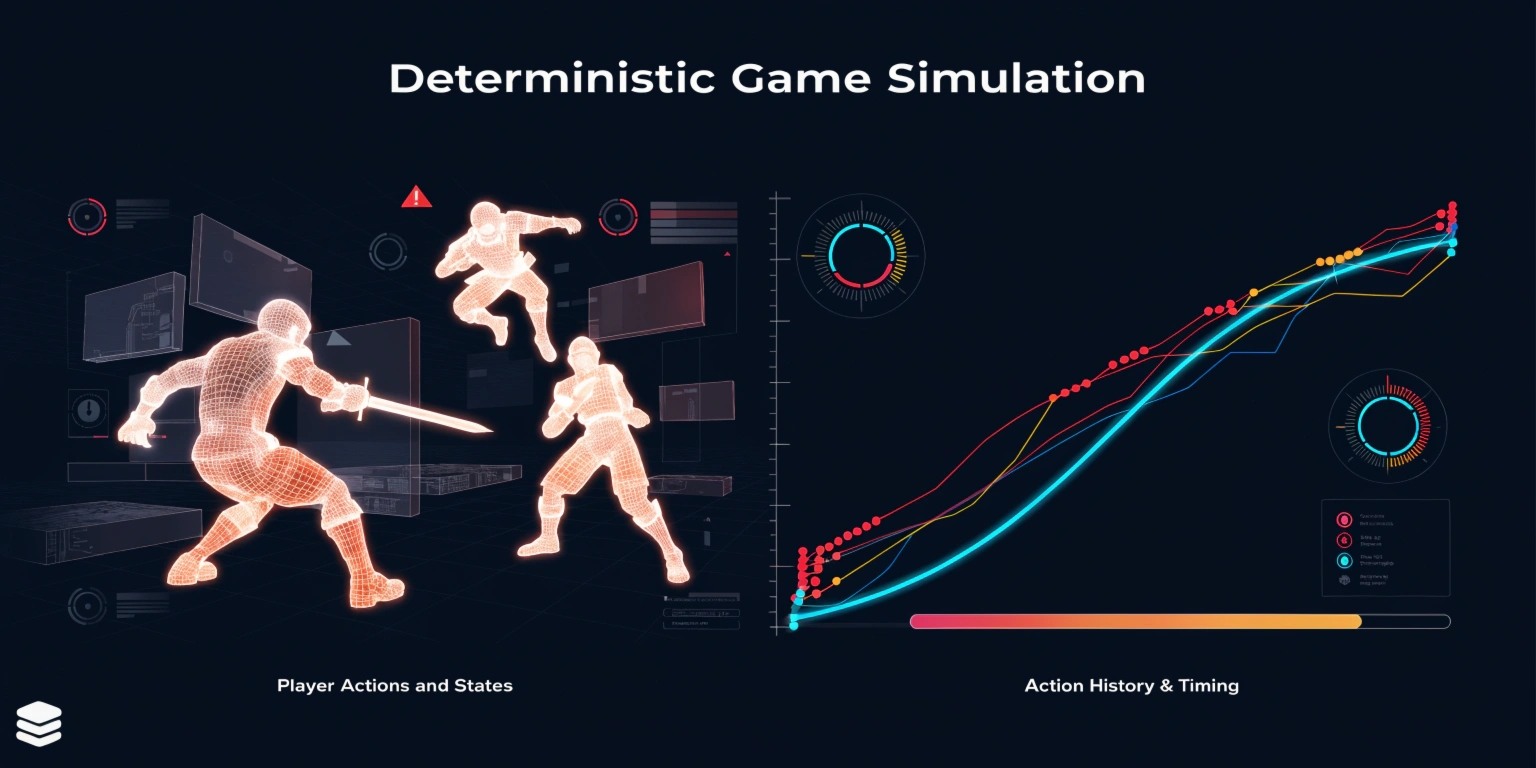
Discover how deterministic game simulation enables fair and synchronized competitive multiplayer games. Learn about lockstep networking, rollback systems, synchronization techniques, benefits, challenges, and best practices for creating responsive online gaming experiences.
- rge simulations
Limitations
- Input delay increases with network latency.
- Slow connections affect all participants.
- Less suitable for fast-paced action games without additional techniques.
Rollback Networking
Modern fighting games often combine deterministic simulation with rollback networking.
Instead of waiting for delayed inputs:
- The game predicts missing inputs.
- Simulation continues immediately.
- If the prediction proves incorrect, the simulation rewinds to the affected frame.
- Correct inputs are applied.
- Several frames are re-simulated rapidly.
Players experience smoother gameplay while maintaining synchronization.
Popular competitive fighting games rely heavily on rollback networking to minimize input delay and preserve responsiveness.
Maintaining Determinism
Several factors must remain identical across every client.
Fixed Time Steps
Game logic should run using a fixed simulation interval.
Variable frame rates can produce inconsistent movement, collision detection, and physics calculations.
A fixed timestep ensures every client processes the same amount of simulation each update.
Deterministic Physics
General-purpose physics engines may generate slightly different results on different hardware or operating systems.
Developers often:
- Use simplified physics
- Replace floating-point calculations
- Build custom deterministic physics systems
- Limit non-deterministic operations
Consistency is more important than realism in competitive games.
Consistent Random Number Generation
Random events must also remain synchronized.
Rather than generating random values independently, games use identical random seeds and deterministic random number generators.
Every client produces the same sequence of "random" outcomes.
Common Challenges
Although powerful, deterministic simulation introduces several engineering challenges.
Floating-Point Precision
Different processors may handle floating-point calculations slightly differently.
Even tiny numerical differences accumulate over time, eventually causing simulation divergence.
Many competitive games use integer or fixed-point arithmetic to avoid this issue.
Platform Differences
Games running on Windows, PlayStation, Xbox, Nintendo Switch, or mobile devices may execute calculations differently.
Cross-platform testing is essential to verify deterministic behavior across all supported platforms.
Network Latency
Delayed packets can interrupt synchronization.
Developers mitigate latency through:
- Input buffering
- Rollback networking
- Client prediction
- Lag compensation
- Reliable packet delivery
Desynchronization Detection
Games periodically compare checksums or hashes of the game state.
If clients detect mismatched states, developers can:
- Re-synchronize affected clients
- Reload the correct state
- Disconnect corrupted sessions
- Log diagnostics for debugging
Benefits of Deterministic Simulation
When implemented correctly, deterministic networking offers several advantages:
- Reduced bandwidth consumption
- Lower server costs
- Consistent gameplay across clients
- Fair competitive matches
- Easier replay generation
- Spectator support
- Simplified cheat detection
- Better scalability
These benefits make deterministic architectures particularly attractive for esports and highly competitive titles.
Best Practices
To build reliable deterministic multiplayer systems:
- Use fixed update intervals for simulation.
- Minimize floating-point arithmetic.
- Synchronize only player inputs whenever possible.
- Use deterministic random number generators.
- Implement rollback for latency-sensitive games.
- Validate synchronization regularly using state hashes.
- Test extensively across different hardware and operating systems.
- Separate rendering logic from simulation logic.
- Keep gameplay calculations deterministic and reproducible.
Real-World Applications
Deterministic simulation is widely used across various genres:
- Fighting games rely on rollback networking and deterministic inputs for frame-perfect combat.
- Real-time strategy games synchronize hundreds or thousands of units efficiently using lockstep networking.
- Multiplayer sports games ensure identical ball physics and player interactions.
- Turn-based strategy games maintain perfectly synchronized game states with minimal network traffic.
- Competitive simulation games use deterministic systems to guarantee fairness and replay accuracy.
Conclusion
Deterministic game simulation is one of the most effective techniques for building fair, synchronized, and bandwidth-efficient competitive multiplayer games. By ensuring that identical inputs always produce identical outcomes, developers can maintain consistent game states across all clients while reducing network overhead.
Although implementing deterministic systems requires careful attention to timing, physics, random number generation, and cross-platform consistency, the benefits are substantial. Combined with modern techniques such as rollback networking and client-side prediction, deterministic simulation enables responsive gameplay, robust cheat resistance, accurate replays, and a level playing field—qualities that are essential for today's competitive multiplayer and esports experiences.
We build scalable web, mobile, and game products for clients worldwide — combining modern frameworks, cloud infrastructure, and best engineering practices.
.jpg)