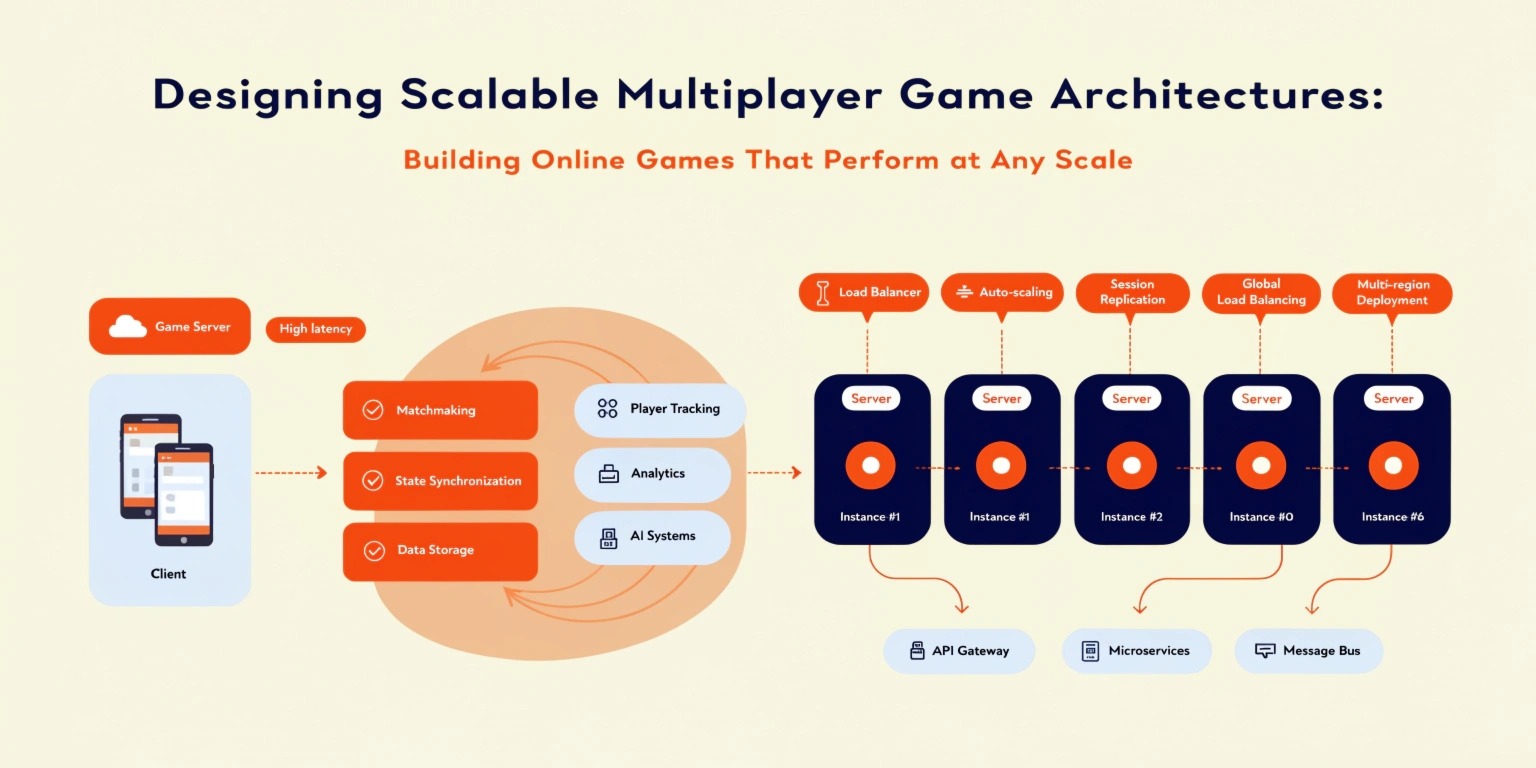
Scalable multiplayer game architecture is the backbone of successful online games. Learn the key principles, server models, networking strategies, synchronization techniques, cloud infrastructure, and optimization methods required to build multiplayer games capable of supporting massive player communities.
Modern gamers expect smooth online experiences whether they are battling in a battle royale, racing against hundreds of players, or collaborating in large-scale MMORPGs. Behind these seamless experiences lies a carefully designed multiplayer game architecture capable of handling unpredictable traffic, low latency requirements, and millions of concurrent users.
Creating a scalable multiplayer architecture isn't simply about purchasing larger servers. It involves designing distributed systems that efficiently manage networking, gameplay synchronization, matchmaking, persistence, security, and cloud infrastructure while maintaining exceptional performance.
This article explores the core concepts behind scalable multiplayer game architectures and how development teams can prepare their games for long-term success.
Understanding Multiplayer Architecture
A multiplayer architecture defines how players communicate with each other and with the game servers.
The architecture determines:
- Player synchronization
- Server authority
- Network communication
- Matchmaking
- Authentication
- Data persistence
- Security
- Performance optimization
Poor architectural decisions often lead to lag, cheating, server crashes, and poor player retention.
Client-Server vs Peer-to-Peer
Peer-to-Peer (P2P)
Players communicate directly with each other.
Advantages:
- Lower infrastructure costs
- No dedicated servers
- Easy implementation
Disadvantages:
- High cheating risk
- Host migration issues
- NAT traversal complications
- Limited scalability
Suitable for:
- Casual multiplayer games
- Small co-op games
- Local multiplayer
Dedicated Client-Server
Players connect to centralized servers.
Advantages:
- Better security
- Consistent gameplay
- Server authority
- Easier updates
- Better scalability
Disadvantages:
- Higher infrastructure costs
- Requires backend maintenance
Suitable for:
- MMORPGs
- Battle Royale
- Competitive shooters
- MOBA games
- Live service games
Today, nearly every successful online multiplayer title relies on dedicated server architecture.
Server Authoritative Design
Modern multiplayer games use authoritative servers.
Instead of trusting player devices, the server validates every important action.
Examples include:
- Player movement
- Damage calculations
- Item collection
- Inventory updates
- Economy transactions
- Skill execution
This dramatically reduces cheating and keeps gameplay fair.
Microservices for Game Backends
Large multiplayer games rarely use one massive backend.
Instead, they divide services into independent components such as:
- Login Service
- Authentication Service
- Matchmaking Service
- Inventory Service
- Friends Service
- Chat Service
- Leaderboard Service
- Store Service
- Payment Service
- Analytics Service
Each service can scale independently depending on demand.
Matchmaking Systems
Efficient matchmaking keeps players engaged by creating balanced matches.
Modern matchmaking considers:
- Skill rating (MMR)
- Ping
- Region
- Platform
- Party size
- Player behavior
- Preferred game modes
Sophisticated matchmaking significantly improves player satisfaction and retention.
Real-Time Networking
Real-time multiplayer requires continuous communication between clients and servers.
Popular networking protocols include:
UDP
Ideal for:
- Position updates
- Movement
- Shooting
- Physics
Advantages:
- Extremely fast
- Low latency
- No retransmission delays
TCP
Best suited for:
- Login
- Inventory
- Purchases
- Chat
- Player profiles
Advantages:
- Reliable delivery
- Ordered packets
- Guaranteed transmission
Many modern games combine both protocols.
State Synchronization
Keeping every player synchronized is one of multiplayer development's biggest challenges.
Common synchronization techniques include:
Snapshot Synchronization
Servers periodically send the complete game state.
Pros:
- Reliable
- Simple implementation
Cons:
- High bandwidth usage
Delta Updates
Only changed data is transmitted.
Benefits include:
- Lower bandwidth
- Better scalability
- Faster updates
Client Prediction
Clients immediately predict movement before receiving server confirmation.
Benefits:
- Smooth controls
- Responsive gameplay
The server later corrects any prediction errors.
Interpolation
Used to smooth movement between updates.
Players experience fluid animations despite network delays.
Interest Management
Large worlds cannot send every object to every player.
Interest management ensures players receive only relevant data.
Examples:
- Nearby enemies
- Visible players
- Nearby NPCs
- Local projectiles
- Nearby environmental events
Benefits include:
- Lower bandwidth
- Better server performance
- Improved scalability
Load Balancing
Player traffic fluctuates throughout the day.
Load balancers distribute players across multiple servers.
Benefits include:
- Higher availability
- Better performance
- Automatic failover
- Reduced server overload
Cloud platforms can automatically create additional game servers during peak hours.
Horizontal Scaling
Instead of upgrading a single server, multiplayer games scale horizontally.
Rather than one powerful machine:
- Server A
- Server B
- Server C
- Server D
Incoming players are distributed automatically.
Horizontal scaling enables games to support millions of players simultaneously.
Cloud Infrastructure
Cloud platforms have transformed multiplayer hosting.
Popular providers include:
- AWS
- Microsoft Azure
- Google Cloud
Benefits:
- Auto-scaling
- Global regions
- Reduced downtime
- High availability
- Managed databases
- CDN integration
Cloud-native infrastructure provides elasticity during game launches and seasonal events.
Database Architecture
Player data must remain consistent and highly available.
Common storage includes:
SQL Databases
Ideal for:
- Purchases
- Player accounts
- Transactions
- Economy
NoSQL Databases
Suitable for:
- Player sessions
- Telemetry
- Match history
- Cached data
Many studios combine both database types.
Security Considerations
Multiplayer games are frequent targets of attacks.
Essential protections include:
- Encryption
- Secure authentication
- Anti-cheat systems
- DDoS protection
- Rate limiting
- Input validation
- Server authority
- Token-based authentication
Strong security safeguards both players and business revenue.
Monitoring and Analytics
Successful multiplayer games continuously monitor:
- Active players
- Server CPU usage
- Network latency
- Match completion rates
- Crash reports
- Packet loss
- Database performance
- Memory usage
Real-time monitoring enables teams to identify issues before players are affected.
Future Trends
The next generation of multiplayer architecture is embracing:
- Edge computing
- Kubernetes orchestration
- Serverless backend services
- AI-powered matchmaking
- Predictive auto-scaling
- Cross-platform synchronization
- 5G networking
- Cloud-native game servers
- Digital twins for testing
- Machine learning-based cheat detection
These technologies will support increasingly immersive online worlds while maintaining low latency and exceptional scalability.
Conclusion
Designing scalable multiplayer game architectures requires more than networking expertise—it demands a holistic understanding of distributed systems, cloud infrastructure, real-time communication, security, and backend services. By leveraging dedicated servers, microservices, authoritative game logic, intelligent matchmaking, horizontal scaling, and continuous monitoring, developers can build multiplayer games that remain stable and enjoyable even as player populations grow into the millions. Investing in a robust architecture from the outset not only enhances gameplay but also lays the foundation for long-term success in the competitive online gaming industry.
We build scalable web, mobile, and game products for clients worldwide — combining modern frameworks, cloud infrastructure, and best engineering practices.
.jpg)