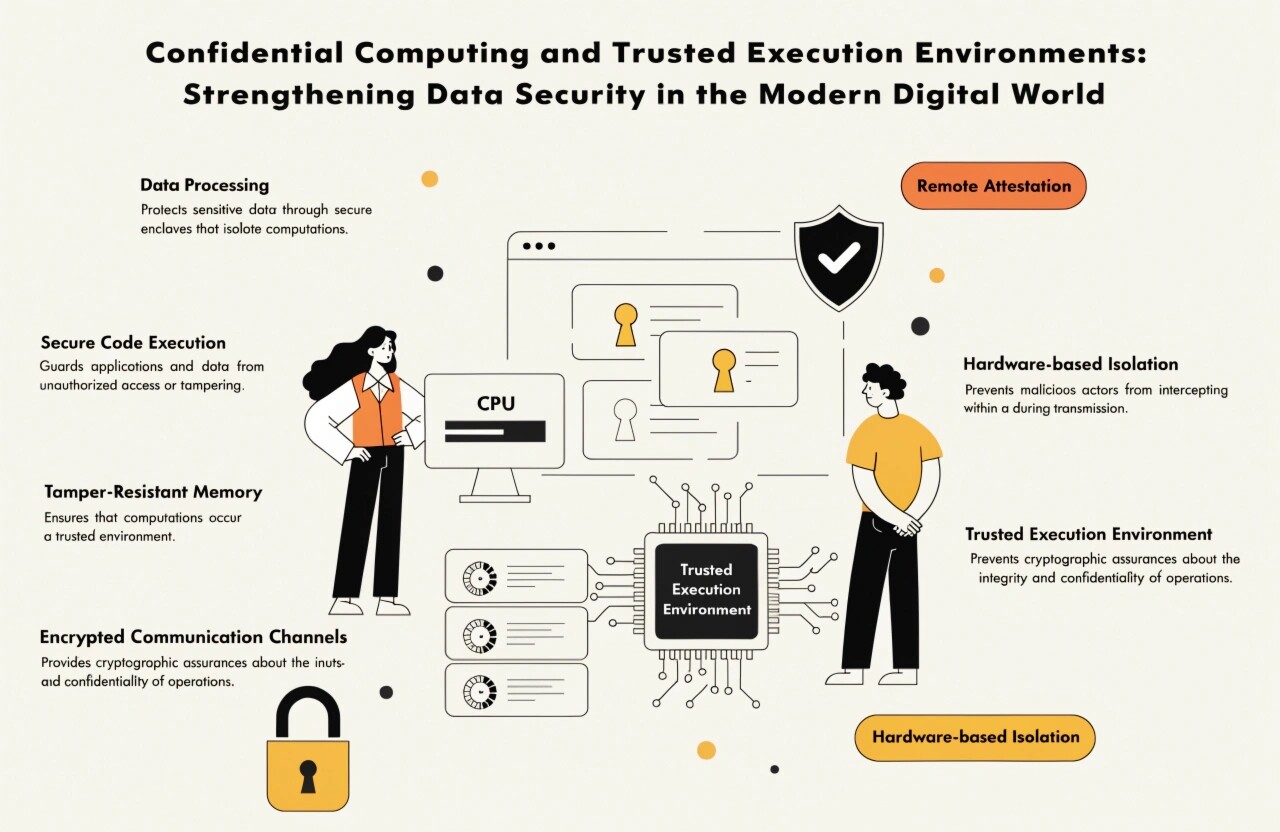
Confidential computing and Trusted Execution Environments protect sensitive information during processing using hardware-based security. Discover how TEEs work, their benefits, real-world applications, limitations, and role in securing cloud computing, AI workloads, and enterprise applications.
Introduction
Data security has become a major priority for businesses as cloud computing, artificial intelligence, and digital applications continue to grow. Organizations regularly process sensitive information, including financial records, customer details, healthcare data, and confidential business documents. Protecting this information requires more than traditional security measures.
Confidential computing is an advanced security approach designed to protect data while it is being processed. It uses hardware-based technologies, particularly Trusted Execution Environments (TEEs), to isolate sensitive workloads from unauthorized access. This approach helps organizations improve data privacy, strengthen cloud security, and maintain greater control over confidential information.
Understanding confidential computing and TEEs is essential for businesses seeking stronger protection for modern digital systems.
What Is Confidential Computing?
Confidential computing is a security technology that protects data during computation. Traditionally, data security focuses on protecting information at rest, such as files stored on servers, and data in transit, such as information transferred over networks.
However, data must often be decrypted when applications process it. During this stage, sensitive information may become vulnerable to privileged software, compromised operating systems, or unauthorized access.
Confidential computing addresses this challenge by using hardware-supported isolation and encryption mechanisms to protect selected workloads while they execute.
For example, a financial organization processing customer information in a cloud environment can use confidential computing to isolate sensitive calculations from other software running on the same infrastructure. This can reduce exposure even when the underlying environment is not fully trusted.
What Is a Trusted Execution Environment (TEE)?
A Trusted Execution Environment is a protected execution area designed to isolate code and data from the surrounding system. It uses hardware security features to help prevent unauthorized access or modification.
A TEE creates a controlled environment in which sensitive applications can execute with additional security protections. Depending on the technology, it may provide memory isolation, integrity protections, cryptographic measurements, and support for remote attestation.
Unlike conventional application isolation alone, a hardware-backed TEE is designed to maintain security boundaries even when certain privileged software components are compromised.
Examples of technologies associated with confidential computing include Intel Software Guard Extensions (SGX), AMD Secure Encrypted Virtualization (SEV), and Arm Confidential Compute Architecture (CCA). Their designs and security guarantees differ, so organizations must evaluate each platform according to their requirements.
How Does Confidential Computing Work?
Confidential computing combines hardware security, workload isolation, encryption, and verification mechanisms.
1. Hardware-Based Isolation
The processor establishes protected regions for sensitive workloads. These regions help separate confidential code and data from unauthorized software and other workloads.
2. Memory Protection
Depending on the platform, hardware mechanisms encrypt or otherwise protect memory associated with confidential workloads. These protections reduce the risk of sensitive information bein exposed through unauthorized memory access.
3. Secure Workload Execution
Applications process confidential information inside the protected environment. Only authorized operations and carefully controlled interfaces should be permitted to access the workload.
4. Remote Attestation
Remote attestation allows a party to verify evidence about a protected environment before trusting it with sensitive information. Depending on the platform, the evidence may describe hardware identity, configuration, or measurements of the loaded software.
5. Controlled Access to Secrets
After successful verification, a key-management service can release appropriate cryptographic keys or secrets to the trusted workload. This process should follow the organization's authentication, authorization, and policy requirements.
Together, these capabilities help reduce exposure during sensitive computations.
Key Benefits of Confidential Computing
Enhanced Data Privacy: Confidential computing helps protect sensitive information during processing, complementing encryption at rest and in transit.
Improved Cloud Security: Organizations can add hardware-backed isolation to workloads hosted on supported cloud infrastructure, reducing reliance on trust in every layer of the software stack.
Protection for Shared Environments: Multiple organizations can collaborate on selected computations while limiting direct exposure of each participant's data.
Support for Regulatory Requirements: Confidential computing may help organizations implement technical safeguards for sensitive data. However, it does not automatically guarantee compliance with privacy laws or industry regulations.
Greater Trust in AI Workloads: Businesses can use confidential computing to protect selected AI inference, model-serving, and data-processing workloads. The level of protection depends on the implementation and the components included within the trusted boundary.
Real-World Applications of Confidential Computing
Confidential computing supports several important industries and use cases.
Healthcare: Healthcare organizations can process sensitive medical records and research datasets within protected environments, helping reduce unnecessary exposure of patient information.
Banking and Finance: Financial institutions can use confidential workloads for fraud analysis, risk calculations, and selected collaborative analytics involving sensitive financial data.
Artificial Intelligence: Organizations can protect certain AI inputs, model parameters, and inference workloads from unauthorized access. Additional safeguards may still be necessary for model outputs, logging, and data pipelines.
Cloud Computing: Enterprises can deploy sensitive applications on supported confidential virtual machines or other hardware-backed environments to improve workload isolation.
Supply Chain and Business Collaboration: Multiple organizations can perform approved computations on shared datasets while applying technical controls to limit access to underlying information.
Challenges and Limitations
Although confidential computing offers valuable protections, it is not a complete security solution.
Implementation complexity is one major challenge. Applications may require configuration changes, platform-specific development, and integration with identity and key-management systems.
Performance overhead can also occur, depending on the workload, hardware, and security architecture. Some applications may need optimization to achieve acceptable performance.
Furthermore, TEEs do not eliminate every threat. Side-channel attacks, software vulnerabilities inside the protected environment, insecure application interfaces, compromised dependencies, and poorly managed secrets may still create risks.
Organizations should therefore combine confidential computing with secure development practices, access controls, monitoring, vulnerability management, and regular security assessments.
Best Practices for Implementing Confidential Computing
Businesses can improve their results by following several practical guidelines:
- Identify sensitive workloads and determine whether confidential computing is appropriate.
- Select hardware and cloud platforms based on their documented security guarantees.
- Verify attestation evidence before releasing sensitive data or cryptographic keys.
- Minimize the trusted computing base and reduce unnecessary permissions.
- Keep firmware, operating systems, libraries, and application components updated.
- Protect secrets through established key-management practices.
- Test performance, application compatibility, and security boundaries before deployment.
- Establish monitoring, incident-response procedures, and periodic security reviews.
These practices help integrate confidential computing into a broader security strategy.
Conclusion
Confidential computing and Trusted Execution Environments represent important developments in modern data security. By protecting selected workloads during processing, they help organizations reduce exposure of sensitive information across cloud platforms, enterprise applications, financial services, healthcare systems, and AI environments.
However, successful implementation requires careful platform selection, secure application design, attestation verification, and continuous security management. Confidential computing works best as part of a comprehensive cybersecurity strategy rather than as a replacement for existing safeguards.
As digital transformation continues, businesses that understand and adopt these technologies appropriately can strengthen data privacy, improve workload isolation, and build greater trust in secure digital services.
We build scalable web, mobile, and game products for clients worldwide — combining modern frameworks, cloud infrastructure, and best engineering practices.