Introduction
Modern gamers expect the freedom to switch between smartphones, tablets, PCs, and consoles while retaining their progress. Cloud save architecture and data syncing technologies make this possible by storing player information on remote servers rather than relying solely on local device storage.
From mobile RPGs to cross-platform multiplayer games, cloud-based save systems have become a standard feature that enhances player retention and user experience.
What is Cloud Save Architecture?
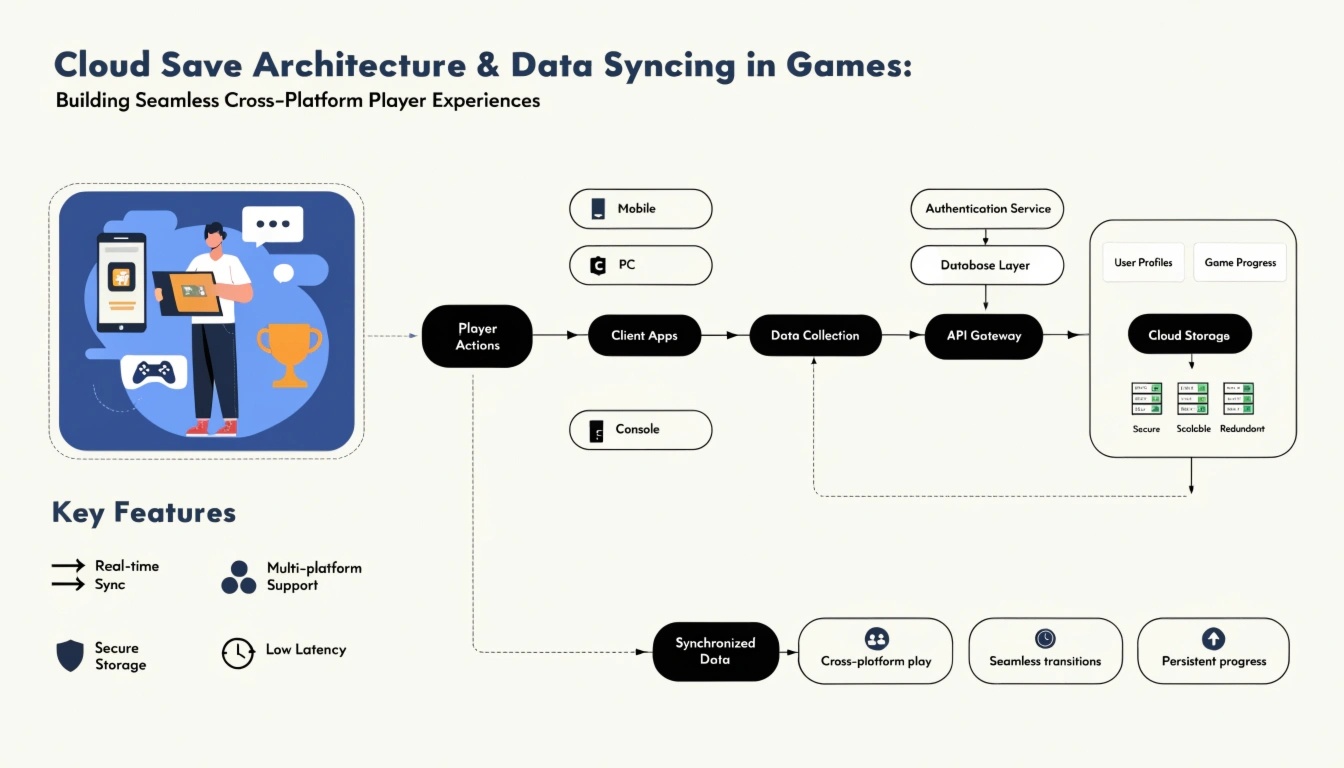
Cloud save architecture refers to the system used to store and manage game progress, player profiles, inventory, achievements, settings, and other important data on cloud servers. Instead of saving information exclusively on a device, the game communicates with backend services to upload and retrieve data whenever required.
The architecture generally consists of:
- Client-side game application
- Authentication system
- Cloud database
- Backend APIs
- Synchronization engine
- Security and encryption mechanisms
Together, these components ensure that player progress remains accessible regardless of the platform being used.
Why Cloud Save Systems Matter
Cross-Platform Gameplay
Players can start a game on a smartphone and continue on a PC or console without restarting their progress.
Better User Experience
Automatic backups reduce the risk of losing achievements or purchased items.
Increased Player Retention
Convenient access to saved progress encourages players to remain engaged for longer periods.
Support for Multiplayer Games
Cloud synchronization keeps inventories, rankings, and player statistics consistent across servers.
Common Cloud Storage Solutions
Several backend technologies are widely used in game development:
Firebase
Firebase provides real-time databases, Firestore, authentication, analytics, and cloud functions. It is particularly popular among indie and mobile game developers.
AWS Game Services
Amazon Web Services offers scalable storage, serverless computing, and database services suitable for large-scale games.
Microsoft Azure
Azure supports game backend development with powerful cloud infrastructure and AI capabilities.
PlayFab
PlayFab delivers specialized gaming services including leaderboards, player data management, and multiplayer support.
Data Synchronization Methods
Real-Time Synchronization
Changes are instantly uploaded to the cloud and reflected across all connected devices. Multiplayer games often rely on this method.
Periodic Synchronization
Game data is uploaded at specific intervals or after important milestones such as level completion.
Event-Based Synchronization
Data synchronization occurs whenever players perform certain actions, such as purchasing items or unlocking achievements.
Offline Synchronization
Players can continue gaming without internet access. Once connectivity is restored, local changes are synchronized with cloud servers.
Handling Data Conflicts
Synchronization conflicts occur when the same save file is modified on different devices.
Common conflict resolution methods include:
- Latest timestamp wins
- Version-based synchronization
- Manual player selection
- Merge-based strategies
Proper conflict handling ensures that valuable player progress is not accidentally overwritten.
Security Considerations
Since game saves often include premium purchases and player information, security is essential.
Important measures include:
- User authentication
- Encryption during transmission
- Secure databases
- Token-based access control
- Anti-cheat validation
- Backup and disaster recovery systems
These protections help prevent data loss and unauthorized modifications.
Scalability Challenges
As games grow in popularity, millions of synchronization requests can occur simultaneously. Developers must design scalable systems capable of handling:
- High traffic volumes
- Low latency requirements
- Global server distribution
- Database replication
- Load balancing
- Automatic backups
Cloud providers offer elastic infrastructure that can adapt to changing player demand.
Future Trends
The future of cloud save systems is becoming increasingly intelligent with:
- AI-driven data optimization
- Edge computing
- Real-time multiplayer synchronization
- Blockchain-based ownership records
- Predictive backup systems
- Hybrid cloud architectures
These innovations will further improve reliability and provide more immersive cross-platform experiences.
Conclusion
Cloud save architecture and data syncing have transformed modern gaming by enabling seamless progression across devices and platforms. By implementing reliable storage solutions, synchronization strategies, conflict resolution mechanisms, and strong security practices, developers can deliver a superior user experience. As cross-platform gaming continues to expand, robust cloud save systems will remain a crucial component of successful game development and player engagement.