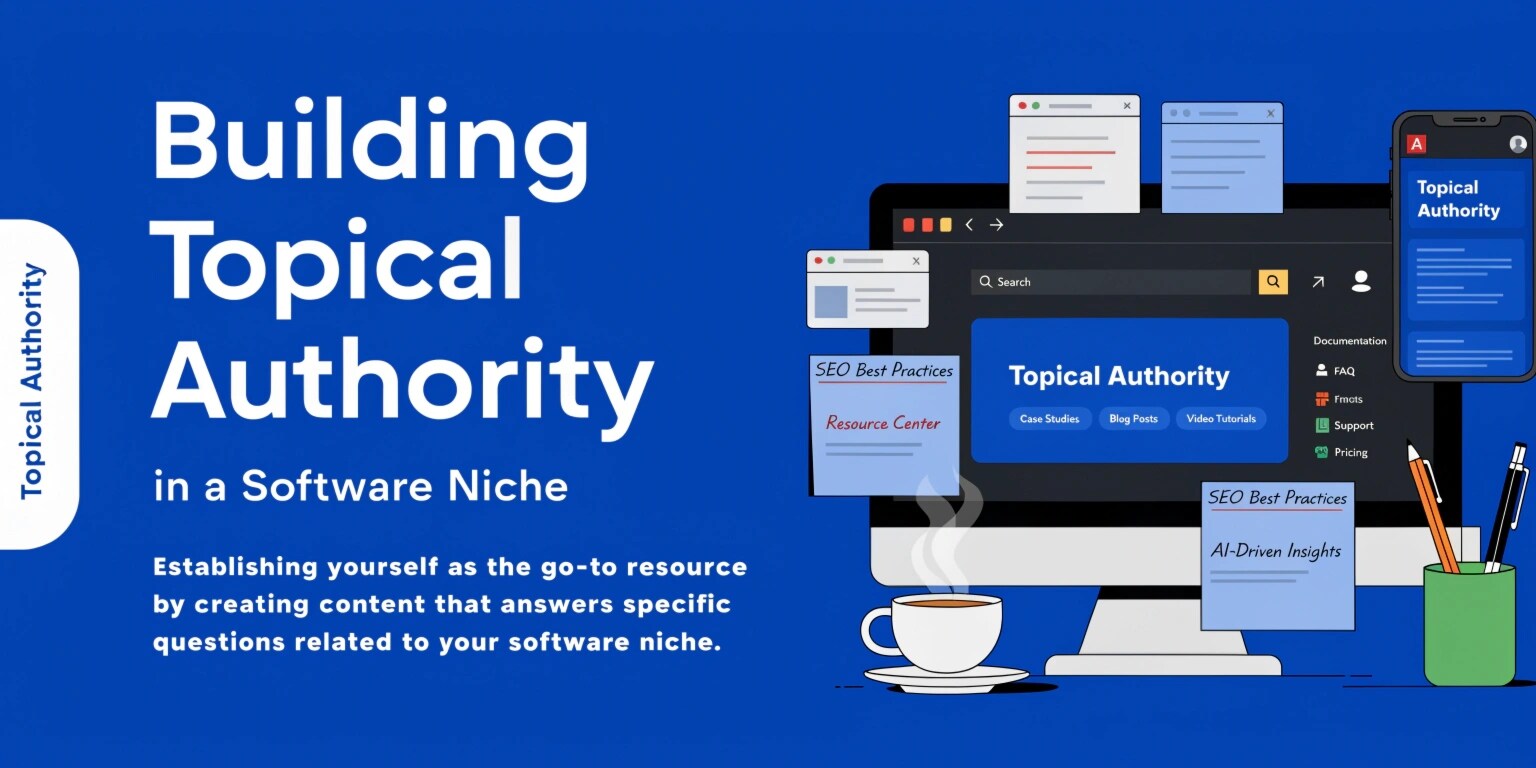
Building topical authority helps software companies establish expertise, improve search visibility, attract qualified organic traffic, and build trust. A structured strategy combining topic clusters, search intent, internal linking, expert content, and consistent publishing creates sustainable SEO growth.
In highly competitive software markets, ranking for a single keyword is no longer enough to build a strong organic presence. Search engines increasingly evaluate how comprehensively a website covers a subject and whether its content provides meaningful value to users. This is where topical authority becomes an important SEO strategy.
Topical authority refers to the level of expertise and coverage a website demonstrates around a specific subject. For software companies, building topical authority can help establish credibility, improve organic visibility, attract qualified visitors, and support long-term content marketing growth.
1. Choose a Clearly Defined Software Niche
The first step is identifying the specific software niche you want your website to become known for.
Instead of creating unrelated articles across dozens of subjects, focus on a defined area such as:
- SaaS development
- Mobile app development
- AI software development
- Cloud computing
- Enterprise software
- Game development
- Cybersecurity
- Web application development
- Software testing
A focused niche makes it easier to build comprehensive content coverage and demonstrate expertise.
2. Identify Your Core Topic
Once the niche is selected, define a broad pillar topic that represents your primary area of expertise.
For example, a mobile app development company could select Mobile Application Development as its core topic.
The pillar page can provide a comprehensive overview, while supporting articles cover specific subtopics such as app architecture, UI/UX, development frameworks, testing, security, performance, deployment, and maintenance.
This creates a structured content ecosystem.
3. Build Topic Clusters
Topic clusters are one of the most effective ways to organize content around a central subject.
A typical structure includes:
Pillar Topic → Subtopics → Supporting Articles
For example:
AI Development
→ Generative AI
→ LLM Applications
→ AI Chatbots
→ AI Model Training
→ AI APIs
→ Vector Databases
→ RAG Architecture
→ AI Security
→ AI Deployment
→ AI Monitoring
Each supporting article should provide detailed information about a specific subtopic while linking back to the main pillar page.
4. Understand Search Intent
Publishing large amounts of content does not automatically create authority. Each piece should address a specific search intent.
Users may search for software topics with different goals:
- Informational: What is Kubernetes?
- Educational: How does Kubernetes scaling work?
- Commercial: Best cloud solutions for SaaS
- Transactional: Hire cloud application developers
- Comparison: AWS vs Azure for SaaS applications
Understanding intent allows you to create content that matches what users actually need.
5. Conduct Comprehensive Keyword Research
Keyword research should go beyond finding high-volume phrases.
Identify:
- Primary keywords
- Long-tail keywords
- Related questions
- Semantic keywords
- Industry terminology
- Problem-based searches
- Comparison keywords
- Commercial keywords
For example, instead of targeting only “React development,” cover related searches such as React performance optimization, React Server Components, React application architecture, React security, React testing, and React scalability.
This creates broader topical coverage.
6. Create Expert-Level Content
Topical authority depends heavily on content quality.
Software content should demonstrate technical understanding rather than simply repeating information already available online.
Include practical examples, architecture explanations, implementation considerations, advantages and limitations, use cases, performance considerations, security implications, and real-world scenarios where appropriate.
Technical writers should also work closely with developers, engineers, product experts, and subject-matter specialists.
7. Develop Strong Internal Linking
Internal links connect related content and help users navigate your website.
For example, an article about API security can link to related content about authentication, OAuth, API gateways, rate limiting, and secure API architecture.
A strong internal linking structure helps search engines understand relationships between pages and allows authority to flow between relevant content.
Avoid adding links simply for SEO purposes. Links should provide genuine value and help users explore related information.
8. Cover the Entire Customer Journey
Software companies should create content for users at different stages of the buying journey.
Awareness:
Educational guides, definitions, trends, and industry problems.
Consideration:
Comparisons, implementation guides, technology evaluations, and best practices.
Decision:
Case studies, service pages, pricing information, product comparisons, and technical capabilities.
Retention:
Tutorials, documentation, troubleshooting guides, and optimization resources.
This approach allows content to support both SEO and lead generation.
9. Demonstrate First-Hand Experience
Generic content rarely creates a strong competitive advantage.
Software companies can differentiate their content by sharing practical experience, technical lessons, implementation examples, project insights, performance findings, and industry observations.
Original research, case studies, benchmarks, expert interviews, and technical experiments can further strengthen credibility.
10. Maintain and Update Existing Content
Topical authority is not built by publishing content once and forgetting about it.
Software technologies evolve rapidly. Frameworks change, APIs are updated, security practices improve, and new technologies emerge.
Regularly review older articles for outdated information, broken links, obsolete technologies, inaccurate statistics, and missing developments.
Updating existing content can help maintain relevance and improve the overall quality of the website.
11. Measure Topical Authority Progress
Track more than individual keyword rankings.
Important metrics include:
- Organic traffic
- Keyword visibility
- Number of ranking keywords
- Impressions
- Click-through rate
- Internal link engagement
- Content conversions
- Leads generated
- Backlinks
- Returning visitors
Analyze which topic clusters generate the most traffic and qualified leads. Use these insights to determine which subjects deserve deeper coverage.
Conclusion
Building topical authority in a software niche requires consistency, depth, structure, and genuine expertise. Instead of publishing disconnected articles based only on keyword volume, software companies should create comprehensive topic ecosystems that answer customer questions from basic concepts to advanced implementation.
By combining focused niche selection, topic clusters, search intent analysis, expert content, strategic internal linking, regular updates, and performance measurement, software businesses can strengthen their organic visibility and establish themselves as trusted sources within their industry.
Topical authority is a long-term SEO strategy, but when executed correctly, it can create a sustainable source of organic traffic, brand credibility, qualified leads, and business growth.
We build scalable web, mobile, and game products for clients worldwide — combining modern frameworks, cloud infrastructure, and best engineering practices.