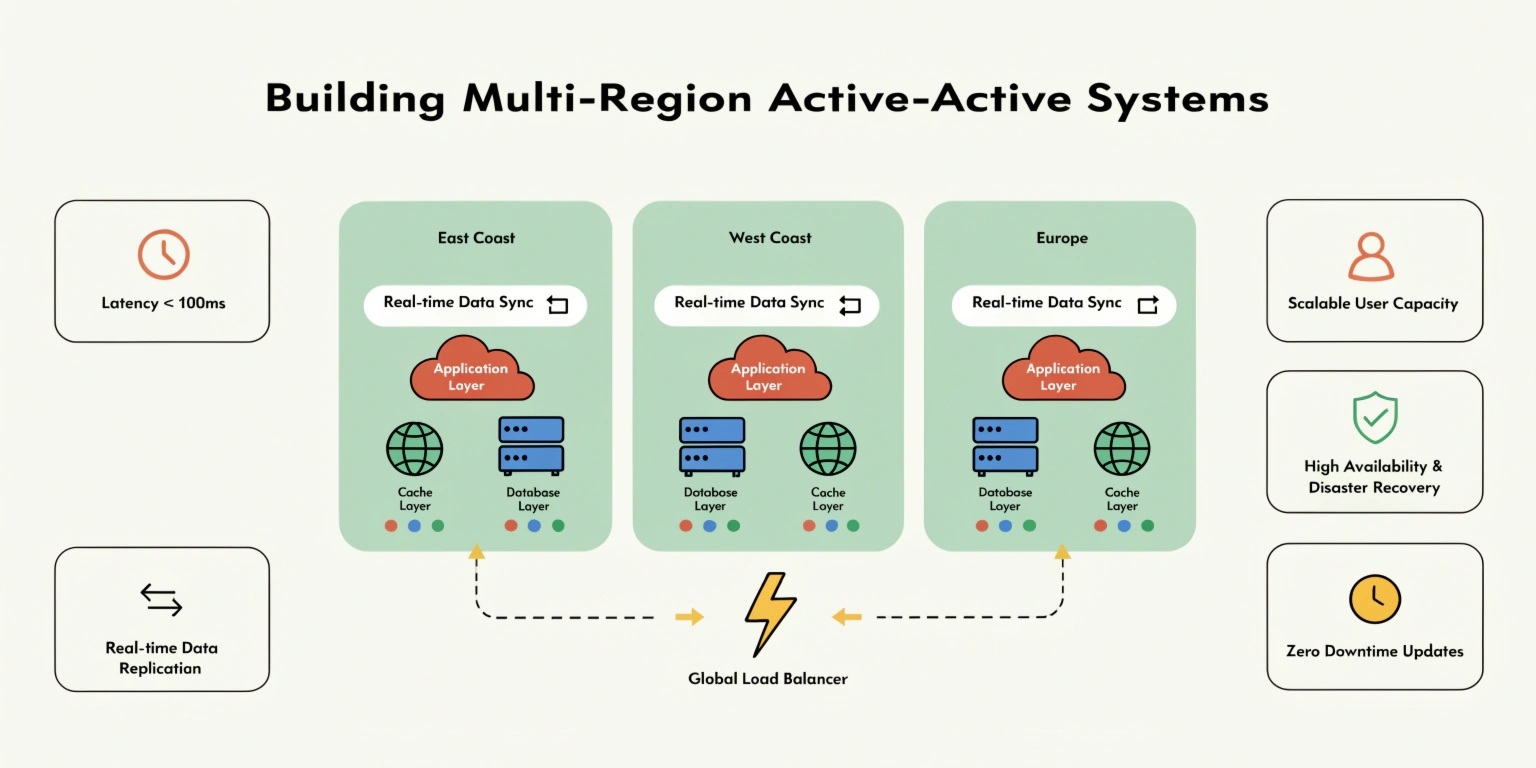
Multi-region active-active architecture runs application workloads simultaneously across multiple geographic regions. It improves availability, reduces latency, and provides resilience against regional failures, but requires careful handling of data replication, consistency, traffic routing, observability, and distributed-system complexity.
Modern digital applications often serve users across multiple countries and time zones. For businesses operating globally, keeping an application available when an entire cloud region experiences an outage can be a major architectural requirement.
A multi-region active-active architecture addresses this challenge by running production workloads simultaneously in multiple geographic regions.
Instead of keeping one region active and another region waiting for disaster recovery, both regions actively serve users.
This approach can improve availability and reduce latency, but it also introduces significant distributed-system challenges.
What Is an Active-Active Architecture?
In an active-active system, multiple infrastructure regions are simultaneously capable of serving production traffic.
For example, an application could operate in:
US Region + Europe Region + Asia-Pacific Region
Users can be routed to an appropriate region based on factors such as geographic location, latency, capacity, and health status.
If one region becomes unavailable, traffic can be redirected to the remaining healthy regions.
Active-Active vs Active-Passive
In an active-passive architecture, the primary region handles production traffic while a secondary region remains available as a backup.
During a failure, the secondary environment is activated.
Active-active architecture is different because multiple regions are already serving production traffic.
Active-Passive:
Primary Region → Production Traffic
Secondary Region → Standby
Active-Active:
Region A → Production Traffic
Region B → Production Traffic
Region C → Production Traffic
Active-active systems can provide better resource utilization and potentially faster recovery, but they are more complicated to design and operate.
Global Traffic Routing
A multi-region application needs a mechanism for directing users to healthy application instances.
Global traffic management can use:
- DNS-based routing
- Anycast networking
- Global load balancers
- Latency-based routing
- Geographic routing
- Health checks
- Weighted routing
For example, a user in India might be directed toward an Asia-Pacific region, while a user in Europe is routed toward a European region.
If the preferred region becomes unhealthy, the traffic management layer can redirect users elsewhere.
Designing Stateless Application Layers
Stateless application services make multi-region deployment easier.
If an application server does not store user-specific session information locally, requests can be routed between regions without depending on a particular server.
Session information can instead be stored in distributed or regionally replicated systems.
This makes horizontal scaling and regional failover significantly easier.
The Data Problem
The most difficult part of active-active architecture is often not the application servers.
It is the data layer.
If users in different regions can simultaneously modify the same data, the system must determine how those changes are replicated and reconciled.
For example:
Region A: User updates profile name.
Region B: User updates profile email at nearly the same time.
The system needs a defined strategy for handling these concurrent changes.
Data Replication Strategies
Several replication approaches are possible.
Synchronous replication attempts to confirm writes across multiple locations before completing the operation.
This can provide stronger consistency but may increase latency and reduce availability during network problems.
Asynchronous replication allows a region to complete writes before changes are replicated elsewhere.
This can provide better performance and availability but introduces replication lag and potential consistency challenges.
The correct strategy depends on business requirements.
Consistency Models
Distributed systems commonly make trade-offs between consistency, availability, and latency.
Some applications require strong consistency.
For example, financial transactions may require carefully controlled ordering and atomicity.
Other workloads, such as social activity feeds, analytics, or content views, may tolerate eventual consistency.
Developers should classify data according to its consistency requirements instead of applying one strategy to the entire application.
Conflict Resolution
Active-active databases may encounter conflicting writes.
Applications therefore need a conflict-resolution strategy.
Possible approaches include:
- Last-write-wins
- Version numbers
- Timestamps
- Application-specific merge logic
- Conflict-free replicated data types
- Single-writer ownership for specific records
There is no universal conflict-resolution strategy.
Business semantics should determine how conflicting updates are handled.
Caching Across Regions
Caching can significantly reduce latency and database load.
Content can be cached closer to users through globally distributed caching infrastructure.
However, cached data introduces another consistency consideration.
When information changes in one region, applications may need to invalidate or update cached copies elsewhere.
For relatively static content, eventual consistency may be perfectly acceptable.
For sensitive or frequently changing information, stronger invalidation mechanisms may be required.
Handling Regional Failures
A major benefit of active-active architecture is regional resilience.
However, failover should not depend entirely on manual intervention.
Health checks can continuously monitor:
- Application availability
- Database connectivity
- API response times
- Error rates
- Infrastructure health
- Dependency availability
If a region becomes unhealthy, the traffic layer can reduce or stop routing traffic to that region.
Avoiding Split-Brain Problems
Distributed systems can experience split-brain scenarios where different regions incorrectly believe they should independently control the same resource.
This can create conflicting writes or duplicate operations.
Architectures should carefully define ownership, leader election, quorum mechanisms, or transaction boundaries where required.
For critical workflows, idempotency is also essential.
An operation should be designed so that repeating it does not accidentally create duplicate effects.
Infrastructure as Code
Managing several regions manually creates operational risk.
Infrastructure-as-code tools can help teams define and reproduce infrastructure consistently across locations.
Teams can automate:
- Network configuration
- Compute resources
- Databases
- Load balancers
- Security policies
- Monitoring
- Deployment pipelines
This makes it easier to maintain consistency between regions.
Observability
Multi-region systems require strong observability.
Monitoring should provide both regional and global visibility.
Important metrics include:
- Request latency
- Error rate
- Traffic distribution
- Database replication lag
- Cache hit rate
- CPU and memory usage
- Regional availability
- Network errors
- Queue depth
Distributed tracing can also help identify failures that cross regional and service boundaries.
Testing Regional Failures
An active-active architecture should not be considered resilient simply because multiple regions exist.
Teams should regularly test failure scenarios.
Examples include:
- Region outage
- Database failure
- Network partition
- DNS failure
- Dependency outage
- Deployment failure
- Replication lag
- Increased traffic
Controlled resilience testing helps identify hidden dependencies before a real incident occurs.
Cost Considerations
Multi-region architecture increases infrastructure and operational costs.
Organizations may need duplicate or distributed:
- Compute resources
- Databases
- Networking
- Monitoring
- Security infrastructure
- Data transfer
- Backup systems
The additional cost should be justified by availability, latency, regulatory, and business requirements.
Conclusion
Building a multi-region active-active system is much more than deploying the same application in multiple cloud regions.
The architecture must address global traffic routing, data replication, consistency, conflict resolution, caching, observability, security, automation, and regional failure recovery.
The biggest challenge is usually the distributed data layer. Application services can often be replicated relatively easily, but maintaining correct data behavior across geographic boundaries requires careful architectural decisions.
When designed appropriately, active-active architecture can provide strong resilience, global scalability, lower latency, and improved availability.
The key is to design for failure from the beginning rather than treating disaster recovery as an afterthought.
We build scalable web, mobile, and game products for clients worldwide — combining modern frameworks, cloud infrastructure, and best engineering practices.