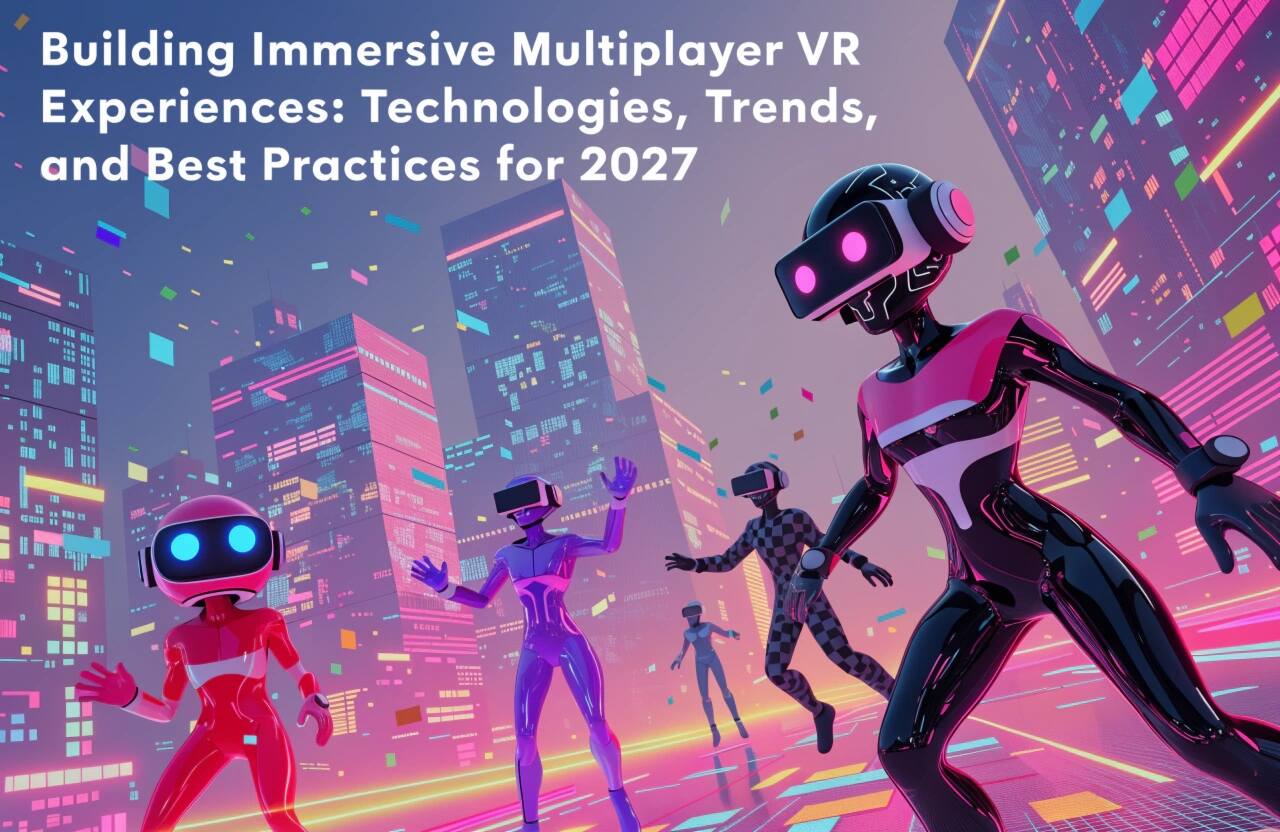
Immersive multiplayer VR combines real-time networking, spatial audio, realistic avatars, AI, and interactive environments to create shared virtual experiences for gaming, training, entertainment, and collaboration.
Main Content
Virtual reality has evolved from a technology focused primarily on individual experiences into a powerful platform for shared digital environments. Immersive multiplayer VR allows multiple users to enter the same virtual world, communicate naturally, interact with objects, and experience activities together in real time.
This makes multiplayer VR particularly useful for gaming, virtual events, employee training, education, simulations, entertainment, and collaborative applications. As VR hardware becomes more accessible and developers gain better networking and rendering technologies, immersive multiplayer experiences are expected to become an important area of digital innovation in 2027 and beyond.
What Is Immersive Multiplayer VR?
Immersive multiplayer VR combines virtual reality with real-time multiplayer technology. Instead of experiencing a virtual environment alone, users can see and interact with other participants within the same digital space.
For example, players can participate in a cooperative VR game, communicate through spatial voice chat, manipulate virtual objects together, and explore an environment as a team.
The goal is not simply to connect multiple users. The real objective is to create a strong sense of presence where participants feel as though they are physically sharing the same virtual environment.
Why Multiplayer VR Is Becoming Important
Traditional online multiplayer games primarily depend on screens, controllers, and voice communication. VR introduces another dimension by allowing users to use body movements, gestures, head tracking, and spatial interaction.
This creates opportunities for more natural communication and collaboration.
Multiplayer VR can be particularly valuable for:
- Cooperative and competitive gaming
- Virtual training and simulations
- Remote collaboration
- Virtual classrooms
- Healthcare and rehabilitation simulations
- Virtual events and entertainment
- Architecture and design visualization
- Military and industrial training
- Social VR applications
For businesses, these applications can provide more engaging experiences than traditional 2D interfaces.
Key Technologies Behind Immersive Multiplayer VR
Several technologies work together to create a convincing multiplayer VR environment.
Real-Time Networking:
Low-latency networking is essential. Players need to see other participants' movements and actions with minimal delay. Technologies such as dedicated game servers, WebSockets, UDP-based communication, and optimized networking frameworks can help synchronize multiplayer environments.
Spatial Audio:
Audio plays an important role in creating presence. With spatial audio, users can hear another participant based on their position and direction in the virtual environment. This makes conversations feel more natural.
Avatars and Body Tracking:
Realistic avatars help users identify and communicate with other participants. Head, hand, facial, and body tracking can make avatar movements more expressive.
Hand Tracking:
Modern VR devices increasingly support controller-free hand interaction. Developers can use hand tracking to allow users to grab objects, gesture, point, and communicate naturally.
Cloud Infrastructure:
Large multiplayer VR applications require scalable infrastructure. Cloud servers can help manage authentication, matchmaking, multiplayer sessions, data storage, and real-time services.
The Role of AI in Multiplayer VR
Artificial intelligence can make multiplayer VR environments more intelligent and dynamic.
AI-powered NPCs can interact with players, respond to conversations, and adapt their behavior according to the situation. Generative AI can also help create dialogue, missions, environments, and personalized experiences.
For example, an AI-powered virtual trainer could observe a user's performance and provide real-time feedback. In a multiplayer game, AI could dynamically adjust challenges according to the team's abilities.
Performance Optimization Is Critical
VR applications require high and consistent frame rates because poor performance can cause discomfort and negatively affect immersion.
Developers should optimize 3D assets, lighting, textures, physics, network traffic, and rendering pipelines. Level-of-detail systems, object culling, efficient shaders, asset compression, and optimized multiplayer synchronization can significantly improve performance.
For multiplayer applications, developers must also minimize network latency and avoid unnecessary data transmission.
Security and User Privacy
Multiplayer VR platforms handle significant amounts of user information, including account details, communication data, behavioral information, and potentially biometric or movement data.
Security should therefore be considered from the beginning of development. Secure authentication, encrypted communication, access control, moderation systems, and appropriate data-management practices are important for protecting users and maintaining trust.
The Future of Immersive Multiplayer VR
The future of multiplayer VR will likely involve more realistic avatars, better body tracking, AI-powered interactions, improved spatial audio, faster networks, and increasingly persistent virtual environments.
As VR devices become more capable, multiplayer experiences may move beyond traditional gaming into professional collaboration, education, training, healthcare, and entertainment.
Businesses and game studios looking to enter this market should focus on creating experiences that are not only visually impressive but also comfortable, responsive, scalable, secure, and socially engaging.
Conclusion
Immersive multiplayer VR represents an exciting intersection of game development, artificial intelligence, networking, 3D design, and real-time communication. Its ability to bring people together inside interactive virtual environments makes it particularly valuable for next-generation gaming and digital experiences.
For developers, success depends on balancing immersion with performance, networking reliability, usability, security, and scalability. With continued advances in VR hardware, cloud infrastructure, AI, and real-time technologies, multiplayer virtual reality has significant potential to become one of the most influential areas of interactive technology in the coming years.
We build scalable web, mobile, and game products for clients worldwide — combining modern frameworks, cloud infrastructure, and best engineering practices.
.jpg)