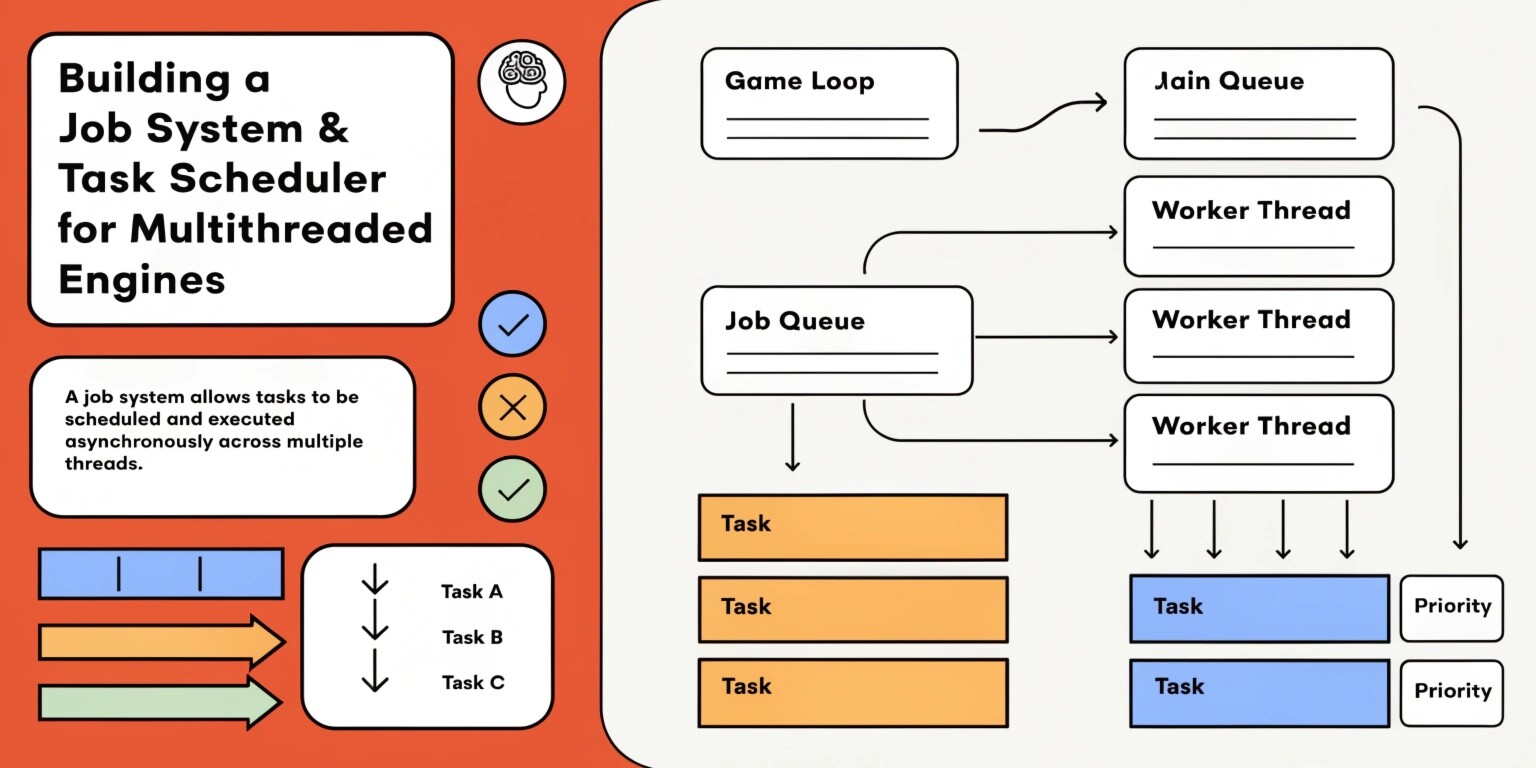
Discover how job systems and task schedulers enable multithreaded engines to execute workloads efficiently through parallel processing, thread pools, dependency management, and intelligent task scheduling for maximum performance.
game engines and real-time applications process enormous amounts of data every frame. Physics simulations, artificial intelligence, animation, rendering preparation, audio processing, networking, asset streaming, and user input all compete for CPU resources. Running these systems sequentially on a single thread creates bottlenecks that limit performance and scalability.
To fully utilize today's multi-core processors, developers rely on job systems and task schedulers. Instead of assigning entire engine subsystems to dedicated threads, work is divided into many small, independent jobs that can execute in parallel across available CPU cores. A task scheduler coordinates these jobs, manages dependencies, balances workloads, and ensures efficient resource utilization.
This article explains the architecture of modern job systems, explores scheduling strategies, and highlights best practices for building scalable multithreaded engines.
What Is a Job System?
A job system is a framework that breaks large tasks into smaller units of work called jobs. Each job performs a specific operation and is designed to execute independently whenever its required data is available.
Examples of engine jobs include:
- Physics calculations
- AI decision updates
- Animation blending
- Particle simulations
- Visibility culling
- Audio processing
- Resource loading
- Network synchronization
Because jobs are small and self-contained, they can be distributed across multiple CPU cores simultaneously.
Understanding the Task Scheduler
The task scheduler is responsible for deciding when and where jobs execute.
Its responsibilities include:
- Managing job queues
- Assigning work to worker threads
- Resolving dependencies
- Balancing CPU workloads
- Prioritizing critical tasks
- Synchronizing completed jobs
A well-designed scheduler keeps every CPU core busy while minimizing idle time.
Core Components of a Job System
Thread Pool
Rather than creating new threads for every task, engines maintain a fixed pool of worker threads.
Benefits include:
- Reduced thread creation overhead
- Faster task execution
- Better CPU utilization
- Predictable performance
Each worker continuously retrieves jobs from shared or local queues until all work is complete.
Job Queue
The job queue stores pending work waiting to be executed.
Depending on the engine design, queues may be:
- Global shared queues
- Per-thread local queues
- Priority queues
- Lock-free queues
Efficient queue management minimizes contention between worker threads.
Job Dependencies
Some jobs cannot begin until others have finished.
Examples include:
- Animation updates before rendering
- Physics calculations before collision responses
- Asset loading before object creation
- AI pathfinding before movement execution
Dependency tracking ensures that jobs execute in the correct order while preserving as much parallelism as possible.
Work Stealing for Load Balancing
One of the most effective scheduling techniques is work stealing.
Instead of remaining idle when its own queue becomes empty, a worker thread "steals" tasks from another worker's queue.
Advantages include:
- Better CPU utilization
- Automatic workload balancing
- Reduced idle time
- Improved scalability
- Higher throughput
Work stealing is widely used in modern game engines because it adapts dynamically to changing workloads.
Synchronization and Thread Safety
Multiple threads accessing shared data can introduce race conditions and inconsistent results.
Common synchronization techniques include:
- Mutexes
- Spinlocks
- Atomic operations
- Read-write locks
- Lock-free data structures
- Thread-local storage
Developers should minimize locking wherever possible to reduce contention and maintain high performance.
Prioritizing Tasks
Not every job has equal importance. A scheduler often assigns priorities based on gameplay requirements.
Typical priority levels include:
- Critical rendering tasks
- Physics simulation
- Input processing
- AI updates
- Background asset streaming
- Analytics
- Logging
Executing high-priority jobs first helps maintain frame stability and responsiveness.
Memory Management
Efficient memory allocation is essential in multithreaded systems.
Best practices include:
- Preallocating job objects
- Using object pools
- Avoiding unnecessary heap allocations
- Minimizing cache misses
- Improving data locality
- Reducing memory fragmentation
Cache-friendly memory layouts significantly improve execution speed.
Performance Optimization Techniques
To maximize throughput, developers should:
- Keep jobs small and independent.
- Avoid unnecessary synchronization.
- Batch related work where appropriate.
- Reduce false sharing between CPU cores.
- Profile scheduling overhead regularly.
- Minimize context switching.
- Design cache-efficient data structures.
These optimizations allow engines to process thousands of jobs per frame while maintaining consistent performance.
Challenges in Building Job Systems
Designing an efficient scheduler presents several challenges.
Common issues include:
- Deadlocks
- Race conditions
- Starvation of low-priority jobs
- Uneven workload distribution
- Cache contention
- Memory synchronization overhead
- Complex dependency graphs
Comprehensive testing and profiling are essential to identify and resolve these issues.
Future Trends in Multithreaded Engine Design
As processors continue to evolve, job systems are becoming more intelligent.
Emerging innovations include:
- AI-assisted workload scheduling
- Adaptive task prioritization
- NUMA-aware scheduling
- Hybrid CPU-GPU task distribution
- Fiber-based job execution
- Machine learning for performance optimization
- Heterogeneous computing support
These advancements will enable engines to make better use of increasingly diverse hardware architectures.
Best Practices
When implementing a job system, consider the following guidelines:
- Design jobs to be independent and lightweight.
- Use thread pools instead of creating threads on demand.
- Implement work-stealing algorithms for dynamic load balancing.
- Minimize shared mutable state.
- Optimize memory access patterns for cache efficiency.
- Track dependencies carefully to maximize safe parallel execution.
- Continuously profile and optimize scheduling performance.
- Test under real-world workloads to ensure scalability.
Following these principles results in a robust and efficient multithreaded architecture.
Conclusion
A well-designed job system and task scheduler form the backbone of modern multithreaded engines. By breaking workloads into small, independent jobs and distributing them intelligently across available CPU cores, developers can dramatically improve performance, scalability, and responsiveness.
Combining thread pools, work-stealing algorithms, dependency management, efficient memory allocation, and careful synchronization allows real-time applications to handle increasingly complex workloads without sacrificing frame rates. As hardware continues to advance and applications demand greater computational power, robust job systems will remain a critical component of high-performance engine architecture.
We build scalable web, mobile, and game products for clients worldwide — combining modern frameworks, cloud infrastructure, and best engineering practices.
.jpg)