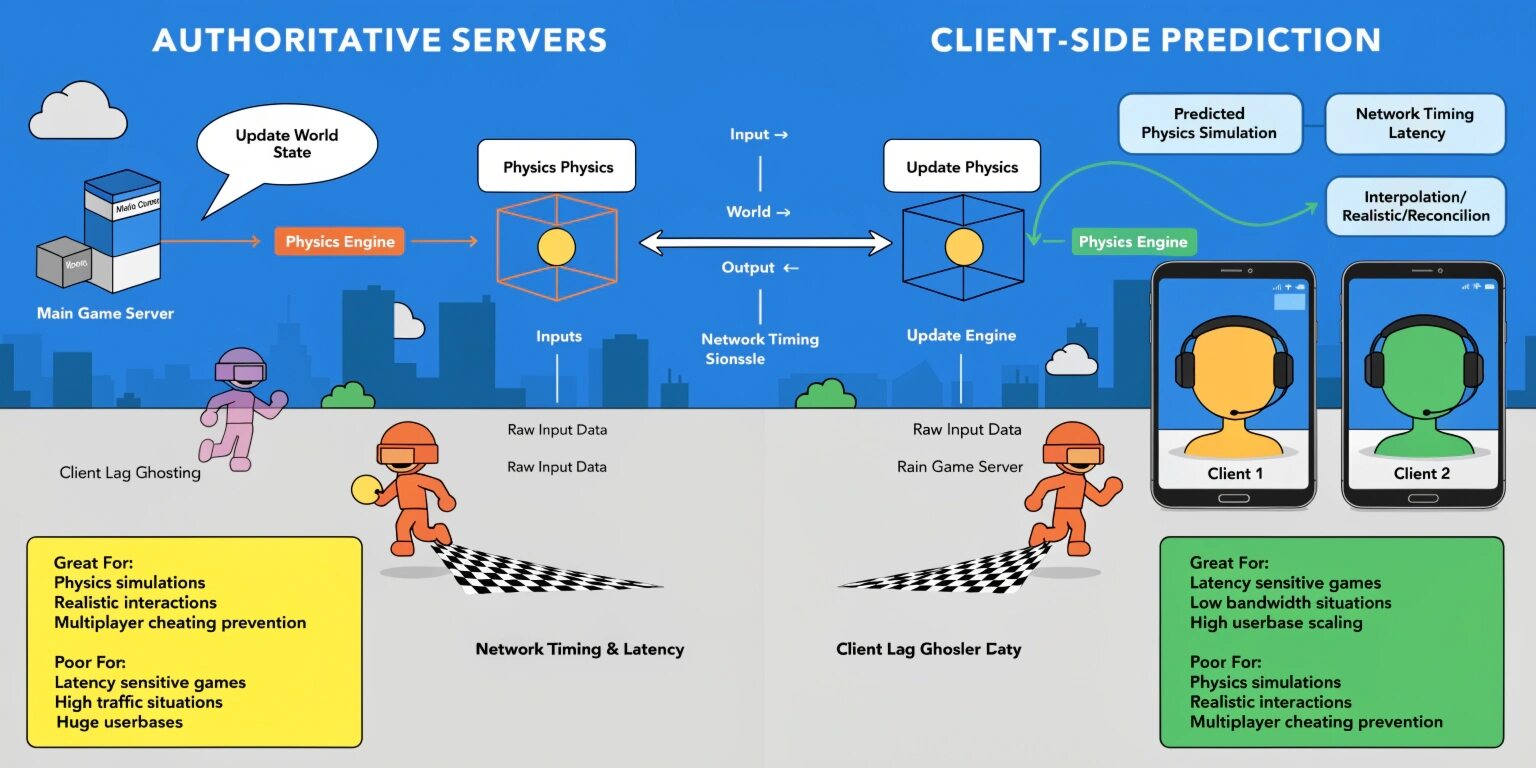
This blog explains authoritative servers and client-side prediction, comparing their strengths and weaknesses in multiplayer games, helping developers balance responsiveness, fairness, and security.
In modern multiplayer game development, delivering a smooth and responsive experience while maintaining fairness and security is a constant challenge. Two core networking models—authoritative servers and client-side prediction—play a crucial role in achieving this balance. Understanding how these approaches work and when to use them is essential for building scalable and enjoyable online games.
What is an Authoritative Server?
An authoritative server is a centralized system that acts as the single source of truth for the game state. All player actions are sent to the server, which validates them, updates the game world, and then broadcasts the results back to all clients.
For example, when a player moves or shoots, the client sends the input to the server. The server processes the action and determines whether it is valid before updating the game state.
Advantages:
- Security: Prevents cheating since clients cannot directly manipulate the game state.
- Consistency: Ensures all players see the same version of the game world.
- Fairness: Eliminates discrepancies caused by local client manipulation.
Disadvantages:
- Latency: Players may experience delays due to round-trip communication.
- Reduced Responsiveness: Actions may feel sluggish, especially in fast-paced games.
This model is widely used in competitive multiplayer games where fairness is critical, such as FPS and battle royale titles.
What is Client-Side Prediction?
Client-side prediction is a technique used to improve responsiveness by allowing the client to simulate actions locally before receiving confirmation from the server.
When a player performs an action, the client immediately predicts the outcome and displays it. Meanwhile, the input is sent to the server, which processes it and sends back the authoritative result. If there is a mismatch, the client corrects its state.
Advantages:
- Responsiveness: Immediate feedback creates a smooth gameplay experience.
- Better User Experience: Reduces the perception of lag.
- Essential for Fast-Paced Games: Critical in games requiring quick reactions.
Disadvantages:
- Complexity: Requires reconciliation logic to handle mismatches.
- Potential Inconsistencies: Temporary discrepancies between client and server states.
- Security Risks: More vulnerable to cheating if not handled properly.
How They Work Together
In practice, most modern multiplayer games use a hybrid approach that combines both models.
- The server remains authoritative to ensure fairness and prevent cheating.
- The client uses prediction to provide immediate feedback to players.
This combination allows developers to deliver both responsiveness and reliability. When a mismatch occurs, the client performs reconciliation, adjusting the predicted state to match the server’s authoritative state.
Key Concepts in Implementation
1. Reconciliation
When the server response differs from the client’s prediction, the client rewinds and reapplies inputs to correct the state. This ensures accuracy without sacrificing responsiveness.
2. Interpolation
Used for smoothing movement of other players by interpolating between received server updates, reducing visual jitter.
3. Lag Compensation
Servers may account for latency by rewinding the game state when processing actions like shooting, ensuring fairness across players with different ping times.
Use Cases and Best Practices
- Authoritative Server Only:
- Suitable for turn-based or slower-paced games where latency is less noticeable.
- Client-Side Prediction + Authoritative Server:
- Ideal for real-time games like FPS, racing, and action games.
- Mobile Multiplayer Games:
- Often rely heavily on prediction due to unstable network conditions.
Best Practices:
- Always validate inputs on the server.
- Keep prediction logic lightweight and efficient.
- Use interpolation to smooth visual updates.
- Minimize correction frequency to avoid jarring player experience.
Choosing the Right Approach
The choice depends on your game type and priorities:
- If fairness and anti-cheat are critical → prioritize authoritative servers.
- If responsiveness and user experience are key → implement client-side prediction.
- For most real-time multiplayer games → use a hybrid model.
Conclusion
Authoritative servers and client-side prediction are not competing approaches but complementary techniques. While authoritative servers ensure consistency and security, client-side prediction enhances responsiveness and player satisfaction.
The real challenge lies in striking the right balance between the two. By combining these methods effectively, developers can create multiplayer experiences that feel smooth, fair, and immersive—even under less-than-perfect network conditions.
We build scalable web, mobile, and game products for clients worldwide — combining modern frameworks, cloud infrastructure, and best engineering practices.