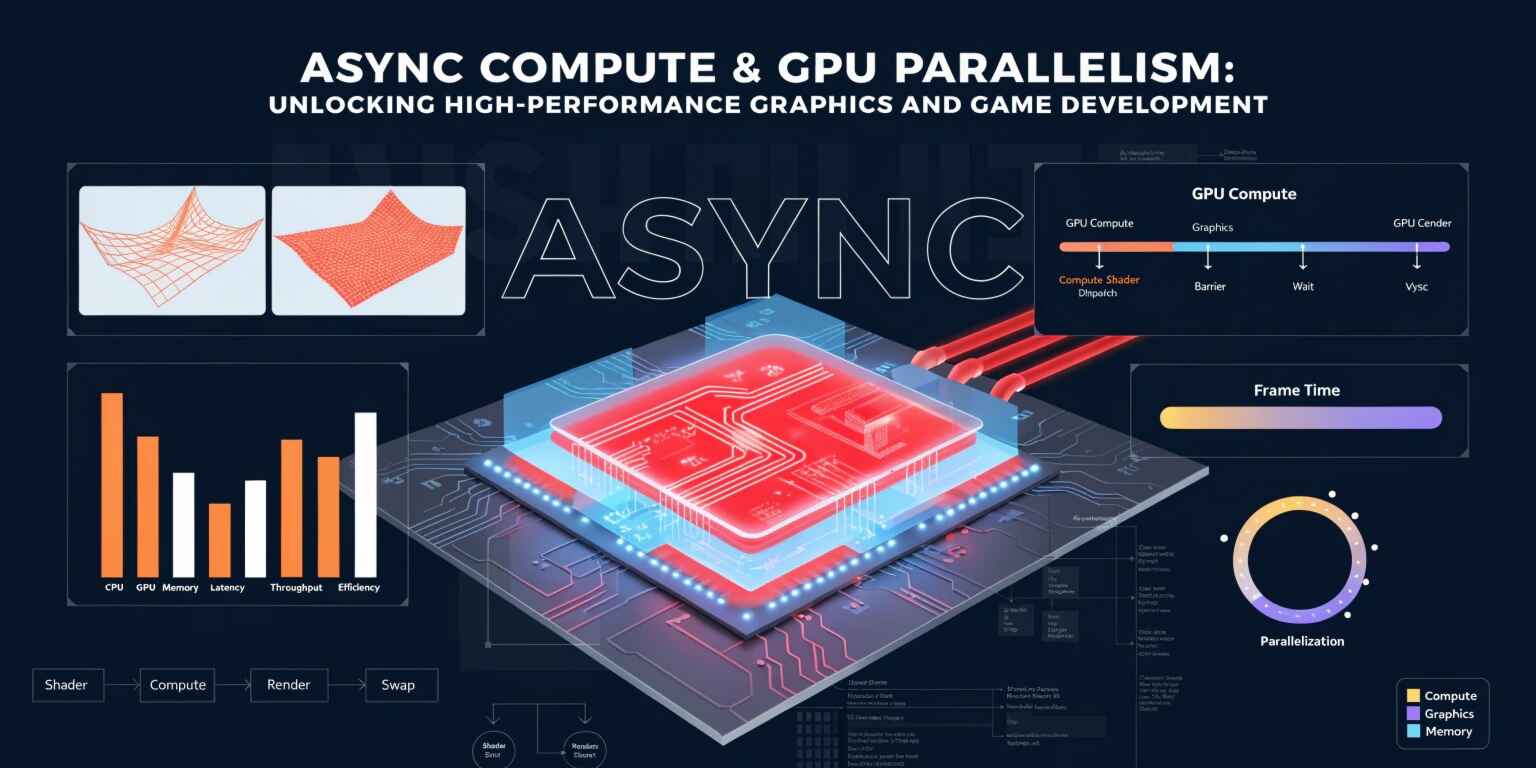
Learn how Async Compute and GPU Parallelism enable modern GPUs to execute multiple tasks simultaneously, boosting rendering speed, AI processing, and overall gaming performance through efficient hardware utilization.
As video games, artificial intelligence, and real-time graphics become increasingly sophisticated, the demand for faster and more efficient computing continues to grow. Modern applications no longer rely solely on powerful processors—they also depend heavily on Graphics Processing Units (GPUs) capable of executing thousands of operations simultaneously.
Two technologies that play a major role in maximizing GPU performance are Async Compute and GPU Parallelism. These techniques allow developers to fully utilize GPU resources, resulting in smoother gameplay, faster rendering, and improved computational efficiency.
Understanding these concepts is essential for game developers, graphics programmers, AI engineers, and anyone interested in high-performance computing.
What is GPU Parallelism?
Unlike a CPU, which typically has a limited number of powerful cores designed for sequential processing, a GPU contains thousands of smaller processing cores built for parallel execution.
Instead of processing one task after another, a GPU divides workloads into thousands of small operations that run simultaneously.
For example:
- Rendering millions of pixels
- Calculating lighting effects
- Running physics simulations
- Processing AI inference
- Video encoding and decoding
This parallel architecture makes GPUs significantly faster for graphics and data-intensive workloads.
Understanding Async Compute
Traditionally, graphics rendering and compute tasks were executed sequentially. The GPU would complete one workload before moving to the next.
This often resulted in unused GPU resources and lower efficiency.
Async Compute changes this approach by allowing multiple independent workloads to execute simultaneously.
For example:
While one section of the GPU renders shadows, another section can process:
- Physics calculations
- Particle simulations
- AI behaviors
- Post-processing effects
Rather than waiting for one task to finish, the GPU performs multiple operations concurrently.
How Async Compute Works
Modern graphics APIs such as:
- DirectX 12
- Vulkan
- Metal
allow developers to submit workloads through multiple command queues.
Common queues include:
Graphics Queue
Responsible for:
- Geometry rendering
- Rasterization
- Lighting
- Final image generation
Compute Queue
Handles:
- Physics
- Particle systems
- AI calculations
- Image processing
- Machine learning inference
These queues can operate simultaneously when hardware resources are available.
Benefits of GPU Parallelism
1. Better Hardware Utilization
Instead of leaving GPU cores idle, parallel workloads maximize resource usage.
This improves efficiency without requiring additional hardware.
2. Higher Frame Rates
Games become smoother because compute tasks no longer interrupt graphics rendering.
Players experience:
- Stable FPS
- Reduced frame drops
- Lower latency
3. Faster AI Processing
Modern AI applications execute thousands of matrix operations simultaneously.
GPU parallelism dramatically accelerates:
- Deep learning inference
- Image recognition
- Natural language processing
- Recommendation systems
4. Improved Visual Quality
Developers can introduce:
- Realistic lighting
- Better reflections
- Advanced particle effects
- Volumetric clouds
without significantly affecting performance.
Async Compute in Game Development
Game engines extensively utilize Async Compute for advanced rendering pipelines.
Typical examples include:
- Shadow map generation
- Screen-space reflections
- Ambient occlusion
- Motion blur
- Physics simulation
- GPU particle systems
Instead of processing these features one after another, they execute in parallel whenever possible.
This allows developers to deliver visually impressive games while maintaining smooth performance.
APIs Supporting Async Compute
Several modern graphics APIs provide robust support for asynchronous GPU workloads.
DirectX 12
Provides explicit GPU scheduling, multiple command queues, and low-level hardware control for Windows gaming.
Vulkan
Offers cross-platform, low-overhead graphics programming with extensive parallel execution capabilities.
Metal
Apple's graphics API supports efficient GPU scheduling for macOS and iOS applications.
These APIs give developers direct control over GPU resources, enabling advanced optimization techniques.
Challenges of Async Compute
Although powerful, Async Compute is not always easy to implement.
Developers must carefully manage:
- Resource synchronization
- Memory dependencies
- Queue scheduling
- Data hazards
Poor implementation can actually reduce performance instead of improving it.
Profiling tools and performance analysis are therefore essential during development.
Best Practices
To maximize GPU efficiency:
- Divide workloads into independent tasks.
- Avoid unnecessary synchronization.
- Balance graphics and compute operations.
- Profile GPU bottlenecks regularly.
- Optimize memory usage and bandwidth.
- Test performance across different GPU architectures.
Efficient scheduling often produces better results than simply adding more graphical effects.
The Future of GPU Parallelism
Emerging technologies continue to increase the importance of GPU parallel processing.
Examples include:
- Real-time ray tracing
- AI-powered graphics upscaling
- Neural rendering
- Large language model inference
- Virtual reality
- Digital twins
- Scientific simulations
Future GPU architectures will feature even more intelligent workload scheduling, allowing graphics, AI, and simulation tasks to operate together with greater efficiency.
Developers who understand Async Compute today will be well-prepared for tomorrow's high-performance computing landscape.
Conclusion
Async Compute and GPU Parallelism have fundamentally changed how modern GPUs process workloads. By enabling multiple graphics and compute operations to execute simultaneously, these technologies improve rendering efficiency, enhance visual quality, and accelerate AI-driven applications.
Whether developing AAA games, AI software, visualization tools, or high-performance applications, understanding GPU parallelism is essential for achieving maximum hardware performance. As graphics APIs and GPU architectures continue to evolve, mastering these concepts will remain a valuable skill for developers building the next generation of interactive and intelligent software.
We build scalable web, mobile, and game products for clients worldwide — combining modern frameworks, cloud infrastructure, and best engineering practices.
.jpg)