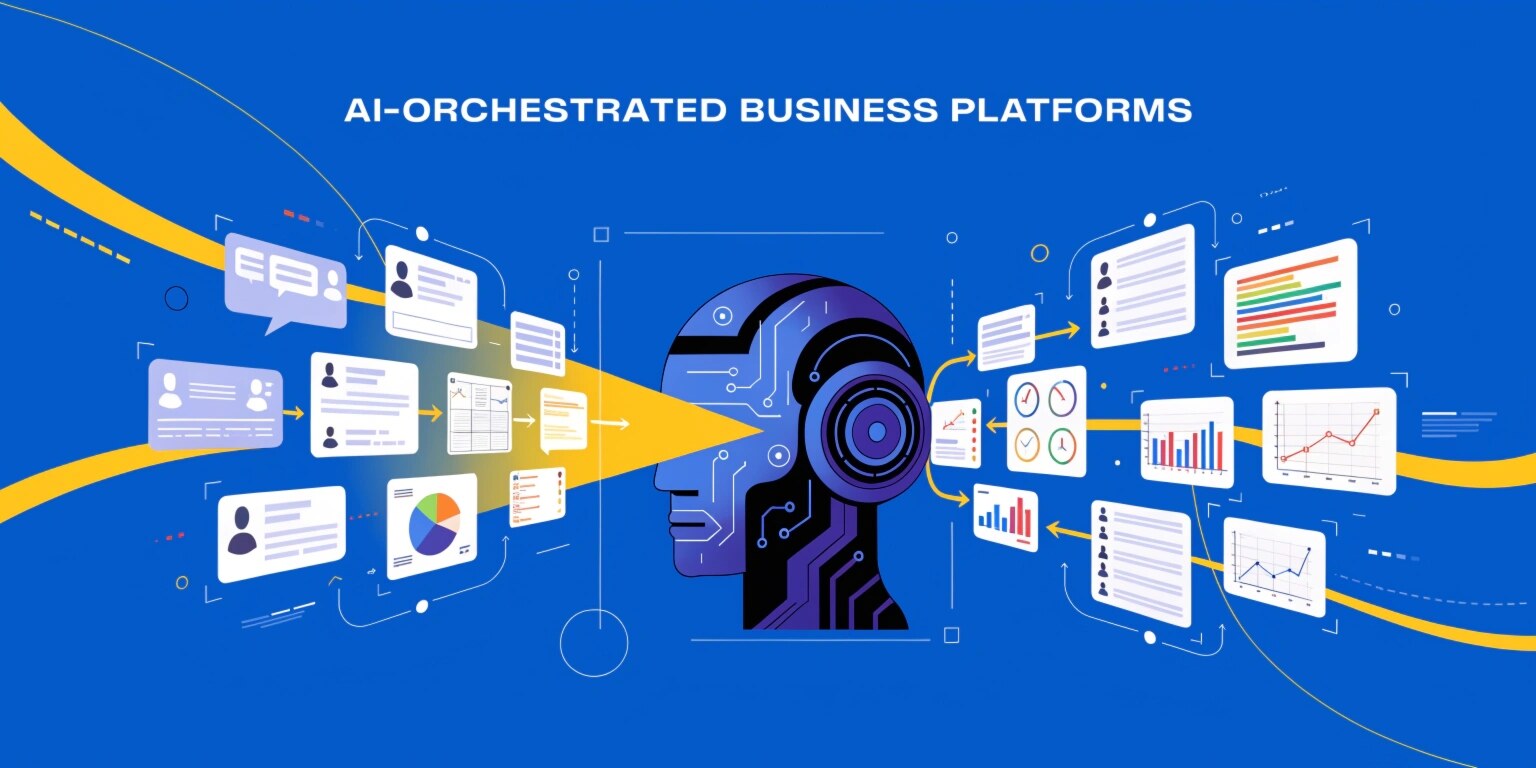
AI-orchestrated business platforms combine artificial intelligence, automation, and workflow management to streamline enterprise operations. They improve efficiency, enhance decision-making, and enable organizations to scale faster in an increasingly digital world.
Businesses today operate in an increasingly complex environment where data, processes, customers, and technologies are interconnected. Managing these moving parts manually can lead to inefficiencies, delays, and missed opportunities. Traditional automation systems have helped organizations streamline repetitive tasks, but modern enterprises require more intelligent and adaptive solutions.
This need has given rise to AI-Orchestrated Business Platforms—next-generation systems that combine artificial intelligence, workflow automation, analytics, and decision-making capabilities into a unified ecosystem.
Unlike traditional software platforms that execute predefined rules, AI-orchestrated platforms continuously analyze data, predict outcomes, automate decisions, and coordinate activities across departments. These platforms are rapidly becoming the foundation of digital transformation strategies, helping organizations improve efficiency, agility, and competitiveness.
What Are AI-Orchestrated Business Platforms?
AI-orchestrated business platforms are integrated systems that use artificial intelligence to manage, optimize, and automate business processes across an organization.
These platforms connect various business functions such as:
- Sales
- Marketing
- Customer Support
- Human Resources
- Finance
- Supply Chain Management
- Operations
- Product Development
Rather than operating as isolated systems, they work together through AI-driven orchestration that coordinates workflows and decision-making processes.
The goal is to create a connected, intelligent business environment where systems can act autonomously while remaining aligned with organizational objectives.
Key Components of AI-Orchestrated Business Platforms
Artificial Intelligence Engine
The AI engine serves as the platform's brain.
It performs tasks such as:
- Predictive analytics
- Pattern recognition
- Natural language processing
- Recommendation generation
- Decision support
Workflow Orchestration Layer
This component coordinates activities between different systems and departments.
It ensures that tasks move efficiently from one process stage to another without manual intervention.
Data Integration Framework
Business data often resides in multiple systems.
AI-orchestrated platforms consolidate data from:
- CRM software
- ERP systems
- Marketing platforms
- Customer service tools
- IoT devices
- Cloud applications
This creates a unified source of truth.
Automation Engine
Automation capabilities execute routine tasks based on AI-generated insights and predefined business goals.
Analytics and Reporting
Real-time dashboards provide visibility into business performance and operational efficiency.
How AI Orchestration Works
AI orchestration involves continuously monitoring business operations and coordinating actions across systems.
A typical workflow may include:
- Collecting data from multiple sources.
- Analyzing trends and identifying opportunities.
- Predicting outcomes using machine learning models.
- Automatically triggering workflows.
- Monitoring execution and results.
- Adjusting future actions based on performance data.
This creates a self-improving operational environment.
Benefits of AI-Orchestrated Business Platforms
Increased Operational Efficiency
AI reduces manual work by automating repetitive and time-consuming tasks.
This allows employees to focus on strategic initiatives.
Faster Decision-Making
Real-time analytics and predictive insights help organizations make informed decisions more quickly.
Enhanced Customer Experience
AI-driven personalization improves customer interactions by delivering relevant recommendations and support.
Better Resource Allocation
Businesses can optimize staffing, inventory, budgets, and operational resources based on predictive analysis.
Improved Scalability
As organizations grow, AI-orchestrated platforms can manage increasing workloads without proportional increases in operational complexity.
Real-World Applications
Sales and Business Development
AI platforms can:
- Score leads automatically
- Prioritize opportunities
- Predict sales outcomes
- Recommend follow-up actions
This improves conversion rates and sales productivity.
Marketing Automation
Marketing teams use AI orchestration for:
- Campaign management
- Audience segmentation
- Content personalization
- Performance optimization
Customer Support
AI-powered systems help:
- Route support tickets
- Analyze customer sentiment
- Provide intelligent responses
- Predict service issues
Human Resources
Organizations automate:
- Recruitment screening
- Employee onboarding
- Workforce planning
- Performance analysis
Supply Chain Management
AI orchestration improves:
- Inventory forecasting
- Demand planning
- Logistics optimization
- Vendor management
Role of AI-Orchestrated Platforms in Digital Transformation
Digital transformation requires more than implementing new technologies.
Organizations must create interconnected systems capable of adapting to changing business conditions.
AI-orchestrated platforms support transformation by:
- Breaking down data silos
- Improving collaboration
- Accelerating innovation
- Enabling data-driven culture
- Enhancing organizational agility
As businesses become increasingly digital, orchestration platforms act as the central nervous system of enterprise operations.
Challenges and Considerations
Data Quality
AI systems depend on accurate and reliable data.
Poor-quality data can reduce prediction accuracy and automation effectiveness.
Integration Complexity
Connecting multiple legacy systems may require significant planning and technical expertise.
Security and Compliance
Organizations must ensure that AI-driven processes comply with industry regulations and data protection requirements.
Change Management
Successful adoption requires employee training and organizational alignment.
Resistance to change can slow implementation efforts.
Future Trends in AI-Orchestrated Business Platforms
Several emerging technologies will shape the future of AI orchestration.
Autonomous Enterprises
Organizations are moving toward systems capable of making operational decisions with minimal human intervention.
Generative AI Integration
Generative AI will enhance workflow automation by creating reports, content, recommendations, and business insights automatically.
Hyperautomation
Combining AI, robotic process automation (RPA), and analytics will further streamline business operations.
Digital Twins for Enterprises
Businesses will increasingly use digital replicas of operations to simulate and optimize processes before implementation.
Predictive Business Ecosystems
Future platforms will proactively identify risks, opportunities, and market changes before they impact performance.
Best Practices for Implementation
To maximize success:
- Define clear business objectives.
- Prioritize high-impact processes.
- Ensure strong data governance.
- Start with scalable pilot projects.
- Continuously monitor AI performance.
- Invest in employee training.
- Align technology initiatives with business strategy.
Conclusion
AI-orchestrated business platforms represent a significant evolution in enterprise technology. By combining artificial intelligence, automation, workflow management, and analytics, these platforms enable organizations to operate more efficiently, make smarter decisions, and respond rapidly to changing market conditions.
From sales and marketing to customer support and supply chain management, AI orchestration creates a connected ecosystem where data and processes work together intelligently. As businesses continue their digital transformation journeys, AI-orchestrated platforms will play a critical role in driving innovation, productivity, and sustainable growth.
Organizations that embrace this technology today will be better positioned to compete in an increasingly automated and data-driven future.
We build scalable web, mobile, and game products for clients worldwide — combining modern frameworks, cloud infrastructure, and best engineering practices.