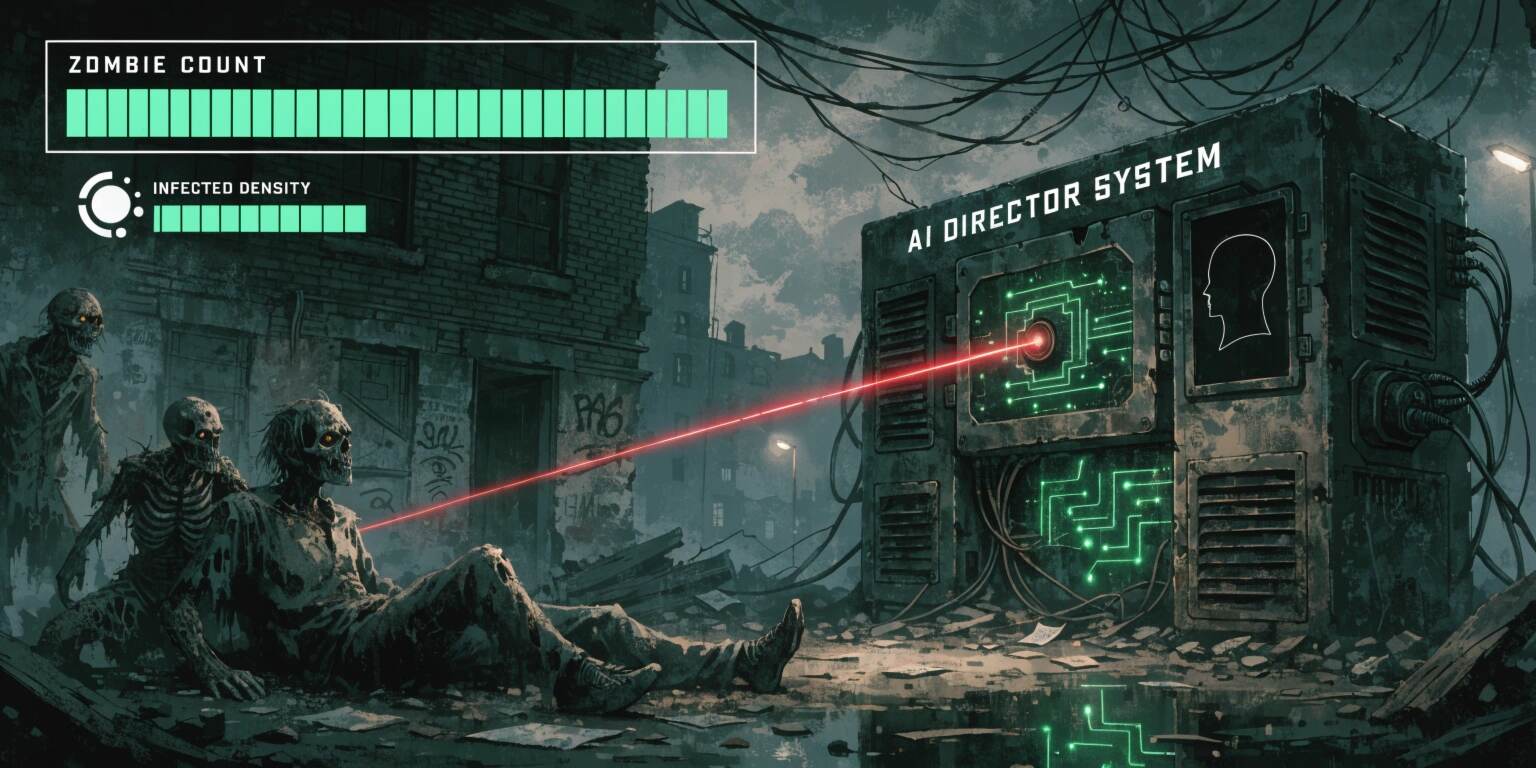
AI Director systems dynamically manage enemy spawns, game pacing, and resource distribution based on player performance. Learn how adaptive AI creates unique, immersive, and replayable gaming experiences.
Modern video games strive to deliver experiences that remain exciting and unpredictable, even after multiple playthroughs. Traditional scripted events often create memorable moments, but once players learn the patterns, the sense of surprise fades. To overcome this limitation, developers have introduced adaptive AI systems capable of responding to player behavior in real time.
One of the most influential examples is the AI Director concept, first popularized by Left 4 Dead. Rather than following a fixed script, the AI Director continuously monitors gameplay and dynamically adjusts enemy encounters, item placement, and pacing. This creates unique experiences for every session, making gameplay feel fresh and responsive.
Today, AI Director systems are used as inspiration for many adaptive game mechanics across various genres. This article explores how these systems work, their benefits, implementation strategies, and their future in game development.
What Is an AI Director?
An AI Director is a high-level game management system that observes player actions and dynamically controls gameplay elements to maintain engagement.
Instead of directly controlling individual enemies, it manages the overall experience by deciding:
- When enemies appear
- Where enemies spawn
- How many enemies attack
- When to provide resources
- When to create moments of tension or relief
- How the game pacing evolves
Think of the AI Director as an invisible game master that adjusts the experience behind the scenes.
Why AI Director Systems Matter
Every player has a different skill level and playstyle.
Some players move cautiously, while others rush into combat. Fixed game scripts cannot accommodate these differences effectively.
AI Director systems help by:
- Creating personalized experiences
- Increasing replayability
- Improving player engagement
- Reducing repetitive gameplay
- Maintaining balanced difficulty
- Enhancing immersion
The result is a game that feels alive and responsive.
Core Components of an AI Director
Player Monitoring
The AI Director constantly collects gameplay information, including:
- Player health
- Ammunition levels
- Number of enemies defeated
- Team cohesion
- Player movement speed
- Time spent in combat
- Success or failure rates
This data forms the basis for adaptive decisions.
Threat Assessment
The system evaluates how much pressure players are currently experiencing.
Factors include:
- Active enemy count
- Recent damage received
- Resource availability
- Player stress indicators
- Combat intensity
This assessment determines whether to increase or decrease game difficulty.
Dynamic Event Management
Based on current conditions, the AI Director may:
- Spawn additional enemies
- Delay encounters
- Trigger environmental hazards
- Generate scripted events
- Introduce elite opponents
Events occur dynamically rather than at predetermined locations.
Dynamic Enemy Spawning
Instead of fixed enemy placements, AI Directors determine:
- Spawn timing
- Spawn location
- Enemy composition
- Attack frequency
- Group size
For example, if players are progressing too easily, additional enemies may appear through alternative routes.
Conversely, struggling players may encounter fewer threats.
Resource Distribution
Adaptive systems also manage valuable resources.
Examples include:
- Health kits
- Ammunition
- Weapons
- Armor
- Crafting materials
When players face repeated failures, the AI Director may increase resource availability.
If players perform exceptionally well, supplies may become scarcer, encouraging strategic decision-making.
Controlling Gameplay Pacing
One of the defining features of an AI Director is pacing management.
Good gameplay alternates between:
- Exploration
- Combat
- Recovery
- Suspense
- Intense action
Without pacing control, constant combat can become exhausting.
The AI Director introduces quiet moments before escalating tension again, creating emotional variety throughout gameplay.
AI Decision-Making Techniques
Several AI approaches support Director systems.
Rule-Based Systems
Developers define conditions and corresponding actions.
Example:
"If player health falls below 30%, reduce enemy spawn frequency."
Behavior Trees
Behavior Trees organize complex decision-making into modular, reusable structures.
They are widely used in commercial game engines.
Utility AI
Utility systems assign scores to possible actions and select the most appropriate response.
This creates more flexible and natural behavior.
Machine Learning
Advanced AI Directors can learn from gameplay data to improve balancing over time.
Although still emerging, machine learning enables increasingly personalized experiences.
Applications Beyond Survival Games
AI Director concepts are useful across many genres.
Open-World Games
Control random encounters and world events.
RPGs
Adjust quest difficulty and enemy scaling.
Horror Games
Manage fear through dynamic sound, lighting, and enemy appearances.
Strategy Games
Adapt enemy tactics according to player strategies.
Multiplayer Games
Balance encounters while maintaining fairness for all participants.
The underlying principles remain applicable even when gameplay differs significantly.
Benefits of AI Director Systems
Implementing an AI Director offers several advantages:
- Higher replay value
- Better player retention
- Personalized gameplay
- Dynamic storytelling
- Balanced challenge
- Reduced predictability
- Improved immersion
These benefits contribute to longer engagement and greater player satisfaction.
Challenges
Despite their advantages, AI Director systems introduce design complexities.
Fairness
Players should never feel that the game is cheating.
Transparency
Adaptive changes should remain subtle and believable.
Performance
Continuous monitoring and decision-making require efficient optimization.
Extensive Testing
Developers must validate countless gameplay scenarios to ensure balanced experiences.
Proper tuning is essential for success.
Future of AI Director Systems
Advances in artificial intelligence are expanding what AI Directors can achieve.
Emerging innovations include:
- Reinforcement learning
- Emotion-aware gameplay adaptation
- Player behavior prediction
- Procedural narrative generation
- AI-generated missions
- Personalized world events
- Cloud-powered adaptive AI
Future systems may evolve alongside players, creating experiences that continuously adapt to individual preferences.
Best Practices for Developers
When designing an AI Director:
- Define clear pacing objectives.
- Monitor meaningful gameplay metrics.
- Avoid sudden or unrealistic difficulty spikes.
- Balance randomness with predictability.
- Combine Director logic with Dynamic Difficulty Adjustment (DDA).
- Continuously gather player feedback.
- Test across different skill levels and playstyles.
These practices help create adaptive systems that enhance rather than disrupt gameplay.
Conclusion
AI Director systems have redefined how modern games deliver dynamic and memorable experiences. By observing player behavior and intelligently adjusting enemy encounters, resource placement, and pacing, these systems create gameplay that feels personalized, balanced, and highly replayable. Inspired by the groundbreaking approach introduced in Left 4 Dead, AI Directors continue to influence game design across survival, action, role-playing, and open-world genres.
As artificial intelligence, machine learning, and procedural content generation continue to advance, AI Director systems will become even more sophisticated. Developers who embrace these adaptive technologies will be able to create richer worlds, more immersive narratives, and gameplay experiences that remain engaging long after the first playthrough.
We build scalable web, mobile, and game products for clients worldwide — combining modern frameworks, cloud infrastructure, and best engineering practices.
.jpg)