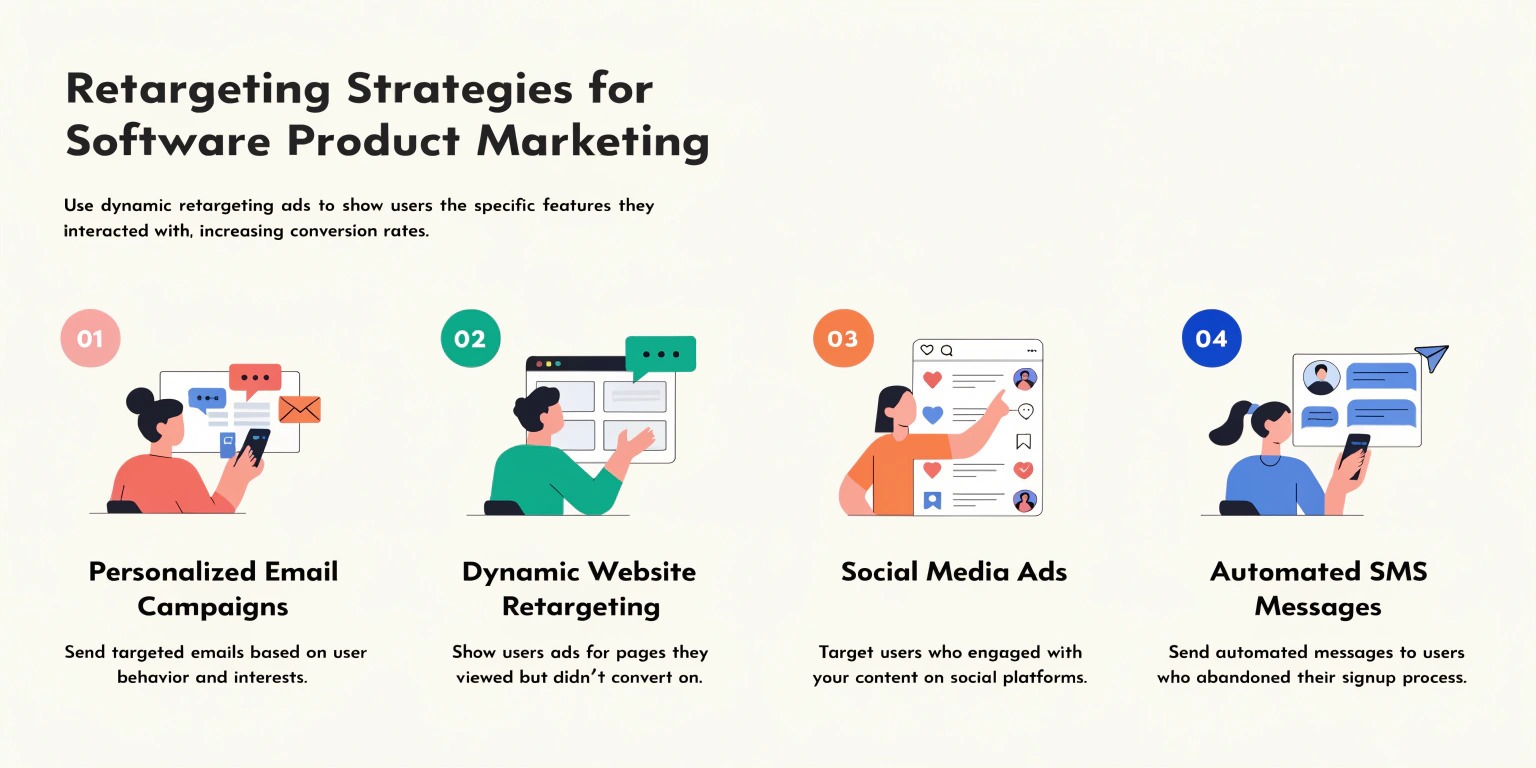
Retargeting helps software companies reconnect with visitors, trial users, and prospects who did not convert initially. By combining audience segmentation, personalized messaging, multi-channel campaigns, and funnel-based strategies, businesses can improve conversions and maximize the value of existing marketing traffic.
Software products often have longer buying journeys than traditional consumer products. A potential customer may visit a website, explore pricing, read a case study, watch a product demo, or start a free trial without making an immediate purchase.
This does not necessarily mean the prospect is lost. They may simply need more information, additional trust, or the right message at the right time. This is where retargeting becomes an important part of software product marketing.
Retargeting allows businesses to reconnect with people who have previously interacted with their website, product, advertisements, or other digital assets. Instead of repeatedly paying to acquire completely new audiences, marketers can continue nurturing prospects who have already demonstrated interest.
What Is Retargeting?
Retargeting is a digital advertising strategy that displays relevant advertisements to users based on previous interactions with a brand.
For software companies, these interactions could include:
- Visiting the product website
- Viewing the pricing page
- Reading a blog
- Downloading an ebook
- Watching a product video
- Starting a free trial
- Registering for a webinar
- Booking or abandoning a demo
- Creating an account without upgrading
The goal is not simply to show the same advertisement repeatedly. Effective retargeting delivers contextual messages based on where the prospect is in the buying journey.
1. Segment Audiences Based on Intent
One of the biggest mistakes in retargeting is treating every website visitor as the same.
A person who visited a blog post has different intent from someone who spent several minutes on the pricing page.
Create separate audience segments such as:
Awareness Visitors: Users who read educational content.
Product Visitors: Users who explored product features.
High-Intent Visitors: Users who visited pricing, integrations, or comparison pages.
Trial Users: People who registered but have not converted.
Demo Prospects: Users who interacted with a sales representative but have not purchased.
Each segment should receive different messaging.
2. Retarget Pricing Page Visitors
Pricing-page visitors are often among the most valuable audiences because they have demonstrated commercial intent.
Instead of displaying a generic "Buy Now" advertisement, consider promoting:
- Customer success stories
- Product comparisons
- ROI calculators
- Free consultations
- Product demonstrations
- Limited-time onboarding benefits
For example, a visitor who viewed enterprise pricing could receive an advertisement focused on scalability, security, integrations, or enterprise support rather than basic product features.
3. Retarget Free-Trial Users
Free trials are extremely important for SaaS businesses.
However, signing up does not guarantee activation or conversion.
Create campaigns for users who:
- Signed up but never logged in
- Logged in but did not complete onboarding
- Used one important feature
- Approached their usage limit
- Completed a trial but did not upgrade
Each group requires a different message.
For example, inactive users may benefit from onboarding content, while highly engaged trial users may respond better to upgrade-focused messaging.
4. Use Funnel-Based Retargeting
Retargeting should correspond to the marketing funnel.
Top of Funnel
Focus on education:
- Industry insights
- Guides
- Webinars
- Research reports
- Educational videos
Middle of Funnel
Focus on evaluation:
- Product demonstrations
- Case studies
- Comparisons
- Feature explanations
- Customer testimonials
Bottom of Funnel
Focus on conversion:
- Free consultation
- Trial activation
- Personalized demo
- Pricing information
- Sales contact
This approach prevents prospects from receiving aggressive sales messages before they are ready.
5. Use Multi-Channel Retargeting
Software buyers rarely convert after seeing one advertisement.
A strong retargeting strategy can combine multiple channels, including:
- Google Ads
- LinkedIn Ads
- Meta Ads
- YouTube
- Email marketing
- Display advertising
- Website personalization
For B2B software, LinkedIn can be particularly useful for reaching professional audiences, while Google and other channels can help capture users based on their previous website interactions.
The key is to maintain consistent messaging across channels without overwhelming the audience.
6. Personalize Retargeting Messages
Personalization can make retargeting significantly more relevant.
Instead of:
"Discover Our Software."
Try messages based on the user's previous interaction:
"Still evaluating project management platforms? See how [product category] teams simplify collaboration."
The message should reflect the prospect's interests without becoming invasive.
Use information such as:
- Pages viewed
- Product category
- Industry
- Funnel stage
- Previous engagement
- Trial activity
7. Retarget Content Engagers
Not every prospect is ready for a sales conversation.
Someone who downloaded an industry report may still be researching the problem.
Retarget content consumers with related educational resources before pushing a sales message.
For example:
Blog article → Industry guide → Case study → Product demo → Free trial
This creates a natural progression from education to conversion.
8. Control Ad Frequency
Showing the same advertisement repeatedly can create fatigue and negatively affect brand perception.
Set frequency limits and rotate creative assets regularly.
Use different advertisements for different stages of the customer journey.
For example:
- First interaction: Educational content
- Second interaction: Case study
- Third interaction: Product benefit
- Fourth interaction: Demo or trial CTA
Retargeting should feel like helpful communication rather than repetitive advertising.
9. Build Strong Retargeting Landing Pages
Clicking an advertisement is only one part of the conversion process.
The landing page should match the advertisement's message.
If the advertisement promotes an enterprise solution, the landing page should immediately explain enterprise-specific benefits, integrations, security, scalability, and support.
Message consistency between the advertisement and landing page can reduce friction and improve conversion potential.
10. Measure More Than Clicks
Clicks are useful, but they do not necessarily represent business success.
Software marketers should track:
- Conversion rate
- Cost per lead
- Cost per acquisition
- Demo bookings
- Trial registrations
- Trial-to-paid conversion
- Customer acquisition cost
- Return on ad spend
- Pipeline generated
- Revenue attributed to campaigns
For B2B software, pipeline and revenue are often more meaningful than impressions or clicks.
Conclusion
Retargeting is much more than repeatedly showing advertisements to previous website visitors. For software product marketing, it is a structured method of nurturing prospects throughout a complex buying journey.
By segmenting audiences according to intent, personalizing messages, retargeting trial and demo users, using multiple channels, controlling frequency, and measuring revenue-focused metrics, software companies can turn previously engaged visitors into qualified leads and paying customers.
The most effective retargeting strategy does not ask, "How many people can we advertise to again?"
It asks, "What does this prospect need next to move closer to becoming a customer?"
We build scalable web, mobile, and game products for clients worldwide — combining modern frameworks, cloud infrastructure, and best engineering practices.
.jpg)