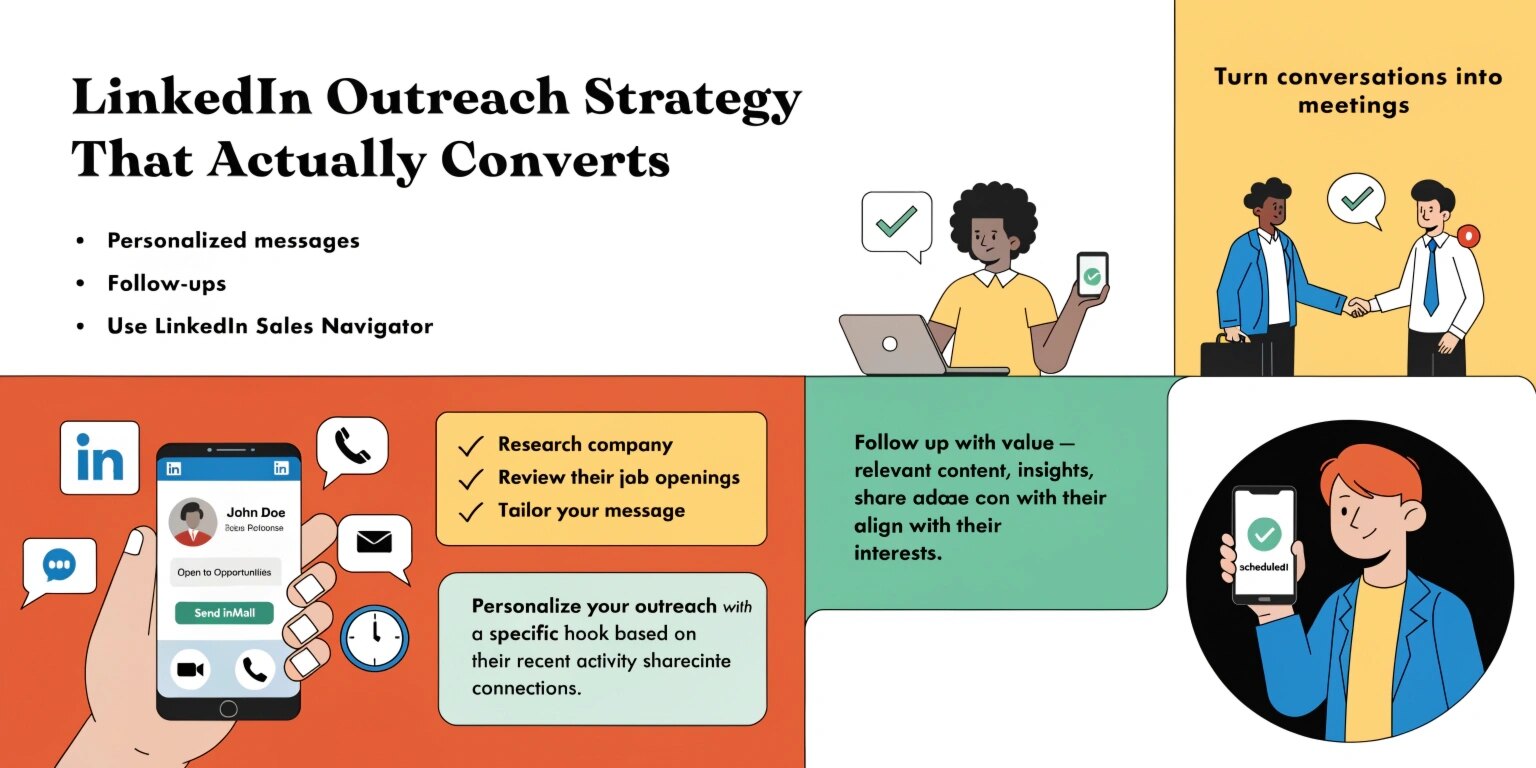
A successful LinkedIn outreach strategy is more than sending connection requests. By targeting the right prospects, personalizing conversations, providing value, following up strategically, and tracking results, businesses can turn LinkedIn conversations into qualified B2B sales opportunities.
LinkedIn has become one of the most valuable platforms for B2B lead generation, particularly for IT service providers, software development companies, SaaS businesses, and technology consultants. However, simply sending hundreds of connection requests does not guarantee results. Effective LinkedIn outreach depends on targeting, personalization, relevance, consistency, and relationship building.
A strategy that actually converts focuses less on selling immediately and more on starting meaningful business conversations.
1. Define Your Ideal Customer Profile
Before sending a single message, determine exactly who you want to reach. Your Ideal Customer Profile (ICP) should include factors such as industry, company size, location, job title, technology requirements, business challenges, and purchasing authority.
For an IT services company, potential decision-makers could include CEOs, CTOs, founders, product managers, IT directors, or technology heads.
Instead of targeting everyone, create focused prospect lists. A smaller list of highly relevant prospects generally provides better opportunities than a large database of random connections.
2. Optimize Your LinkedIn Profile
Your LinkedIn profile works as a landing page for prospects who receive your outreach.
Your headline should clearly communicate what you do and who you help. Instead of simply writing “Business Development Executive,” consider communicating your value proposition, such as helping businesses build scalable software products or improve digital operations.
Your profile should also contain relevant experience, services, achievements, client outcomes, and a professional photo. A strong profile increases credibility when prospects check your background before responding.
3. Research Prospects Before Reaching Out
Personalization starts with research.
Before contacting a prospect, look at their company, role, recent posts, business announcements, hiring activity, product launches, funding news, or technology initiatives.
For example, if a company recently launched a mobile application, an IT service provider could use that information to begin a relevant conversation about application scalability, maintenance, user experience, or future development.
This approach makes outreach feel like a business conversation rather than a mass-generated sales pitch.
4. Send Personalized Connection Requests
Avoid immediately sending a sales pitch with your connection request.
A better approach is to identify a genuine reason for connecting. You might share an industry interest, mutual professional connection, relevant business topic, or common area of expertise.
For example:
“Hi [Name], I noticed your work in the SaaS space and your recent focus on product expansion. I work with technology teams on software development initiatives and would be glad to connect and exchange industry insights.”
The objective is simply to start the relationship.
5. Don't Sell Immediately After Connecting
One of the biggest mistakes in LinkedIn outreach is sending a long promotional message immediately after someone accepts the connection.
Instead, start a conversation.
Ask about their current priorities, respond to something they have posted, or share a useful resource relevant to their business.
For example, instead of saying:
“We provide mobile and web development services. Do you need a developer?”
Try:
“I noticed your team is expanding its digital product portfolio. Are you currently focusing more on improving your existing product or launching something new?”
The second approach creates room for conversation.
6. Build a Value-Based Follow-Up Sequence
Many prospects will not respond to the first message. That does not necessarily mean they are uninterested.
A structured follow-up sequence can help maintain the conversation without becoming intrusive.
A simple sequence could include:
Message 1: Personalized introduction
Message 2: Relevant question or business insight
Message 3: Useful resource, case study, or suggestion
Message 4: Soft follow-up based on their potential business challenge
Message 5: Polite closing message
Every follow-up should provide a reason to continue the conversation rather than repeatedly asking, “Did you get my message?”
7. Use LinkedIn Sales Navigator Strategically
LinkedIn Sales Navigator can help sales teams identify prospects using advanced filters and organize potential leads.
Instead of searching randomly, use specific criteria such as job title, industry, company size, geography, seniority, and other relevant attributes.
The objective should not be to collect the maximum number of leads. It should be to build a highly relevant prospect pipeline.
8. Focus on Conversations, Not Just Connection Numbers
A high connection acceptance rate is useful, but it is not the ultimate goal.
Track metrics such as:
- Connection acceptance rate
- Response rate
- Positive response rate
- Qualified conversations
- Meetings booked
- Sales opportunities generated
- Conversion rate
- Revenue generated
For example, a campaign generating 500 connections but only two qualified conversations may be less effective than a campaign generating 100 connections and 15 relevant conversations.
9. Personalization Should Go Beyond the Name
Simply adding a prospect's first name does not make a message personalized.
Effective personalization references something meaningful about the prospect or company.
Mention a recent achievement, product update, industry challenge, hiring trend, business expansion, or professional interest.
The message should make the prospect feel that you researched their business before contacting them.
10. Combine Outreach With Content Marketing
LinkedIn outreach becomes more effective when supported by valuable content.
Publish practical content related to your target audience's challenges. IT companies, for example, can publish content about software architecture, AI adoption, mobile development, cybersecurity, cloud migration, automation, or digital transformation.
When prospects repeatedly see useful content from you, your outreach becomes more credible.
11. Avoid Common Outreach Mistakes
Several mistakes can significantly reduce LinkedIn outreach performance.
These include sending generic messages, using aggressive sales language, contacting irrelevant job titles, sending excessive follow-ups, writing extremely long messages, pitching before understanding the prospect's needs, and relying completely on automation.
Successful outreach should feel human and relevant.
Conclusion
A LinkedIn outreach strategy that actually converts is built around relevance rather than volume. Finding the right prospects, researching their business, creating personalized messages, providing value, following up thoughtfully, and measuring meaningful conversion metrics can transform LinkedIn from a networking platform into a reliable B2B lead-generation channel.
For IT services and software development companies, the strongest results usually come from combining targeted prospecting with useful content, genuine conversations, and a clearly defined sales process. The goal is not simply to collect connections—it is to build relationships that can eventually become qualified business opportunities.
We build scalable web, mobile, and game products for clients worldwide — combining modern frameworks, cloud infrastructure, and best engineering practices.
.jpg)