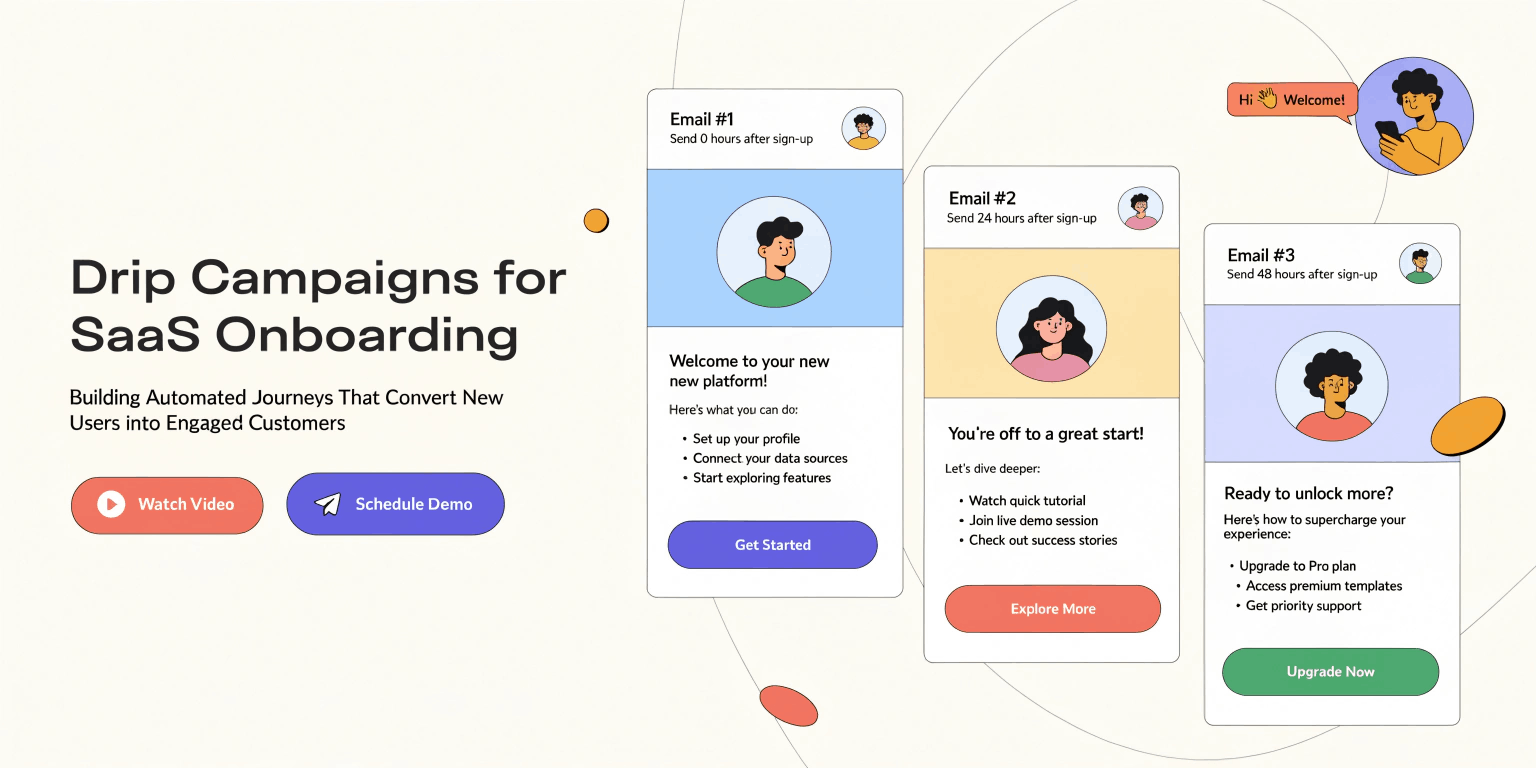
Drip campaigns automate SaaS onboarding by sending relevant messages based on time, user behavior, and product milestones. A well-designed sequence helps users understand the product, reach activation faster, discover valuable features, convert from trials, and remain engaged throughout the customer lifecycle.
Drip campaigns automate SaaS onboarding by sending relevant messages based on time, user behavior, and product milestones. A well-designed sequence helps users understand the product, reach activation faster, discover valuable features, convert from trials, and remain engaged throughout the customer lifecycle.
Main Content
SaaS products often lose potential customers before those users experience the product's actual value. A user may sign up for a free trial, explore the dashboard briefly, and then disappear without completing setup. Effective onboarding can prevent this problem by guiding users toward meaningful product experiences.
One of the most scalable ways to support onboarding is through drip campaigns. A drip campaign is an automated sequence of messages delivered to users based on predefined timing, actions, or behavioral triggers.
Instead of sending the same email to every new customer, SaaS businesses can build an onboarding journey that responds to what users actually do.
What Is a SaaS Onboarding Drip Campaign?
A SaaS onboarding drip campaign is a series of automated communications designed to help new users understand and adopt a software product.
Messages can be triggered by:
- Account creation
- Trial activation
- Profile completion
- Feature usage
- Lack of activity
- Successful setup
- Subscription purchase
- Product milestones
The objective is not simply to send more emails. The objective is to help users reach the aha moment as quickly as possible.
Start With the Activation Goal
Before creating an email sequence, SaaS companies should define what successful onboarding means.
For one product, activation might mean creating the first project. For another, it could mean inviting a teammate, connecting an integration, creating a report, or completing a workflow.
Once the activation event is defined, the drip campaign can guide users toward that action.
For example:
Sign Up → Complete Setup → Create First Project → Invite Team → Use Key Feature → Reach Activation
Each email should support one of these steps.
Build a Simple Onboarding Sequence
A basic SaaS onboarding campaign could include several messages.
Email 1: Welcome
Immediately confirm the signup and explain the next step.
Email 2: Quick Start
Show users how to complete the most important setup action.
Email 3: Product Value
Explain the problem the product solves and demonstrate a practical use case.
Email 4: Feature Discovery
Introduce an important feature that users may not discover naturally.
Email 5: Social Proof
Use customer stories, results, or testimonials to reinforce the product's value.
Email 6: Activation Reminder
If the user has not completed the key activation action, provide a simple reminder and assistance.
Email 7: Trial Conversion
For free trials, explain the benefits of upgrading and clarify what happens when the trial ends.
The exact number of emails should depend on the product's complexity and customer journey.
Use Behavioral Triggers
Time-based emails are useful, but behavior-based automation can make onboarding much more effective.
For example, suppose a user creates an account but never creates a project. The system can send a targeted reminder.
Another user may create several projects but never invite a team member. Their next message can focus on collaboration features.
This creates a more relevant experience than sending identical emails to every customer.
Segment Users
SaaS products often serve different customer groups.
Segmentation can be based on:
- Industry
- Company size
- Job role
- Plan type
- Product usage
- Acquisition source
- Trial status
- Feature adoption
For example, a marketing manager may care about reporting and campaign automation, while a developer may care more about integrations and APIs.
The onboarding journey should reflect these different priorities whenever sufficient customer data is available.
Personalization Beyond First Names
Adding a user's first name is basic personalization.
More valuable personalization uses behavioral and contextual information.
Instead of saying:
"Hi Sarah, welcome to our platform."
A stronger message might say:
"You created your first project yesterday. Here's how to automate the next step."
This makes the communication directly relevant to the user's current experience.
Reduce Cognitive Overload
New users can easily become overwhelmed by a complex SaaS platform.
An onboarding campaign should therefore introduce features gradually.
Avoid explaining every feature in the first week.
Instead, prioritize the features that help users achieve their initial goal.
A simple principle is:
One email → One primary action.
Clear calls to action make it easier for users to move forward.
Use Educational Content
Drip campaigns can also provide educational resources.
Examples include:
- Product tutorials
- Short videos
- Help articles
- Templates
- Webinars
- Case studies
- Best-practice guides
- Frequently asked questions
Educational content is particularly valuable for products with a learning curve.
Re-Engage Inactive Users
Not every user will follow the onboarding sequence.
If someone becomes inactive, the campaign can automatically trigger a re-engagement sequence.
For example:
Day 1: Helpful reminder
Day 3: Quick tutorial
Day 6: Relevant use case
Day 10: Offer assistance or support
The objective should be to remove friction rather than simply push the user toward purchasing.
Measure the Right Metrics
SaaS onboarding campaigns should be evaluated using behavioral outcomes rather than email metrics alone.
Important measurements include:
- Email open rate
- Click-through rate
- Activation rate
- Feature adoption
- Trial-to-paid conversion
- Time to activation
- Customer retention
- Churn rate
- Unsubscribe rate
An email with a high click-through rate is not necessarily successful if users do not complete the desired product action.
A/B Test the Journey
Different subject lines, CTAs, message lengths, and timing can produce different results.
SaaS teams can test:
- Email timing
- Subject lines
- CTA wording
- Content format
- Personalization
- Product screenshots
- Educational content
- Trial conversion messages
Testing should focus on meaningful outcomes such as activation and conversion rather than optimizing open rates in isolation.
Integrate Email With the Product
The best onboarding strategy does not treat email as a separate marketing channel.
Email, in-app messages, notifications, customer support, and product experiences should work together.
For example, an email can encourage a user to create their first project, while the product dashboard displays a checklist that guides them through the same process.
This creates a consistent onboarding experience across channels.
Conclusion
Drip campaigns can turn SaaS onboarding from a generic welcome process into a structured customer journey.
The most effective campaigns combine timely communication, behavioral triggers, segmentation, personalization, educational content, product guidance, and continuous measurement.
The goal is not to send users a large number of emails. It is to deliver the right guidance when users need it.
By connecting automated lifecycle marketing with real product behavior, SaaS companies can help users reach activation faster, discover valuable features, increase trial conversions, reduce early churn, and build stronger long-term customer relationships.
We build scalable web, mobile, and game products for clients worldwide — combining modern frameworks, cloud infrastructure, and best engineering practices.
.jpg)