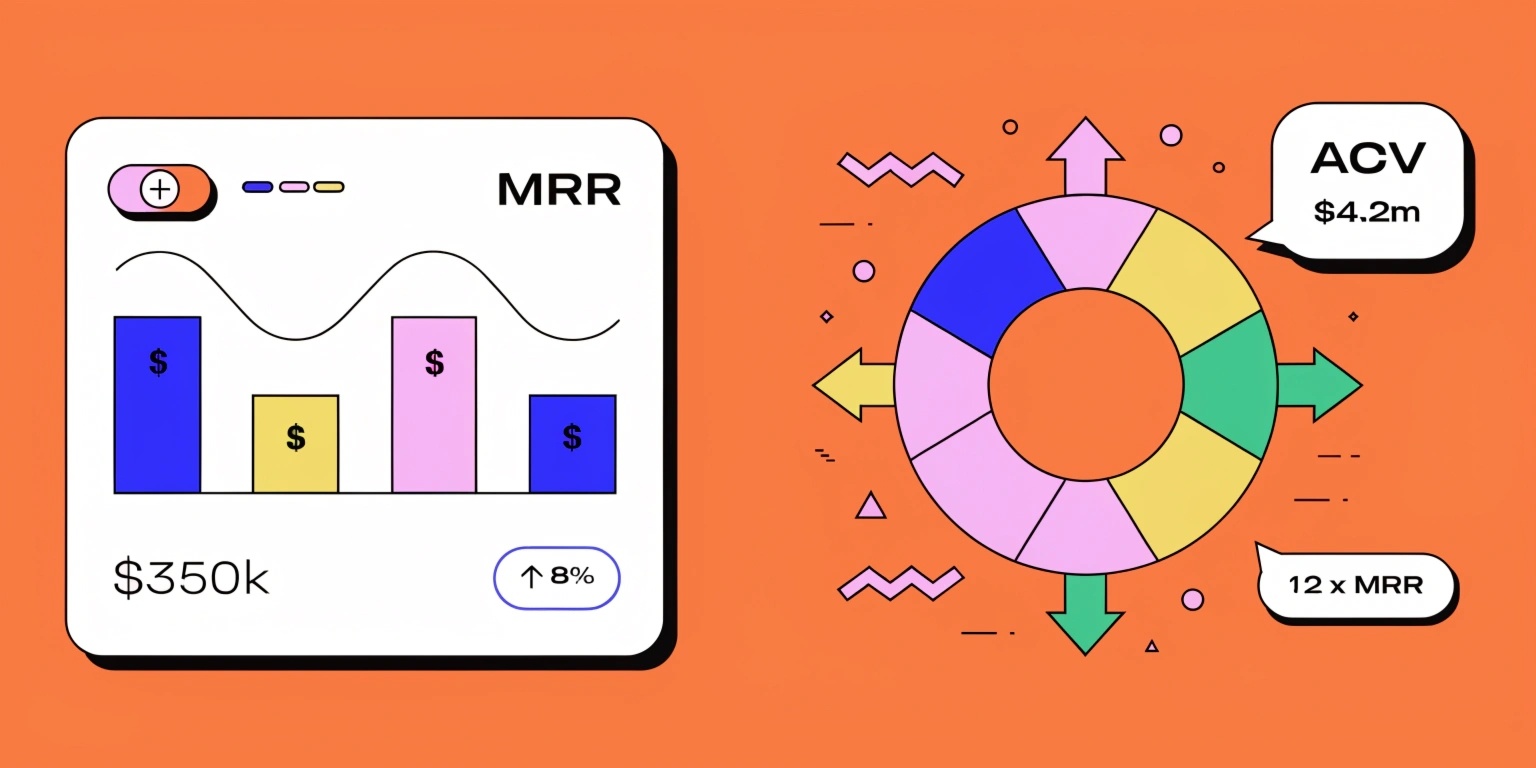
Understand how Monthly Recurring Revenue (MRR) and Annual Contract Value (ACV) help SaaS and IT companies measure growth, forecast revenue, improve sales strategies, and build long-term scalable business models.
In today’s subscription-driven digital economy, SaaS and IT companies rely heavily on recurring revenue models to achieve stable and scalable growth. Unlike traditional businesses that depend on one-time sales, software companies generate predictable income through monthly or yearly subscriptions. To measure this growth effectively, businesses use two essential metrics: Monthly Recurring Revenue (MRR) and Annual Contract Value (ACV).
These metrics help organizations evaluate sales performance, customer value, revenue stability, and future forecasting. Whether you run a SaaS startup, an enterprise IT firm, or a digital product company, understanding MRR and ACV is critical for long-term success.
What is Monthly Recurring Revenue (MRR)?
Monthly Recurring Revenue (MRR) refers to the predictable revenue a company earns every month from active subscriptions. It excludes one-time charges, setup fees, or custom development costs.
MRR is one of the most important metrics for subscription-based businesses because it provides a clear picture of monthly business performance.
Formula for MRR
MRR=∑(Monthly Subscription Revenue from Active Customers)MRR = \sum (Monthly\ Subscription\ Revenue\ from\ Active\ Customers)MRR=∑(Monthly Subscription Revenue from Active Customers)
Example
Suppose a SaaS company has:
- 100 customers paying $50/month
- 50 customers paying $100/month
The total MRR would be:
(100 × 50) + (50 × 100) = $10,000 MRR
Types of MRR
1. New MRR
Revenue generated from newly acquired customers.
2. Expansion MRR
Additional revenue from existing customers through upgrades or add-ons.
3. Churned MRR
Revenue lost due to customer cancellations.
4. Reactivation MRR
Revenue from customers who re-subscribe after leaving.
Tracking these categories helps businesses understand revenue trends and customer behavior.
Why MRR is Important
Predictable Revenue Forecasting
MRR allows businesses to estimate future income accurately.
Business Stability
A growing MRR indicates healthy customer retention and product demand.
Investor Confidence
Investors often evaluate SaaS companies based on recurring revenue growth.
Better Decision-Making
Companies can use MRR data to plan hiring, marketing budgets, and product expansion.
What is Annual Contract Value (ACV)?
Annual Contract Value (ACV) measures the average yearly revenue generated per customer contract. It is commonly used in B2B SaaS and enterprise IT businesses where contracts are annual or multi-year.
Formula for ACV
ACV=Total Contract ValueContract Duration in YearsACV = \frac{Total\ Contract\ Value}{Contract\ Duration\ in\ Years}ACV=Contract Duration in YearsTotal Contract Value
Example
If a company signs a 3-year contract worth $30,000:
ACV = $30,000 ÷ 3 = $10,000
This means the customer contributes $10,000 annually.
Difference Between MRR and ACV
MetricPurposeTime PeriodBest ForMRRMeasures monthly recurring incomeMonthlySubscription businessesACVMeasures annual contract revenueYearlyEnterprise/B2B contracts
While MRR focuses on short-term recurring revenue tracking, ACV helps businesses evaluate long-term customer value.
How MRR & ACV Work Together
Successful SaaS companies use both metrics together to analyze growth.
MRR Helps With:
- Monthly forecasting
- Churn tracking
- Revenue monitoring
- Growth analysis
ACV Helps With:
- Enterprise sales evaluation
- Contract negotiation strategies
- Long-term customer profitability
- Sales team performance measurement
For example:
- A company with high MRR but low ACV may focus on small subscription clients.
- A company with high ACV may rely on enterprise customers with long-term contracts.
Using both metrics creates a balanced growth strategy.
Common Mistakes Companies Make
Including One-Time Revenue in MRR
MRR should only include recurring subscription income.
Ignoring Churn
High customer acquisition means little if churn rates are also high.
Miscalculating Multi-Year Contracts
ACV should annualize long-term contracts correctly.
Focusing Only on Revenue
Businesses should also analyze customer retention and profitability.
Strategies to Improve MRR and ACV
Improve Customer Retention
Satisfied customers remain subscribed longer and increase recurring revenue.
Introduce Upselling
Offer premium plans, advanced features, or additional services.
Build Enterprise Solutions
Customized enterprise packages often increase ACV significantly.
Optimize Pricing Models
Experiment with subscription tiers and usage-based pricing.
Invest in Customer Success
Dedicated support and onboarding reduce churn rates.
Role of MRR & ACV in IT and SaaS Companies
Modern IT businesses increasingly rely on data-driven decision-making. MRR and ACV provide valuable insights into:
- Revenue consistency
- Product-market fit
- Sales efficiency
- Customer lifetime value
- Financial forecasting
These metrics are also essential for startups seeking funding because investors prioritize scalable recurring revenue models.
Companies offering:
- SaaS products
- Cloud solutions
- CRM software
- AI platforms
- Subscription-based applications
must continuously monitor MRR and ACV to remain competitive in the digital market.
Conclusion
Monthly Recurring Revenue (MRR) and Annual Contract Value (ACV) are more than financial metrics—they are growth indicators for modern SaaS and IT businesses. MRR provides visibility into recurring monthly income, while ACV helps businesses understand long-term contract value and enterprise profitability.
Together, these metrics help organizations forecast revenue, improve customer retention, optimize pricing strategies, and scale effectively. In a highly competitive software industry, businesses that accurately track and improve MRR and ACV gain a significant advantage in achieving sustainable growth.
We build scalable web, mobile, and game products for clients worldwide — combining modern frameworks, cloud infrastructure, and best engineering practices.
.jpg)